


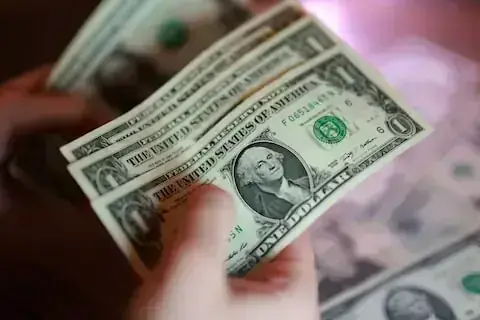

NEW YORK: The dollar eased on Wednesday after data showed US consumer inflation rose to its highest level in three years in May, though the reading was in line with economists’ expectations, marginally reducing the chances of the Federal Reserve hiking rates this year.
US consumer inflation increased at its fastest pace in three years in May as the Middle East conflict raised the price of gasoline and other energy products.
The Consumer Price Index increased 4.2 percent in the 12 months through May, the largest gain since April 2023, the Labor Department’s Bureau of Labor Statistics said on Wednesday. Economists polled by Reuters had forecast the CPI increasing 4.2 percent year-on-year.
“Underlying inflation avoided a widely feared acceleration last month, suggesting that soaring energy prices are not—yet—feeding into the core measures targeted by the Federal Reserve,”
said Karl Schamotta, chief market strategist at Corpay in Toronto.
The dollar index, which measures the US currency against six peers, was 0.2 percent lower at 99.75, but remained close to the two-month high of 100.214 touched on Monday.
“Traders are positioning for a more neutral statement from officials at next week’s meeting, and are modestly lowering expectations for a rate hike by year-end,” Schamotta said.
Traders of short-term US interest rates edged away from bets that the Federal Reserve will deliver a rate hike as soon as September, but continued to show strong conviction that a rate hike would arrive by October.
The US-Israeli conflict with Iran also kept traders on edge.
US President Donald Trump said on Wednesday Iran had taken too long to negotiate a deal and would now “have to pay the price,” while Tehran said it would reassess diplomatic engagement with Washington after overnight tit-for-tat strikes.
“Even with the kind of re-upping of some of the tensions in the short term, actually the overall sentiment that we see more broadly is that we’re still closer to some kind of deal or agreement than further away,” said Dominic Bunning, head of G10 FX strategy at Nomura.
Meanwhile a Bank of Japan rate hike at a June 16 policy meeting is now almost fully priced in, meaning it is unlikely on its own to trigger a significant reversal in yen weakness if delivered.
“It’s going to take some hawkish commentary from Governor (Kazuo) Ueda that signals the BOJ could bring forward its next hike from December to September - with the possibility of a third hike before year-end,” said Tony Sycamore, market analyst at IG, in a note.
“Without that or something similar, the Ministry of Finance will likely need to pull out its cheque book again to defend the currency.”
The Japanese yen was steady against the greenback at 160.34 per dollar, continuing to hover around the 160 level that is widely viewed as a line in the sand for official intervention.
A Reuters poll of economists indicated the BOJ will raise its key interest rate this month and again in the fourth quarter, taking borrowing costs to 1.25 percent by the end of the year, as it grows more wary of inflation risks than downside hazards to the economy.




















Comments