


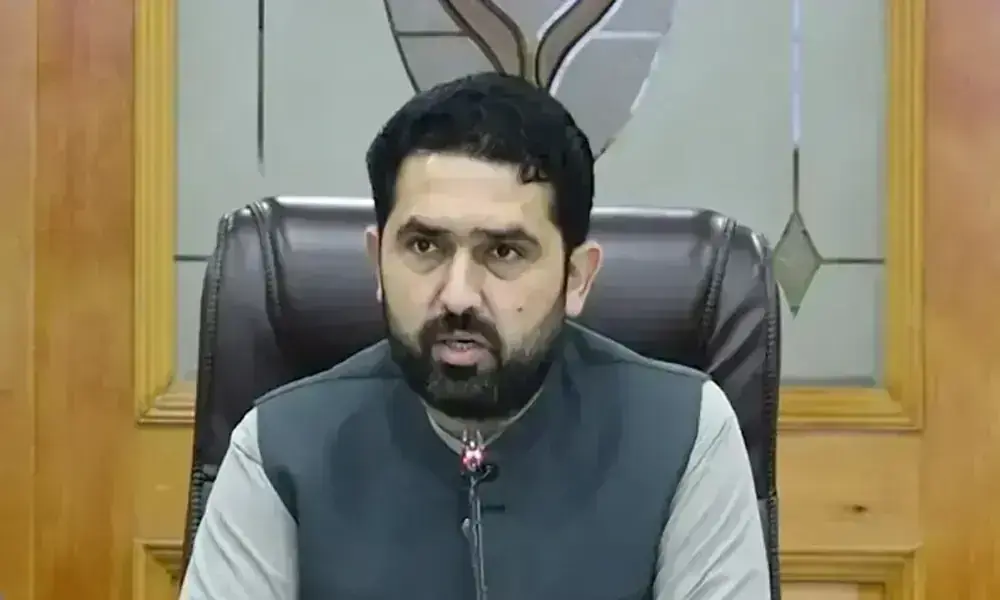

PESHAWAR: The Chief Minister of Khyber Pakhtunkhwa, Muhammad Sohail Afridi, and the JUI-F chief, Maulana Fazlur Rehman, held a detailed consultation on the constitutional and financial rights of the province to develop a consensus-based approach for the protection of Khyber Pakhtunkhwa’s rights.
The chief minister had visited the Mufti Mahmood Markaz late on Monday night where he, along with Maulana Fazlur Rehman, addressed a press conference.
The chief minister told the press conference that the most pressing issue relating to provincial rights was Khyber Pakhtunkhwa’s share under the National Finance Commission (NFC) framework, and alleged that the federal government had “subjected the province to discriminatory treatment over the past eight years”.
He said that following the 25th Constitutional Amendment, the annual distribution of resources under the existing NFC framework had become unconstitutional, as the Constitution clearly provides that NFC resources are to be distributed among the four provinces.
He noted that after the merger of the former Federally Administered Tribal Areas with the Khyber Pakhtunkhwa in 2018, more than six million people had became part of the province. However, he said, the share attributable to the merged districts was not being provided to Khyber Pakhtunkhwa and was instead being distributed among the other provinces.
The chief minister said that he had also raised the matter during his meeting with the federal minister earlier in the day and told him that the existing NFC Award had effectively become obsolete and outdated.
He called for either an immediate revision of the current arrangement or the constitution of the Eleventh NFC Award.
Referring to the issue of wheat supply, Muhammad Sohail Afridi said that the Punjab government had been continuously blocking the supply of wheat to Khyber Pakhtunkhwa, describing the move as a clear violation of Article 151 of the Constitution.
He termed the measure unconstitutional and said that consensus had been reached with Maulana Fazlur Rehman that such a situation should not be allowed to continue. He added that both sides would raise a joint voice and pursue efforts against the unconstitutional action.
The chief minister said that the second major issue discussed was the suspension of gas supply to the province.
Referring to Article 158 of the Constitution, he stated that a province producing natural gas had the first right to meet its own requirements before any surplus was supplied to other parts of the country.
He noted that Khyber Pakhtunkhwa produced more than 500 MMCFD of natural gas on a daily basis, while the province’s total consumption stands at approximately 150 MMCFD.
He said that by this calculation, Khyber Pakhtunkhwa supplied around 350 MMCFD of gas to the rest of the country. Despite this, he added, the province continued to face persistent gas loadshedding by the federal authorities.
The chief minister stated that full consensus had also been reached with Maulana Fazlur Rehman on this issue, and that a common position would be adopted in this regard as well.
He further stated that detailed discussions had been held on other issues confronting the tribal districts, and reaffirmed the commitment to continue joint efforts for the protection of the constitutional, financial, and fundamental rights of the people of Khyber Pakhtunkhwa.
Responding to a question regarding consensus with the Jamiat Ulema-e-Islam (F) on the registration of Deeni Madaris, the chief minister clarified that the provincial government would support legislation for the registration of madrassas and would play a positive and constructive role in that process.
In response to another question, the chief minister said that the budget belonged to the people of the province, and that it was the government’s responsibility to consult the leadership to whom the people had entrusted their mandate.
Copyright Business Recorder, 2026




















Comments