


Pakistan's tightrope walk: balancing IMF demands against economic survival
- Economists, market experts expect fiscally conservative package aimed at meeting ambitious IMF targets
Pakistan's upcoming federal budget for FY2026-27 is expected to be fiscally conservative, focusing on IMF targets with limited relief for households and growth, despite ambitious revenue goals.
- Ambitious tax collection targets and potential new tax measures.
- Projected increase in the petroleum development levy.
- Concerns over a potential General Sales Tax hike.
- Limited relief measures for salaried individuals.
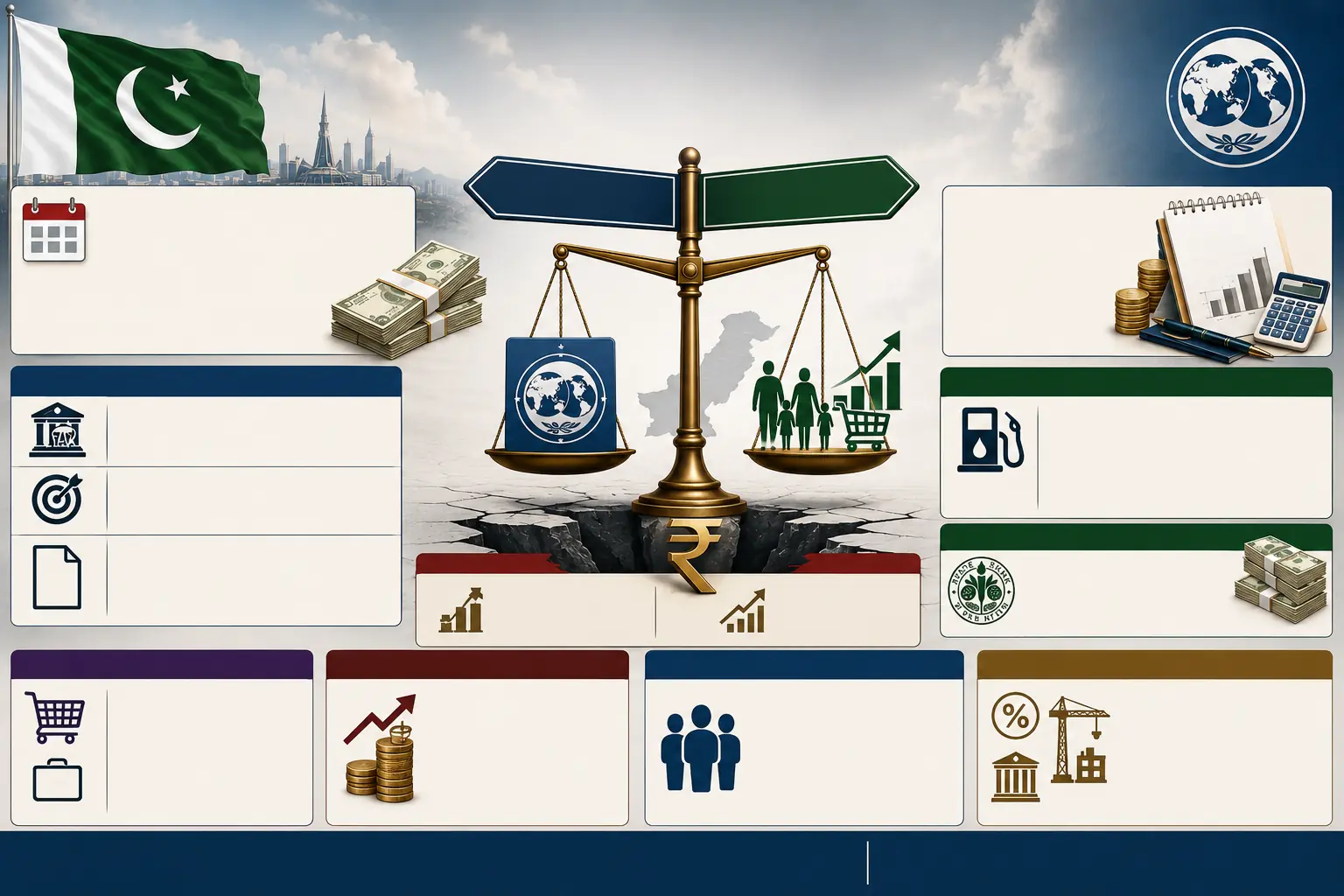

With Pakistan set to announce the federal budget for FY2026-27 next week, economists and market experts expect a fiscally conservative package aimed at meeting ambitious International Monetary Fund (IMF) targets while offering limited support for growth and inflation-weary households.
The budget comes as the country remains in a $7 billion the International Monetary Fund (IMF) bailout programme, which has helped the economy stabilise and recover.
On Tuesday, Senior Pakistan Muslim League-Nawaz (PML-N) leader and Member of the National Assembly (MNA), Tahira Aurangzeb, confirmed to Business Recorder that the federal budget, which was earlier scheduled to be announced on June 5 (Friday), would now be presented on June 10 (Wednesday).
Advisor to the Finance Minister Khurram Schehzad also confirmed the date on Thursday.
Speaking to Business Recorder, experts said the upcoming budget would largely remain focused on fiscal consolidation, leaving little room for broad-based relief measures despite persistent concerns over the cost of living and weak purchasing power.
“We expect a budget outlay of around Rs17-17.5 trillion for FY27,” said Sana Tawfik, Head of Research at Arif Habib Limited.
She said that the Federal Board of Revenue (FBR) might be assigned a tax collection target of around Rs15-15.5 trillion for FY27.
“However, the target seems to be overambitious. We are expecting Pakistan to collect around Rs12.5 trillion by the end of this fiscal year, which implies a shortfall of roughly Rs700-800 billion against the target,” said Tawfik.
“Moving from that base to a collection target exceeding Rs15 trillion will be challenging.”
She noted that while the government had repeatedly emphasised enforcement and documentation measures to improve revenue collection, recent IMF documents suggested that Pakistan might still need to generate around Rs430 billion through new tax measures.
“The key question is whether the government can achieve its revenue objectives through enforcement alone or whether it will eventually have to resort to additional taxation.”
Waqas Ghani, Head of Research at JS Global, described the upcoming budget as a “balancing act” between maintaining fiscal discipline under the IMF programme and supporting economic growth.
“We have a very tall revenue target under the IMF programme and a primary surplus target of around 2% of GDP [gross domestic product],” Ghani said. “At the same time, the government is targeting economic growth of around 4%. Therefore, it cannot afford to present an expansionary budget… but it will be a pro-stability budget.”
He said the government might introduce selective growth-supporting measures, but the overall stance was likely to be balanced “as we have seen in the last two years”.
Petroleum development levy
A major area of attention in the budget will be the petroleum development levy (PDL), which has emerged as a key source of non-tax revenue in recent years.
Analysts expect the government to target PDL collections of around Rs1.7 trillion to Rs1.75 trillion in FY27, up from approximately Rs1.4 trillion in the outgoing fiscal year.
Also read: Petroleum levy should not be a fiscal tool, says forum
To achieve this target, Tawfik said the government might need to maintain the levy at current levels of around Rs90 per litre, particularly “if we are not expecting any uptick in overall economic activity”.
Ghani also termed the target “achievable” but warned that lower fuel sales could complicate collection efforts.
Beyond tax revenues and petroleum levies, analysts believe the government will continue relying on non-tax revenues, particularly profits transferred by the State Bank of Pakistan (SBP), to support its fiscal position. However, pressures on the expenditure side are also expected to persist.
“If SBP is able to post another over Rs2 trillion profit this year as well, given the interest rates are already high, we might see some support from that front,” said Tawfik.
Tawfik pointed out that interest payments could remain elevated despite the recent monetary easing cycle, while development spending might once again face pressure as authorities sought to contain overall expenditures.
“Historically, development expenditure is often the first area where governments make adjustments to meet fiscal targets,” she said, adding that actual allocation under the Public Sector Development Programme (PSDP) could ultimately fall short of announced targets.
General sales tax
Another proposal being discussed ahead of the budget is a one-percentage-point increase in the general sales tax (GST), raising it to 19% as the government aims at generating additional revenue of around Rs300-400 billion.
However, both analysts expressed reservations about such a move.
Also read: ‘Next budget may create more difficulties for traders’
Tawfik said raising GST would be “extremely inflationary in nature” and argued that the government should instead focus on widening the tax base by bringing untapped sectors into the formal system.
“The focus should be on widening the tax net rather than imposing additional burden on existing taxpayers,” she said, identifying retailers, wholesalers and agriculture among sectors with untapped revenue potential.
Ghani echoed those concerns, noting that sales tax was an indirect levy that affected all segments.
“It is not ideal to increase the burden of an indirect tax that impacts the entire society. It would be inflationary at a time when households are already facing economic pressures,” he said.
Salaried class
On relief measures, analysts expect the government to provide some support to salaried individuals, particularly lower-income groups, although the scope of any concessions is likely to remain limited due to IMF commitments.
Also read: Salaried individuals: Tax rate too high in region, admits FBR chief
“There are proposals under discussion regarding relief for salaried individuals,” Tawfik said. “If that happens, the challenge would be how the government intends to compensate for the revenue collection that it will forego in case of relief.”
“Given that we are in an IMF programme, we cannot expect a lot of relief measures, especially when the target set for FBR is pretty high. So we might not see significant relief measures. But considering the overall circumstances, the government might give some relief to the general public,” she added.
Ghani argued that some relief for salaried taxpayers would be justified after several years of elevated inflation, terming it positive, though any concessions would need to be balanced against revenue considerations.
“We are hopeful that taxes will be brought down, as the overall effective tax rate for the working class remains very high, hitting 38% in some cases,” he said.
























Comments