


Pakistan’s petroleum revenue machine gears up
Pakistan's fiscal strategy increasingly relies on petroleum levies, projected to reach Rs1.8 trillion by FY27. This structural dependence means consumers may not benefit from lower global oil prices, creating regressive tax burdens.
- Projected Rs1.8 trillion revenue from petroleum and carbon levies.
- Government absorbing global oil price drops through increased fuel taxes.
- Regressive nature of fuel levies and their inflationary impact.
- Risks of over-reliance on petroleum taxes and provincial revenue shortfalls.
Pakistan’s fiscal dependence on petroleum consumers is no longer cyclical. It is becoming structural.
The latest IMF country report lays bare the scale of that dependence. By FY27, cumulative revenues from Petroleum Levy (PL), and the newly introduced carbon levy (CL) are projected to touch nearly Rs1.8 trillion, more than six times the level seen just five years ago. Excluding customs duties and import-stage taxes, petroleum products are quietly turning into one of the federal government’s most reliable revenue engines.
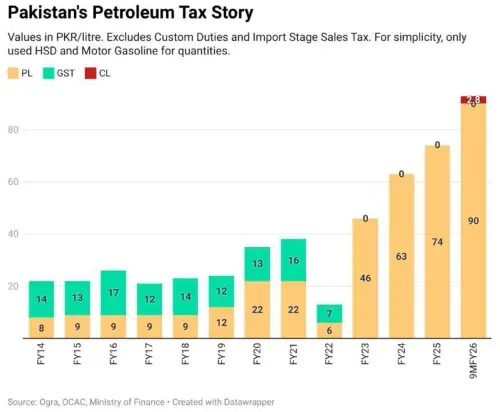
The shift has been dramatic. A decade ago, the petroleum levy averaged less than Rs10/litre on motor gasoline and high-speed diesel (HSD). Today, the IMF framework effectively envisages PL averaging close to Rs100/litre by FY27. Add the carbon levy, expected to rise to Rs5/litre from the current Rs2.5/litre, and the tax burden embedded in fuel prices becomes difficult to ignore.
The implications are straightforward. Even if global oil prices soften materially, retail petroleum prices may not provide proportionate relief to consumers. Islamabad increasingly lacks fiscal space to pass through lower international prices in full. Every decline in crude prices now creates temptation to absorb the benefit through higher levy collections instead.
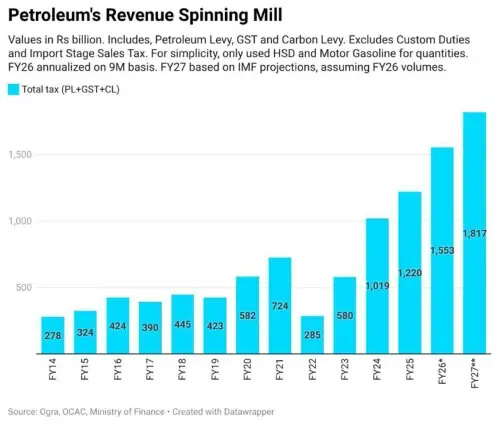
That reality has already been visible over the past two years. As global oil prices eased from post Ukraine-war highs, petroleum levy rates rose aggressively. The result was a sharp divergence between international price trends and domestic consumer relief. Petroleum taxation effectively became a fiscal shock absorber.
The IMF programme, particularly under the Resilience and Sustainability Facility (RSF), reinforces this direction. The logic is not entirely without merit. Fossil fuel consumption carries environmental and externality costs, and carbon pricing mechanisms are increasingly becoming part of global policy architecture. Pakistan’s adoption of a carbon levy is therefore consistent with broader IMF-backed climate financing frameworks.
However, the speed and scale of reliance raise important questions.
At nearly Rs1.7 trillion, petroleum levy alone is set to become one of the single largest federal tax streams. Unlike direct taxation, however, fuel levies are inherently regressive. They cascade across transport, logistics, food, manufacturing, and household energy costs. In an economy where inflationary scars remain fresh and real incomes compressed, the room to keep extracting more from petroleum consumers is not infinite.
More importantly, the FY27 revenue arithmetic leaves little margin for slippage elsewhere.
The same IMF framework projects provincial tax revenues to rise from roughly Rs1.26 trillion to Rs1.94 trillion within two years. Embedded within that target is nearly Rs430 billion in additional provincial tax mobilisation measures. That is an extraordinarily ambitious expectation, especially given the historical weakness in provincial tax administration, agricultural taxation inertia, and fragmented enforcement capacity.
If provincial revenues underperform, the pressure inevitably shifts back to federally controlled revenue handles. Petroleum taxation then becomes the path of least resistance.
That is where the real risk lies.
If international oil prices remain elevated, Islamabad’s flexibility to keep increasing PL and CL levels narrows considerably without triggering political and inflationary backlash. But if other revenue assumptions fail simultaneously, the fiscal hole could widen rapidly. In effect, the government may find itself trapped between IMF targets on one side and consumer affordability on the other.
Pakistan’s petroleum tax story is therefore no longer merely about fuel pricing. It is increasingly about the state’s growing dependence on a narrow, politically sensitive, consumption-based revenue stream to hold together an already stretched fiscal framework.
And that dependence is becoming harder to unwind with every passing year.














Comments