


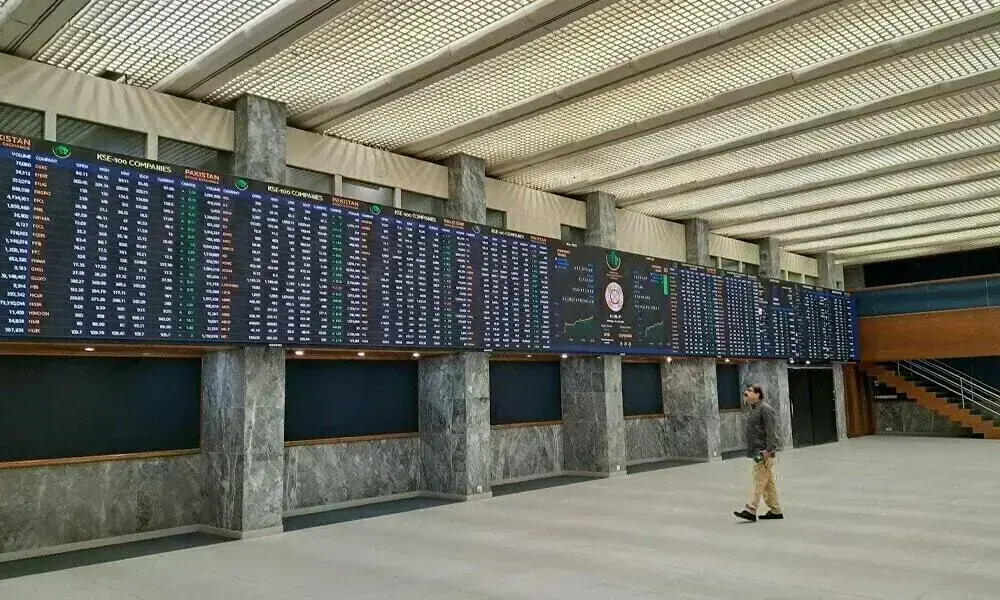

KARACHI: Pakistan’s stock market remained under pressure during the outgoing week, with the benchmark KSE-100 Index declining 3.2 percent, or 5,519.75 points, as continued uncertainty surrounding geopolitical tensions in the Middle East kept investor sentiment subdued despite improving domestic macroeconomic indicators.
The benchmark KSE-100 Index opened the week at 171,115.81 points and closed at 165,596.06 points, shedding 5,519.75 points on a week-on-week basis as investors largely adopted a cautious stance amid fears of further escalation in regional tensions. Market participants remained wary despite some positive economic developments, as geopolitical concerns continued to overshadow improving macroeconomic fundamentals.
The BRIndex100 opened the week at 18,855.75 points and eventually settled at 18,190.70 points, registering a decline of 665.05 points during the period, reflecting sustained selling pressure in the broader market. Total turnover in the index stood at 2.98 billion shares during the week, translating into an average daily turnover of approximately 596.64 million shares. Similarly, the BRIndex30 opened at 68,129.37 points and eventually closed at 66,275.99 points, reflecting a decline of 1,853.38 points, amid a broad-based retreat in major blue-chip stocks. Total turnover in the index stood at 1.92 billion shares during the week, averaging approximately 384.66 million shares per trading day.
According to a weekly report by JS Global Capital, persistent uncertainty linked to the Middle East conflict remained the key driver behind market weakness, reversing part of the gains recorded in the previous week. Investor appetite remained limited as regional instability continued to raise concerns over oil supply disruptions, imported inflation, and broader external sector vulnerabilities.
On the external front, Pakistan received a significant boost after the International Monetary Fund (IMF) approved and disbursed $1.3 billion under the Extended Fund Facility (EFF) and Resilience and Sustainability Facility (RSF) programmes after the country met most of the major targets under the third EFF review. The development was viewed positively by investors, strengthening confidence in Pakistan’s external financing position and economic reform trajectory.
Meanwhile, Finance Minister officials continued discussions with the visiting IMF team regarding the formulation of the FY27 federal budget, with policy measures and fiscal discipline remaining key areas of engagement under the ongoing programme.
Pakistan’s economic growth data also offered encouraging signals. The country’s gross domestic product (GDP) expanded by 3.99% during the third quarter of FY26, primarily driven by 4.65% growth in the industrial sector, suggesting a gradual recovery in economic activity despite persistent macroeconomic challenges.
In another major development, Pakistan successfully raised USD250 million through a three-year Panda Bond at a financing rate of 2.5 percent, with the issue reportedly oversubscribed by more than five times, indicating strong investor confidence in Pakistan’s sovereign debt profile and improving external financing prospects.
The fiscal side also showed signs of improvement. Pakistan recorded its lowest fiscal deficit in nearly three decades during 9MFY26, with the deficit clocking in at Rs856 billion, equivalent to 0.7 percent of GDP. The improvement was primarily supported by higher Petroleum Development Levy (PDL) collections and lower debt servicing costs, reflecting strengthening fiscal management despite ongoing revenue pressures.
In the latest Treasury bill auction, the government raised Rs950 billion against a target of Rs1 trillion, while yields increased across longer-tenor papers by up to 40 basis points, indicating rising investor preference for higher returns amid uncertainty in financial markets.
On the sectoral front, Pakistan’s automobile industry continued to show exceptional momentum, with auto sales posting a staggering 108 percent year-on-year increase in April 2026, taking cumulative growth during 10MFY26 to nearly 50% year-on-year, reflecting improving consumer demand and easing supply constraints.
Meanwhile, the State Bank of Pakistan’s foreign exchange reserves recorded a marginal improvement, increasing by USD23 million week-on-week to USD15.9 billion, providing modest support to the country’s external position.
A weekly snapshot of the Pakistan Stock Exchange reflected weaker market participation during the period. Total market capitalization declined by 2.7 percent to Rs18.39 trillion, compared to Rs18.90 trillion in the previous week. In dollar terms, market capitalization also fell 2.7 percent to USD66 billion, down from USD67.83 billion.
Trading activity in the ready market remained subdued. Average daily traded volume declined by 5.2 percent to 827.42 million shares, compared to 872.87 million shares in the previous week. In value terms, average daily turnover dropped sharply by 39.5 percent to Rs25.41 billion, compared to Rs42.01 billion recorded previously. Similarly, dollar-based turnover declined by 39.5 percent to USD91.19 million, from USD150.74 million.
Sector-wise performance remained broadly negative, highlighting widespread selling pressure across equities. The Textile Composite sector emerged as the worst performer, declining 8.2 percent, followed by Cement down 5.2 percent, Banks losing 4.3 percent, Pharmaceuticals declining 3.9 percent, and Oil Marketing Companies (OMCs) falling 3.4 percent. While Fertilizer declined 2.9 percent, Chemical sector lost 2.6 percent, Technology & Communication fell 1.8 percent, Exploration & Production (E&Ps) dropped 1.7 percent, Engineering decreased 1.0 percent, Autos slipped 0.6 percent, Power fell 0.5 percent, Food declined 0.4 percent, and Refinery sector remained comparatively resilient with a marginal decline of 0.1 percent.
Trading concentration remained centered around a few sectors. The Power sector dominated market volumes with a 16 percent share, followed by Food sector at 11 percent, Technology & Communication at 10 percent, Refinery at 9 percent, and Investment Banks accounting for 8 percent, while all remaining sectors collectively contributed 45 percent to total traded volume.
Among individual stocks, GADT emerged as the top performer of the week, surging 24.3 percent to close at Rs357.30, followed by TRG gaining 14.3 percent to Rs63.43, PGLC rising 9.0 percent to Rs14.21, KEL increasing 4.2 percent to Rs8.46, SRVI advancing 4.0 percent to Rs1,847.10, CNERGY gaining 3.5 percent to Rs8.83, and AIRLINK climbing 3.4 percent to Rs147.53.
On the downside, KTML led losses, declining 9.1 percent to Rs44.63, followed by PIOC down 8.9 percent to Rs253.70, AICL losing 8.9% to Rs75.35, UBL falling 8.6 percent to Rs379.50, FHAM shedding 8.2 percent to Rs30.30, KOHC decreasing 8.0 percent to Rs80.98, and YOUW slipping 7.8 percent to Rs5.79.
Overall, the week reflected the Pakistan equity market’s continued sensitivity to geopolitical developments, as external uncertainty outweighed improving macroeconomic indicators, IMF-related progress, stronger GDP growth, fiscal improvement, and improving external financing conditions.
Market direction in the near term is likely to remain dependent on regional stability, macroeconomic policy developments, and investor confidence regarding Pakistan’s reform momentum.
Copyright Business Recorder, 2026




















Comments