


Real GDP grew by 3.8% in H1FY26, deep economic reforms key to sustainable growth: SBP
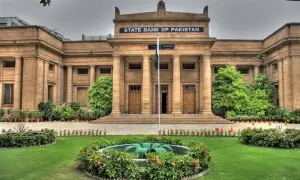
The State Bank of Pakistan emphasizes deep economic reforms are crucial to address persistent structural weaknesses, despite recent macroeconomic improvements and GDP growth in H1-FY26.
- Persistent structural weaknesses in Pakistan's economy.
- Recent macroeconomic stability and GDP growth.
- Pakistan's vulnerability to climate change impacts.
- Need for deep-rooted economic reforms.


KARACHI: The State Bank of Pakistan (SBP) has emphasized that deep-rooted economic reforms are essential to address persistent weaknesses, including low savings and investment levels, weak competitiveness, declining exports, subdued foreign direct investment (FDI), and the country’s consistently low tax-to-GDP ratio.
According to “State of Pakistan’s Economy,” Half Year Report FY26, released on Tuesday by the SBP, although Pakistan’s overall economic conditions have shown improvement, the country still faces major structural challenges in achieving sustainable high growth and long-term macroeconomic stability.
The country’s transition to a sustainable high-growth path, besides maintaining overall macroeconomic stability, would require deep-rooted economic reforms to address the chronic structural weaknesses, the report said.
READ MORE: SBP foresees moderation in economic activities in FY26, FY27
In this context, the report highlights several underlying issues that continue to hinder the economy’s long-term growth potential.
According to the SBP, Pakistan’s macroeconomic stability strengthened further in the first half of this fiscal year (FY26), despite headwinds from global trade-related uncertainty and domestic floods. Real GDP grew by 3.8 percent in H1-FY26, up from 1.9 percent in H1-FY25.
The growth was broad-based, with the major impetus coming from industry, followed by services and agriculture sectors.
The report highlights that economic indicators improved significantly in H1-FY26. Average National CPI inflation eased further, while the SBP’s FX purchases and net financial inflows shored up external buffers.
These outcomes were supported by prudent monetary and fiscal policies, ongoing structural reforms, favourable commodity prices and IMF program.
Specifically, SBP continued a cautious monetary policy stance, maintaining an adequately positive real interest rate. Fiscal consolidation also remained on track with the fiscal balance posting a surplus, first since FY02, led primarily by a sharp reduction in interest payments. The macroeconomic stability, in turn, facilitated growth momentum.
The real GDP in H1FY26 grew at twice the pace of the same period last year, mainly driven by pickup in industrial activity, followed by services and agriculture sectors. The momentum in economic activity translated into a volume-driven increase in imports in H1FY26.
At the same time, a significant drop in rice exports led to a decline in export earnings. Nonetheless, steadily rising workers’ remittances continued to finance a major part of the deficits in trade, services, and primary income balance, helping to keep the current account deficit at moderate levels.
The report further notes that continued prudent policy mix, an improved external account position and stability in exchange rate, softened international commodity prices along with downward adjustments in administered electricity tariffs led to a moderation in inflation during H1FY26.
The National CPI (NCPI) inflation averaged 5.2 percent in H1FY26, about 2 percentage points lower compared to the same period last year. The report also highlights that the substantial reduction in interest payments and fiscal consolidation measures turned the fiscal balance into a surplus in H1FY26, for the first time since FY02, while the primary surplus remained at last year’s level.
The LSM output increased by 4.8 percent in H1FY26, after showing contraction for the last three years. The recovery in LSM was mainly driven by automobiles, textiles & wearing apparel, and coke & petroleum products Growth in textiles and wearing apparel mainly benefited from higher exports amid relatively lower US tariffs.
Cement and petroleum output increased in line with improved construction and transport activities in the country. The report also includes a special chapter titled ‘Climate Change and its impact on Pakistan’s Economy’. The chapter highlights that while Pakistan’s contribution to global greenhouse gas emissions is very low, it is the 15th most affected country by climatic events.
Pakistan is also among the countries that face high levels of vulnerability to climate change and low levels of preparedness to deal with the ensuing challenges. This low readiness enhances the risks to country’s economy.
Furthermore, Pakistan’s emissions intensity of GDP is relatively high, reflecting structural inefficiencies and a carbon-intensive growth trajectory. This requires substantial investments in climate mitigation and adaptation, which currently remain largely unmet due to low international climate inflows, and challenges to domestic public and private sector financing.
The report said that structural weaknesses are also evident in the export sectors. Pakistan’s export base remains concentrated in a narrow set of products and markets, with limited technological upgradation.
The gain from PKR appreciation against US dollar and lower accumulation of government deposits, also contributed to a slower pace of public debt accumulation.
Copyright Business Recorder, 2026


























Comments