


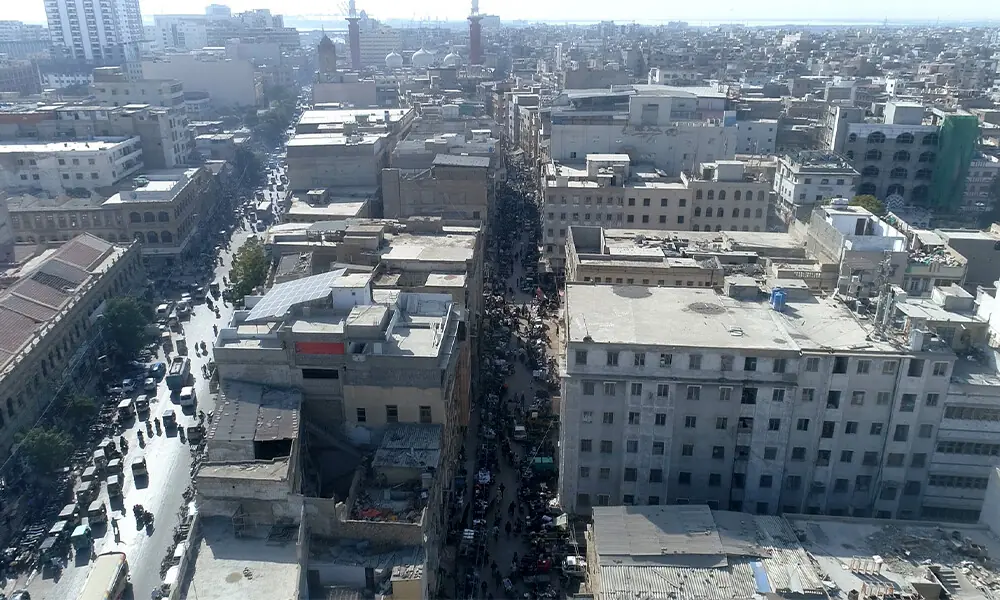
Karachi, a sprawling mega city once envisioned as a “garden city,” has morphed into a concrete jungle.
Unlike the gentle caress of a sea breeze one might expect from a coastal metropolis, Karachi’s embrace is feeling more like a sweltering, stifling hug each year. It isn’t just discomfort; it’s now a crisis with far-reaching consequences, particularly for the city’s most vulnerable residents.
Being Pakistan’s largest metropolis and the 13th biggest in the world, Karachi, Pakistan’s primary port and economic hub, has grown at a dizzying pace. With its population skyrocketing from a settlement of 450,000 in 1947 to over 20 million today (the number still feels understated), its urban landscape is now a patchwork of high-rise buildings, sprawling informal settlements, and crumbling infrastructure. Progress is being made, no doubt, but the pace is not at par with its growth.
Behind this rapid, short-sighted and unplanned expansion lies a less visible, yet deeply felt consequence, heat and the urban heat island (UHI) effect. It’s more than just a hot topic; for the residents of Karachi, it’s worsening their quality of life and pushing the city’s infrastructure to the brink, while raising temperatures, worsening air quality, and putting immense pressure on the city’s utilities.
Today, Karachi currently ranks as one of the least livable cities in the world, not for one reason.
The Urban Crucible: Karachi’s Heat
You don’t have to imagine this anymore, its reality; a sweltering afternoon in Karachi, temperatures hovering around 40°C, and the streets, paved with heat-absorbing asphalt and surrounded by high-rises, radiating oppressive heat long after the sun sets. This is the urban heat island effect in action, and the residents of Karachi feel it deeply. The UHI effect occurs when cities trap heat through the materials they’re built from, concrete, asphalt, and glass, and their human activities, creating temperature differentials as high as 7°C between urban and rural areas.
Temperatures in some areas record highs crossing 40°C during the summer months, followed by unusual heatwaves well into late October/November like last year. According to the Pakistan Meteorological Department, Karachi’s mean temperature has increased by approximately 2.4°C over the past few decades, contributing to increasingly intense, lengthy heatwaves. Exacerbation of UHI has been noted to be due to Karachi’s land cover comprising 66% bare land and 21% built-up areas, meanwhile only a measly 10.4% are designated green spaces.
The city’s coastal geography should ideally provide some natural cooling; instead, it amplifies the problem with high humidity. Densely packed neighborhoods with a staggering 62% of the city’s population are characterized by narrow, sunbaked alleyways and the absence of green spaces.
A study found strong positive correlation between green areas’ cooling intensity. It was also found that Karachi West and Malir districts display higher UHI effects. Urban areas with a higher percentage of green cover experience lower temperatures.
Densely populated areas like Orangi Town and Korangi, which also have no tree cover, have become inadvertent heat traps. Dense urban corridors including high-traffic roads like Shahrah Faisal, Tariq Road, and Shahra-e-Quaideen experience this too, where heat generated by vehicles lingers. Tall buildings block wind flow, trapping heat that lingers long after sunset.
Karachi’s population is disproportionately impacted. The lack of sufficient trees for shade and green cover in most areas worsens discomfort for outdoor vendors and pedestrians. Even so, with the congested street and harsh sunrays, studies find that shade itself would be an insufficient respite.
Unfortunately, the UHI effect in Karachi has been worsened by a continued lack of cohesive urban planning and an inability to implement large-scale greening projects to mitigate rising temperatures.
The Strained Infrastructure
As heat continues to get trapped within the city, its utility infrastructure also experiences a surge for power. Electricity consumption skyrockets adding demand on K-Electric, Karachi’s main power provider, during summers and heatwaves. Electricity theft using kundas compounds the problem, depriving larger areas of power supply due to high losses in the area.
The water supply problem also exacerbates in summer months. Karachi’s water infrastructure is outdated and inefficient, with some parts of the city receiving water for only a few hours a week. During heatwaves, the demand for water also spikes, which is already in short supply in many parts of the city, regardless of the neighborhood.
The Role of Green Cover in Mitigating Heat: Green Is the New Gold
We now know, green spaces—parks, gardens, and tree canopies—are nature’s antidote to heat, and Karachi’s missing piece in this fight against heat with its trickling effects. They provide shade, cool the air through evapotranspiration, and improve air quality. Unfortunately, Karachi’s per capita green space ratio is woefully inadequate. The city has one of the lowest per capita green space ratios in the world—less than 1 square meter per person, far below the World Health Organization’s recommendation of 9 square meters, emphasizing the dire need for improvement across the big city.
The challenge is aggravated by property rights issues that define many informal or illegal urban settlements. Often these settlements and expansions create safety hazards, sometimes within and sometimes beyond the control of utility companies.
Other cities who recognized the power of green cover in cooling urban areas can provide a blueprint for Karachi. Seoul’s Cheonggyecheon Stream project, for example, replaced a highway with an urban stream and green corridor, dramatically lowering surrounding temperatures. Mumbai, despite its own struggles with density, invested in parks that not only provide relief from the heat but also help with stormwater management during monsoons. These initiatives show that with strategic planning, cities do reduce heat effects and improve residents’ quality of life.
Karachi has tried to introduce Eucalyptus and Peepal trees on roadsides, but unanticipated impacts of their water requirements rendered Karachi’s greening plans like Karachi Strategic Development Plan, 2020 , ineffective.
For Karachi, increasing its green cover and urban governance is now a matter of public health and utility management. Urban parks and trees would lower temperatures in heat-prone areas, reduce the strain on electricity consumption, and create healthier living conditions for all. But there remain significant challenges, limited land availability, high maintenance costs, and a lack of political will, budgets, accountability, cohesive efforts and sadly, implementation.
The writer is an economist with nearly 20 years of experience, and has an interest in Pakistan’s stock market, energy and auto sectors















Comments