



According to breaking news in Pakistani media, the World Bank has officially reclassified Pakistan from its South Asia regional grouping to the Middle East and North Africa (MENA) region for financial and analytical reporting, and this change will take effect in the World Bank’s reporting for the 2026 fiscal year.
The new group will be called the ‘North Africa, Middle East, Afghanistan, and Pakistan (MENAAP) region’. This move indicates collective economic structures, strengthening economic ties with the Gulf region, and regional logistic links. In this way, Pakistan will now be evaluated beside economies like Saudi Arabia, Iran, the UAE, Kuwait, Iraq, Syria, Libya, Egypt, and Morocco in World Bank reports, separating it from the South Asian countries: India, Bangladesh, Sri Lanka, Nepal, Maldives, and Bhutan.
Generally, Pakistan has been considered a part of South Asia, and the majority of international organizations and global think tanks include it in the South Asian group. Its sharing history with Bangladesh and India, and the founding membership of the South Asian Association for Regional Cooperation (SAARC) reflects its association with South Asia. With some exceptions, the same position is applicable in the case of Afghanistan.
Pakistan and Afghanistan are also members of the Central Asia Regional Economic Coope ration (CAREC) and the Economic Cooperation Organization (ECO). This indicates their active participation in the multilateral collaboration with the Central Asian countries. The Silk Road, sharing history, common political heritage, and similarity in culture, ethnicity, and languages, associates these countries with Central Asia.
The strategic location of Pakistan at the junction of South Asia, the Middle East, and Central Asia justifies the possibility of its attachment with all three regional groups. Apparently, the listing of Pakistan and Afghanistan in the MENAAP group, during the Israel/ USA-Iran war, creates ambiguities for geo-economic strategies and future planning.
The Middle East and North Africa region (MENA) is a loosely defined area spanning from Morocco to Iran. The IMF and World Bank include all 21 Arab League nations plus Djibouti, Mauritania, Somalia, Sudan, Iran, and Israel in this group. This group (MENA) is characterized by high, yet varied, economic dependence on natural resources (mainly oil and gas), significant water scarcity, and shared environmental challenges.
The Middle East and North Africa region (MENA) exists as an alternative to the concept of the Greater Middle East, which comprises the bulk of the Muslim world. However, the region has no standardized definition, and groupings may vary. The different organizations define the region as consisting of different territories.
The International Monetary Fund (IMF) includes Afghanistan, Algeria, Bahrain, Djibouti, Egypt, Iran, Iraq, Israel, Jordan, Kuwait, Lebanon, Libya, Mauritania, Morocco, Oman, Pakistan, Palestine, Qatar, Saudi Arabia, Somalia, Sudan, Syria, Tunisia, United Arab Emirates, and Yemen in the list of the Middle East and North Africa (MENA) since 2003. However, the World Bank also includes Israel and Malta in the list of the Middle East and North Africa (MENA). But Afghanistan, Pakistan, Mauritania, Somalia, and Sudan have not been included in the World Bank list. Now, the World Bank has included Pakistan and Afghanistan in this list.
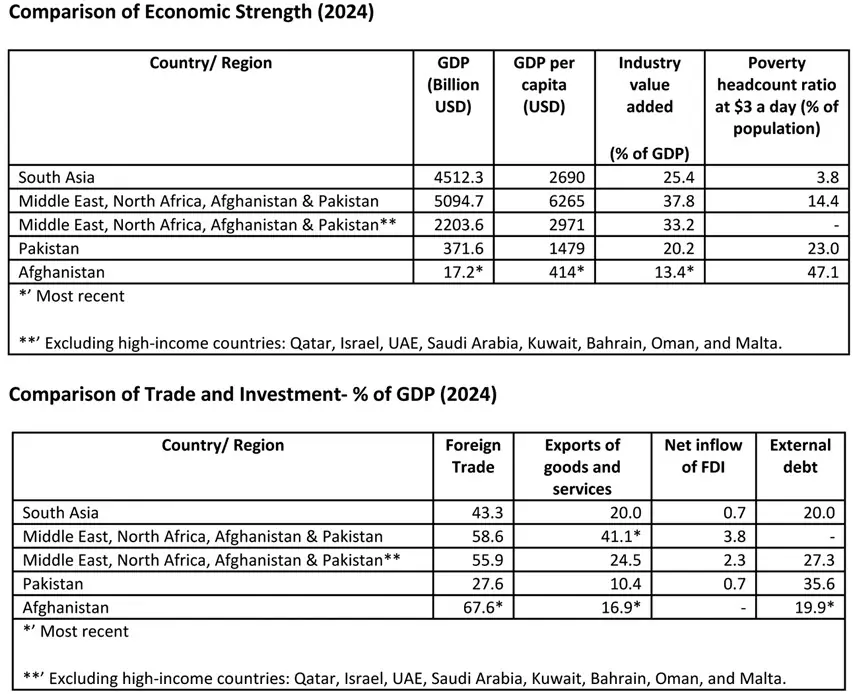
The comparison of the economies in South Asia and the ‘Middle East and North Africa’ shows the significant disparities between these two regions. Based on per capita income, all South Asian countries are classified as middle-income countries. However, 8 high-income countries are included in the list of the Middle East and North Africa. Excluding the high-income countries, the aggregate gross domestic product (GDP) of the Middle East and North Africa is 2.2 trillion US dollars, which is 4.5 trillion US dollars (almost double) in the case of South Asia. The per capita income of the Middle East and North Africa is 2971 US dollars, which is 2690 US dollars for South Asia. Obviously, this average is completely changed after the inclusion of 8 high-income countries in the Middle East and North Africa. In comparison, of gross domestic product (GDP) and per capita income, Pakistan is much behind the average of South Asia and the Middle East and North Africa, while Afghanistan is not even comparable.
The share of industry in the gross domestic product of Pakistan is around 20 percent, which is more than 25 percent in the case of South Asia, and 33 percent in the case of the Middle East and North Africa (excluding high-income countries). The most incomparable socioeconomic indicator is poverty. More than 47 percent of the population of Afghanistan, and more than 21 percent of the population of Pakistan, earn less than 3 US dollars in a day. This ratio is 14.4 percent in the case of the Middle East and North Africa and 3.8 percent in South Asia.
The most important indicator that does not match Pakistan with the Middle East and North African economies is the inflow of foreign investment. From the foreign investment point of view, Pakistan does not seem to be a part of the Middle East and North Africa. The net inflow of foreign direct investment as a percentage of gross domestic product is 0.7 percent in Pakistan, and this is the same on average for South Asian countries. The average inflow of foreign direct investment as a percentage of gross domestic product is 3.8 percent in the countries in the Middle East and North Africa. Even after the exclusion of high-income countries, it is 2.3 percent in the Middle East and North Africa. The world average of the net inflow of foreign direct investment as a percentage of GDP is 1.3. This shows that the countries in the Middle East and North Africa have the capacity to attract foreign investment.
The shares of exports and trade in the gross domestic product of Pakistan indicate a trade deficit. The share of trade is more than double its exports, which shows that the size of imports is greater than exports. A similar position is depicted by South Asia.
However, Pakistan is facing the worst situation in external debts. The magnitude of its external debt is nearly 34 percent of its GDP, which is 20 percent in Afghanistan. The average external debt of the countries in South Asia is also 20 percent, and 27 percent in the case of the Middle East and North Africa.
Copyright Business Recorder, 2026
The author is a professor at Iqra University Karachi.

















Comments