


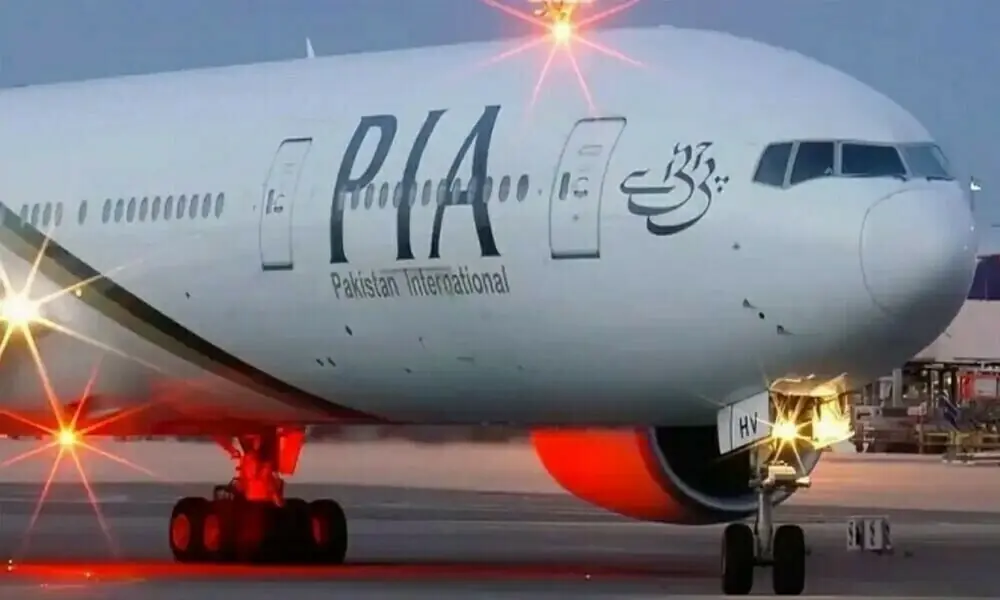

ISLAMABAD: Pakistan International Airlines (PIA), just months into its privatisation transition, has begun scaling back flight operations and adjusting ticket prices as a sharp surge in jet fuel price has squeezed margins and raised fresh questions over the sustainability of its turnaround plan, industry officials and aviation sources said.
The national carrier has reduced frequencies and suspended several international routes, including services to Beijing and Kuala Lumpur, while limiting operations across parts of its Gulf network.
Aviation sources said the adjustments are primarily cost-driven, with fuel price emerging as the single most critical pressure point for the airline’s operations.
Jet fuel (JP-1) price has risen sharply in recent weeks, with estimates suggesting an increase of around 150 percent, pushing per-litre cost from roughly Rs190 to over Rs450, according to media reports and sector analysts.
Given that fuel typically accounts for 30 to 40 percent of an airline’s operating expenses, the spike has significantly eroded operating margins across the sector.
READ MORE: PIA limits operations, ends discounts amid hike in jet fuel
“Under the current pricing environment, certain routes have become commercially unviable,” a senior aviation official said, adding that airlines are being forced to rationalise networks rather than expand their operations.
To withstand the rise in costs PIA has introduced and adjusted a fuel surcharge component, with aviation sources indicating an additional charge of approximately $10 on domestic routes and up to $100 on international sectors, depending on route length and cost structure.
Officials maintain that base fares have not been formally revised across the board, but the withdrawal of discounts and the addition of surcharges have effectively increased ticket prices. Industry analysts estimate that overall airfare levels could see an upward adjustment of 20 to 30 percent as carriers attempt to partially pass on fuel costs to passengers.
Officials acknowledged that the airline cannot fully transfer the cost burden to consumers due to weak demand elasticity and competitive pressures on key routes. “There is a limit to how much can be passed on. Beyond that, demand starts to contract,” an aviation analyst noted.
PIA has also temporarily suspended operations to China and Malaysia for an estimated two to three months, while prioritising Hajj operations through fleet reallocation.
At the same time, flight operations on certain Gulf sectors, including Dubai and Abu Dhabi, remain constrained due to regional security conditions and airspace-related limitations, further complicating scheduling and capacity deployment, according to aviation sources.
While there is no indication of an immediate physical shortage of jet fuel, sector stakeholders described the situation as a “pricing crisis with supply-side uncertainty,” driven in part by regional geopolitical tensions affecting oil markets and supply chains. The resulting volatility has prompted airlines, including PIA, to adopt a more cautious operational posture.
The developments come at a critical time for PIA, which is in the midst of a structural transition following the government’s divestment of a 75 percent stake to a private consortium led by the Arif Habib Group. The remaining 25 percent stake is still held by the government, with further divestment expected at a later stage as part of the broader privatization roadmap.
Officials familiar with the process said that while the majority stake transfer marks a significant milestone, the airline remains in a transition phase where operational restructuring, cost control, and fleet optimisation are yet to fully stabilise.
An internal transition milestone is expected around April 29, though sources described it as a procedural checkpoint rather than a definitive completion stage.
The new management has outlined plans for long-term expansion, including increasing the fleet size and restoring international routes. However, current market conditions are almost certainly likely to delay immediate execution.
Copyright Business Recorder, 2026




















Comments