




The SBP (State Bank of Pakistan) has recently released the estimates of the stock of government debt and other debts of Pakistan as of February 2026.
The objective of this article is to identify the changes in the level and composition of federal government debt since June 2020. The factors contributing to the increase in debt are quantified. A comparison is made with the level of government debt in selected South Asian and East Asian countries.
There is need to first clearly indicate the coverage of government debt. According to the Fiscal Responsibility and Debt Limitation Act of 2005, government debt consists of domestic debt, external debt, including the debt of Pakistan with the IMF, and excludes the government deposits with the banking system.
Based on this definition, the level of government debt was Rs 73,268 billion at the end of 2024-25. It has since gone up to Rs 75,137 billion by February 2026. This implies an increase of 2.6 percent and an absolute rise of Rs 1,869 billion.
The latest estimate of the level of government debt indicates that the per capita burden of debt has risen to almost Rs300,000. It was virtually half this magnitude at the end of 2020-21.
A critical magnitude is the level of government debt as a percentage of the GDP. It is estimated at 64.3 percent of the GDP at the end of 2024-25. The Fiscal Responsibility and Debt Limitation Act has set a ceiling on government debt of 60 percent of the GDP. There are indications that by February 2026 the level of government debt has come closer to 60 percent.
The trend in government debt as a percentage of the GDP has been a variable one since 2020-21 as shown in Table 1. Initially, from 2020-21 to 2022-23, there was a big jump in this magnitude from 63.9 percent of the GDP to 69.1 percent of the GDP, implying thereby a growing violation of the ceiling placed by the Fiscal Responsibility and Debt Limitation Act.
The dominant share in government debt is of domestic debt. The share was 64.8 percent at the end of 2024-25 as shown in Table 1. Earlier, it was 61.9 percent in 2020-21.
Within domestic debt, the largest share is of permanent debt, mostly in the form of Pakistan Investment Bonds (PIBs), of 79.5 percent in June 2025. The shares of unfunded debt and short-term debt are 5.3 percent and 15.2 percent, respectively.
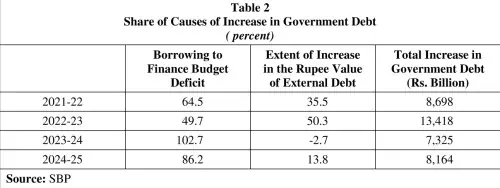
There is need to analyse the causes of the increase in government debt. There are two causes. The first is the need to borrow to finance the federal government budget deficit and the second is the extent of increase in the rupee value of external debt due to depreciation in the value of the rupee.
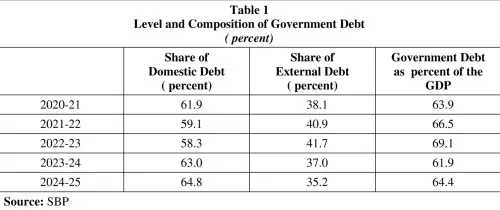
Table 2 shows the big difference in the causes of the increase in government debt. The year, 2022-23, witnessed the largest absolute increase of Rs 13,418 billion. Over half was due to the quantum depreciation of the rupee by over 40 percent. Thereafter, bulk of the increase is due to borrowing to finance the budget deficit. This is also likely to be the main cause of higher debt in 2025-26.
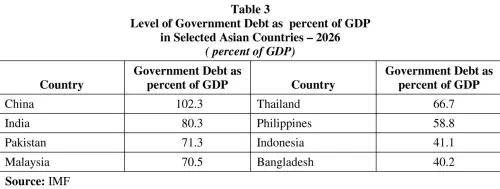
There is need to make a comparison of the level of government debt as a percentage of GDP in selected countries. This is done in Table 3.
The big surprise is the extremely high level of government debt in China and India. Clearly, both countries have adopted very expansionary fiscal policies to stimulate economic growth. The level in Pakistan is 71.3 percent. This is higher than the SBP estimate because government deposits with the banking system are not excluded from government debt. The lowest level of government debt is in Indonesia and Bangladesh at close to 40 percent.
Overall, after an exponential jump from 2020-21 to 2022-23 there is the onset of some decline in the government to GDP ratio in 2023-24 and 2024-25. This is due to contraction in the size of the budget deficit as a percentage of the GDP and stability in the value of the rupee. During the first eight months of 2025-26 the decline in the ratio has persisted. The outcome in the next four months from March to June 2026 is awaited.
There is need to ensure that the budget deficit does not exceed 4 percent of the GDP in 2025-26 and in coming years. Also, if the balance of payments is managed skilfully and not subject to big negative shocks than the value of the rupee should remain relatively stable. This will enable adherence to the ceiling of government debt at 60 percent of the GDP.
Copyright Business Recorder, 2026
The writer is Professor Emeritus at BNU and former Federal Minister

























Comments