


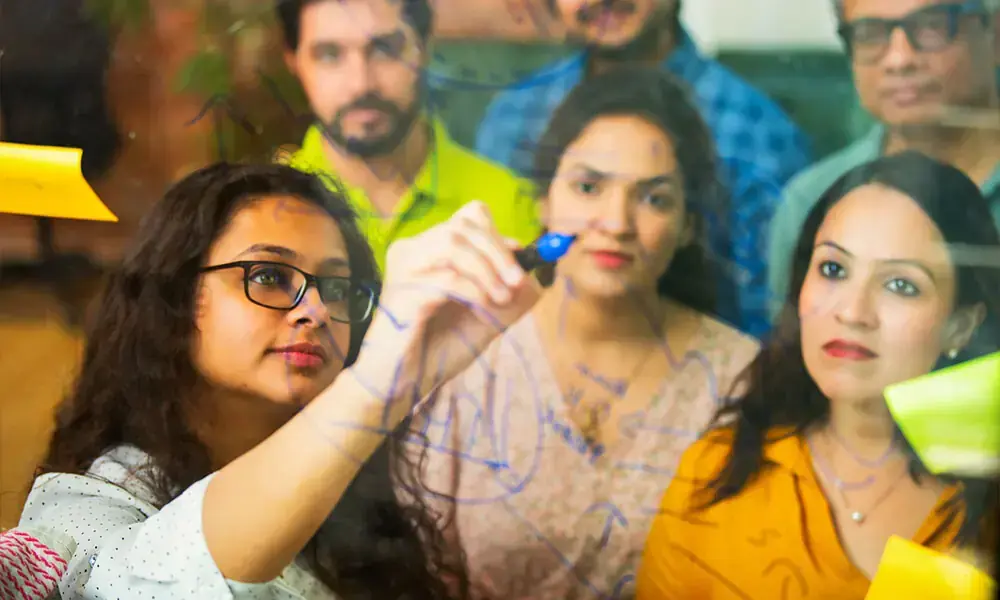

Some of the most disciplined financial leadership in Pakistan does not happen in boardrooms, banks, or balance sheets. It happens in kitchens, courtyards, WhatsApp groups, and neighborhood circles, where women stretch incomes, absorb shocks, plan ahead, and keep households functioning with remarkable precision.
They decide what can be spent today and what must wait until next month. They know when a child’s school fee is due, when a medical bill might hit, and when a little cash needs to be tucked away before it disappears into daily expenses. Long before formal institutions enter the picture, women have often already done the hardest part of financial management: making limited resources last.
And yet, the formal financial system still tends to treat women as peripheral users rather than central economic actors. Documentation requirements, collateral demands, rigid income criteria, and products designed around male patterns of employment all send the same message: this system was not built with women in mind.
So, women build around it.
That parallel system is vast, resilient, and deeply embedded in everyday life. Women manage household consumption, make trade-offs between food, education, healthcare, and savings, and often do so through cash-based systems that rarely leave a formal paper trail. It may not look like finance in the conventional sense, but it is a financial strategy all the same.
In that sense, Adam Smith’s “invisible hand” may have missed something important: the invisible economy women have been running alongside the formal one all along.
This economy cuts across class. In lower-income households, women often supplement family earnings through home-based work, stitching clothes, tutoring children, preparing food, offering domestic services, or selling handmade goods. In middle- and upper-income households, women may not always be counted as earners, but they still act as chief allocators of family resources, quietly influencing some of the most consequential spending decisions a household makes.
According to the World Bank, Pakistan has an estimated 3.6 million home-based female workers generating income through small-scale economic activity, even though much of that labour remains poorly classified and largely invisible in policy and protection systems. Their work may be undercounted in GDP calculations, but it is hardly marginal. It sustains households, smooths financial instability, and supports entire local economies.
Their savings habits are equally sophisticated. For generations, women have relied on informal rotating savings groups, commonly known as committees, where each member contributes a fixed amount on a regular basis, and one member receives the pooled amount in turn. The money may go toward school fees, medical treatment, a daughter’s wedding, stock for a home business, or overdue repairs. These systems do not run on contracts alone. They run on trust, discipline, reputation, and mutual accountability.
That matters because it overturns a tired assumption: women are not financially illiterate. In many cases, they are already managing layered and complex financial responsibilities under conditions of constraint. What they often lack is not capability, but recognition, access, and infrastructure designed to support the way they already operate.
The most promising financial innovations, then, are not the ones trying to “teach” women to participate in the economy as though they are arriving late to it. They are the ones recognizing that women have always been participating and designing tools that strengthen what already exists.
One example is Baji, the AI-supported WhatsApp chatbot developed by Circle Women. Built into a platform that many women already use comfortably, Baji offers free training in digital literacy, financial management, and entrepreneurship. Its strength lies not only in the content it provides, but in the fact that it meets women where they already are, technologically, socially, and practically.
As Sadaffe Abid, Founder & CEO of CIRCLE Women, puts it: “We often talk about bringing women into the economy, but the reality is that women have always been at the center of it; just not in ways that are visible or valued. Through CIRCLE Baji, we make that invisible work more visible, more secure, and more valued, because when women grow, households and communities grow with them.”
Another example is Oraan, which digitizes the traditional committee system and allows women to save, invest, and budget through a verified digital platform. Rather than forcing users through intimidating banking processes, it builds on a familiar behavior and gives it greater transparency, accessibility, and security.
As Halima Iqbal, Founder & CEO of Oraan, explains: “Women in Pakistan have been running committees for generations. It is one of the most sophisticated informal financial systems in the world. At Oraan, we didn’t try to replace that. We digitized it because the behavior was already there. The trust was already there. What was missing was a platform that made it secure, transparent, and accessible at scale.”
That distinction is crucial. The smartest solutions are not dismantling women’s informal systems in favor of something entirely new. They are recognizing the financial intelligence already present in those systems and giving it tools to scale, formalize, and connect more safely to the wider economy.
Women’s financial participation in Pakistan is not a future possibility waiting to be unlocked. It is an existing reality that has been underestimated, undervalued, and too often unseen. The real task is not to invent women’s place in the economy, but to finally build institutions that catch up with the financial leadership women have been demonstrating for decades.
Copyright Business Recorder, 2026
The writer is the Managing Partner at a Private Firm. The views expressed in this article are not necessarily those of the newspaper
The writer is a Consultant at a Private Firm. The views expressed in this article are not necessarily those of the newspaper

























Comments
Comments are closed for this article.