


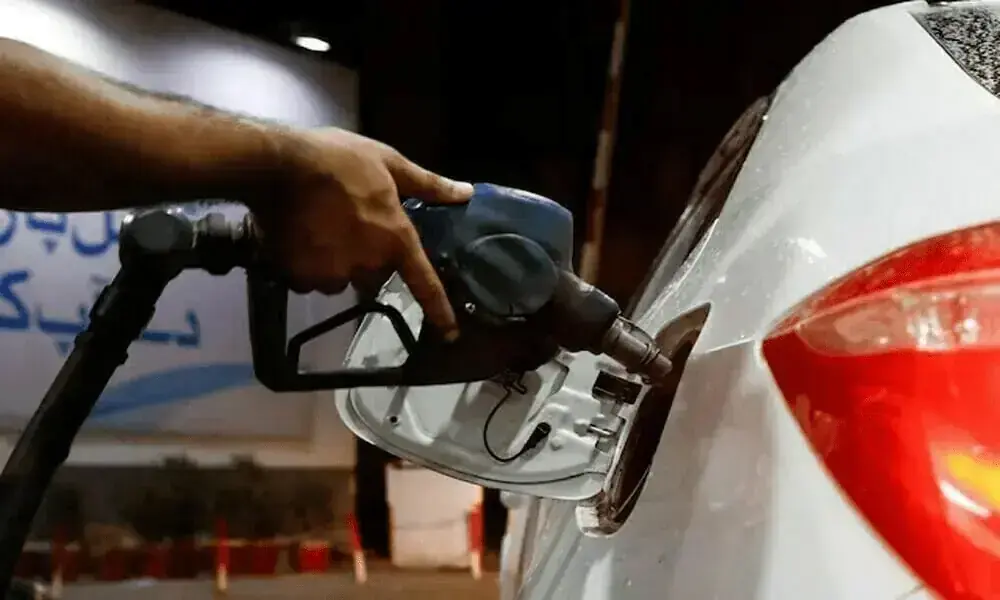
EDITORIAL: The provincial governments have agreed to share the burden of fuel subsidy announced by the Prime Minister necessitated by the rising international price of petroleum and products as a consequence of the Middle East conflict that has entered its fifth week.
While it is not clear whether the Prime Minister consulted the federating units prior to announcing his decision yet all the four chief ministers have endorsed it for obvious reasons: to enable the general public to sustain their quality of life as much as is possible under these trying conditions for which responsibility clearly and unambiguously lies with external players.
Be that as it may, with no meaningful rapprochement between the protagonists in sight, the duration of the fuel supply disruptions is not clear, which implies that the final amount of subsidies based on the Prime Minister’s pledge not to raise petrol prices is not precisely quantifiable.
For a country like Pakistan, which has been suffering from an extremely narrow fiscal space for decades – a key concern of nearly all the 24 International Monetary Fund programmes that the country managed to secure in its 79-year history, including the ongoing 36 months Extended Fund Facility programme—any external shock to revenue collections deepens the economy’s fragility. The usual method that previous administrations also employed to widen the fiscal space is through two measures.
First, by increasing existing taxes that are levied not on the ability to pay principle but on the ease of collection. This accounts for heavy reliance on indirect taxes for revenue and, needless to add, any reduction in the Gross Domestic Product (GDP) growth erodes the value of each rupee earned thereby reducing sales tax collections – IMF has already projected a decline in global GDP as an outcome of the Middle East conflict.
In addition, Pakistan is facing pressure on its foreign exchange reserves, a pressure reflected by the fact that the reserves held by the State Bank of Pakistan are largely borrowed — rollovers from friendly countries and borrowing from multilaterals and other bilaterals. This compromises the capacity to import raw material and semi-finished products which, in turn, reduces output as well as collections under customs and excise duties. The Federal Board of Revenue (FBR) has revealed that the tax shortfall till February 2026 is of 457 billion rupees – a shortfall that is prior to the start of hostilities on 28 February 2026. It stands to reason that this will rise significantly for March.
Secondly; our successive administrations typically overstate the budgeted allocation for Public Sector Development Programme (PSDP) to claim a greater commitment to development than their predecessors but in most years slash this as and when the fiscal deficit rises due to domestic or external factors – a situation that is all the more evident during times when the country is on a Fund programme.
It is relevant to note that the government had already faced a deficit higher than budgeted and hence had begun to slash PSDP even before the onset of the hostilities in the Middle East. In March this year, however, the government announced it was further slashing PSDP by 100 billion rupees to fund the fuel subsidies. The Prime Minister announced an austerity package, whose projected savings may well be too optimistic, though a PM Austerity Fund has been established with the first tranche release of 27 billion rupees – a fund that one would assume is part of a larger package though by the end of the conflict there might be a need to undertake some innovative accounting measures to ease IMF concerns.
To create fiscal space and at the same time reduce dependence on borrowing (domestic and external) the government must slash its current expenditure for a period of two to three years to give itself and the general public some breathing space, whereby measures to raise taxes are backed by reforms that render the system fair, equitable and non-anomalous.
Copyright Business Recorder, 2026




















Comments
Comments are closed for this article.