


Bilal bin Saqib emerges as key link in Pakistan’s crypto-driven outreach to Trump world: report
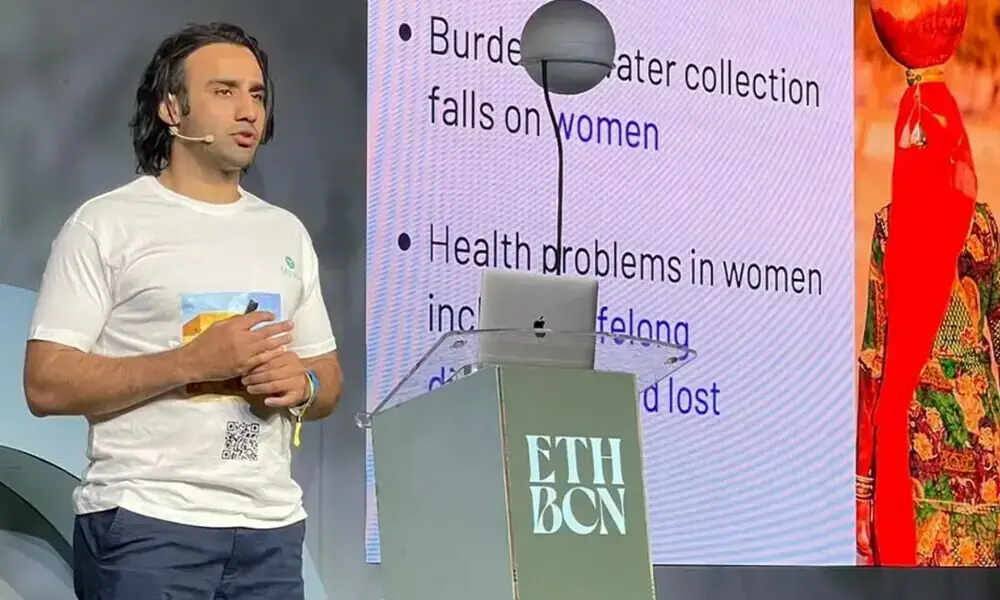
Pakistan has leveraged its growing engagement with the global cryptocurrency ecosystem to build new channels of influence in the United States, particularly within the orbit of US President Donald Trump, with a little-known techie, Bilal bin Saqib, emerging as a key intermediary in the process, reported Bloomberg.
As per the report, the growing ties have largely been driven through Saqib’s connections with World Liberty Financial, a decentralised finance protocol developed by Zachary Folkman, Chase Herro, Alex Witkoff, Zach Witkoff, and Donald Trump family members.
Earlier this year, Pakistan inked a deal with SC Financial Technologies LLC, an affiliate of World Liberty Financial USA (WLF), to foster collaboration on next-generation digital payment systems and cross-border financial innovations.
“Pakistan’s adept use of crypto diplomacy — or ‘biplomacy’ as Saqib calls it, a reference to Bitcoin — has buttressed a burgeoning friendship between Trump and Munir (Pakistan’s army chief),” read the report.
It said that the red carpet treatment in Islamabad, earlier this year, for the American president’s family business highlighted the growing depth of an increasingly important geopolitical relationship, seen by Pakistan’s emergence as a key intermediary between the US and Iran.
“Given how important personal connections are in the Trump White House’s policy process, Pakistan may well have bought itself some influence in the White House that advantaged it when it pitched itself to Washington as a mediator,” Michael Kugelman, resident senior fellow for South Asia at the Washington-based Atlantic Council, told Bloomberg.
“With this unconventional US administration, unconventional factors can help your cause — and that’s certainly the case with crypto.”
Pakistan Crypto Council CEO Bilal bin Saqib quits as PM’s aide on blockchain, crypto
The report noted that Saqib, who rose rapidly within Pakistan’s policy circles in a relatively short time span, has played a central role in facilitating these engagements.
“Because of crypto, doors have opened,” Saqib said in a recent interview. “New conversations have opened, trust has been built. We have gotten an opportunity to rebrand.”
Saqib was instrumental in linking Pakistan with global digital asset players, including Binance founder Changpeng Zhao, as Islamabad seeks to position itself as an emerging hub for virtual assets.
Analysts say the approach reflects an understanding of the importance of personal networks in the current US administration.
“For a country starved of global investor interest, aligning with Washington’s crypto pivot isn’t just about tech,” said Uzair Younus, who is a partner at The Asia Group, a Washington DC-based advisory firm. “It’s about signalling relevance in a shifting global order.”
The report noted that Pakistan’s interest in crypto is a relatively recent phenomenon. “Until two years ago, Pakistan wanted little to do with crypto… But by 2024, sentiment shifted,” Bloomberg wrote, adding that “Pakistan’s military establishment” has realised that crypto could be a useful “bargaining chip” in global diplomacy.
It was in that push where Saqib entered the picture.
While responding to a question on his expertise, Saqib said it was “essentially turning an idea into execution.”
“I am not a trader,” he told Bloomberg. “I’m a builder. I am the artist, not the scientist.”
However, it was not all smooth sailing for the Lahore-born, who struggled to find his footing in the crypto space.
“In crypto, failure is the best teacher,” he said. “There is no formal school for this. And you learn by doing, by making mistakes and getting back up every time.”
“One thing I know,” he added. “If you throw enough mud against the wall, something will stick.”
The report revealed that Saqib was instrumental in drafting the framework for a Pakistan-US trade deal.
PVARA chief, SBP governor discuss digital asset adoption
Pakistan secured trade concessions from the US, drew renewed investor attention, and expanded dialogue on areas such as energy, critical minerals and technology cooperation.
At the same time, the country’s large and growing crypto user base presents a commercial opportunity for global firms looking to expand.
Although risks persist, it noted. “Pakistan still needs to pay back the International Monetary Fund, which has shown an aversion to sovereign crypto experiments,” read the report.
However, Islamabad appears intent on deepening its crypto-led engagement strategy, with Saqib, who remains optimistic that Pakistan is heading in the right direction.
“It’s a lot of serendipity, a lot of good timing,” Saqib said. “All the stars have aligned.”












Comments
Comments are closed for this article.