




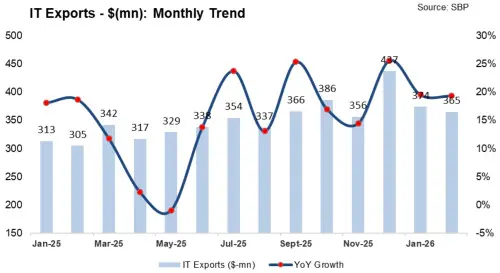
Pakistan’s information technology sector has continued its impressive growth trajectory, recording monthly IT exports of $365 million in February 2026. This represents a 20 percent increase year-on-year, though it reflects a slight 2 percent decline on a month-on-month basis. The latest figures reinforce the sector’s position as one of the dynamic contributors to Pakistan’s foreign exchange earnings.
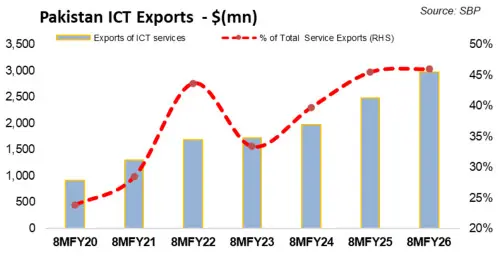
The February 2026 result takes cumulative IT exports in 8MFY26 to $2.98 billion, reflecting a 20 percent year-on-year increase. This points to continued momentum in Pakistan’s IT sector and suggests that export capacity is steadily improving. But the picture should not be overstated: while software services, BPO, and other digital exports are expanding, the industry still has some distance to cover before it can be seen as deeply established in global markets.
The monthly export data from January 2025 through February 2026 further illustrates the sector’s upward momentum. Exports climbed from $313 million in January 2025 to a peak of $437 million in December 2025, before moderating to $374 million in January 2026 and $365 million in February 2026.
The seasonal dip at the start of the calendar year is a familiar pattern, typically followed by renewed momentum in the second half of the fiscal year.
Beyond gross export figures, net IT exports — calculated as exports minus imports — provide a clearer picture of actual foreign exchange generation. Net IT exports for February 2026 stood at $320 million, up 15 percent year-on-year. This metric is particularly significant for the country’s macroeconomic health, as it reflects genuine value retained within the country from digital trade rather than simply gross flows.
The government has set a bold IT export target of $5 billion for FY26. However, analysts maintain a more measured outlook. IT exports are expected to grow by 18–20 percent during the year to reach $4.5 billion, compared to FY25 exports of $3.8 billion. The gap between the official target and market projections reflects structural challenges — including internet infrastructure constraints, regulatory friction, and difficulties in formal remittance channels for freelancers — that continue to limit the sector from achieving its full potential.
The longer-term ambitions are even more striking. Under the ‘Uraan Pakistan’ national economic plan, the government has set an FY29 target of $10 billion in IT exports, implying a required compound annual growth rate (CAGR) of 27 percent through FY29. Achieving this milestone would cement Pakistan’s status as a major emerging-market technology exporter and significantly transform its foreign exchange composition.
However, sustaining such growth will require policy continuity, investment in digital infrastructure, and streamlined banking frameworks for the country’s large freelance community. The 8MFY26 data confirms the foundation is solid — but converting this momentum into the structural transformation envisioned under Uraan Pakistan remains the central challenge and opportunity for the decade ahead.




















Comments
Comments are closed for this article.