



Descon Oxychem Limited (PSX: DOL) was incorporated in Pakistan as a private limited company in 2004 and then changed its status into a public limited company in 2008 under approval of SECP. The principal activity of the company is the procurement, manufacturing, and sale of hydrogen per oxide and its related products.
Pattern of Shareholding
As of June 30, 2025, DOL has 175.031 million sharesoutstanding which are held by 6326 shareholders. Associated companies, undertaking, and related parties hold 72.63 percent of the total outstanding shares of DOL followed by local general public accounting for 23.78 percent shares. Joint stock companies have 2.84 percent stake in the company. The remaining shares are held by other categories of shareholders.
Financial Performance (2019-25)
Except for a dip in 2020 and 2024, DOL’s topline posted year-on-year growth in all the years under consideration. Its bottomline slid in 2021 and 2024. DOL’s margins largely rode an upward trajectory until 2020 followed by a drastic fall in 2021. In the subsequent years, the margins regained their momentum and reached their optimum high level in 2023. In 2024, the margins fell to their lowest level followed by an uptick recorded in 2025. The detailed performance review of the period under consideration is given below.
In 2019, the topline posted a tremendous year-on-year growth of 29.53 percent to clock in at Rs.2704.96 million. This came on the back of robust local sales. Conversely, export sales plummeted during the year.Offtake of Hydrogen per oxide fell by 7.38 percent in 2019 while trading general sales rebounded by 35 percent in 2019 (see the graph of sales volume). Cost of sales also grew by 27.34percent year-on-year mainly due to the conversion of the industry from local gas to expensive RLNG. Despite soaring cost of sales, gross profit boasted 34.78percent year-on-year growth in 2019. GP margin also ticked up from 29.52 percent in 2018 to 30.71 percent in 2019. This was the result of upward price revision as well as Pak Rupee depreciation which increased the margins on export sales Operating expense considerably dropped during the year due to classification of a certain amount of freight and forwarding as cost of sales under IFRS 15.
Other income plunged by 22.72 percent during the year owing to a drop in reversal of loss allowance for doubtful debt coupled with the absence of net gain on insurance claims of assets written off. Conversely, other expense rose by 101 percent on the back of increased provision for WWF and WPFF due to improved profitability during the year combined with impairment loss recognized during the year on the assets which are no longer expected to be used by the company.
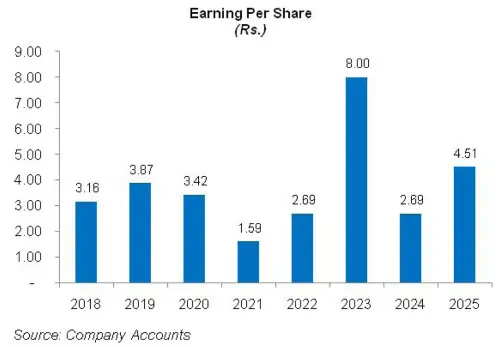
Operating profit mounted by 43.21percent year-on-year in 2019 with OP margin clocking in at 24.31 percent up from the OP margin of 22 percent registered in the previous year. Finance cost grew by 1373.70 percent in 2019not only because of increase in discount rate during the year but also due to intercompany borrowings of Rs.1100 million to redeem the preference shares. The company’s capital structure, which was entirely equity based for the past two years recorded debt-to-equity ratio of 53:47 in 2019.Despite a huge turnaround in the capital structure of DOL which magnified its finance cost by manifold, net profit managed to muster a 22.33 percent year-on-year increase to clock in at Rs.394.27 million in 2019 with EPS of Rs.3.87 versus EPS of Rs.3.16 posted in the previous year. NP margin, however, dropped from 15.43 percent in 2018 to 14.58 percent in 2019.
In 2020, amidst the outbreak of global pandemic, the company made a well-timed decision to launch its multi-purpose sanitizer and disinfectant, Sanidol which buttressed DOL’s revenue despite lockdown. Nonetheless, DOL’s net sales recorded a dip of 2.34 percent to clock in at Rs. 2641.62 million in 2020. This was on account of price adjustments in line with market demand During the year, the company entered into a commercial partnership with Tetra Pak Pakistan which made Aseptox 35 used to disinfect food and beverages packaging. Sales volume of Hydrogen per oxide increased by 3.14 percent while trading general sales dropped by 34.64 percent in 2020.
Reduction in crude oil prices proved to be a great opportunity for the company to lower its cost of sales and improve its GP margin which went up to 32.60 percent in 2020. 34 percent year-on-year rise in distribution cost in 2020 was the consequence of trial fee paid for the product approval in food and beverages segment. Administrative expense also hiked by 14.69 percent in 2020 due to increase in the number of employees from 97 in 2019 to 104 in 2020.
Other income considerably shrank during the year due to less interest on bank deposits as well as no reversals on loss allowance for doubtful debts made during the year. Other expense turned out to be favorable and plummeted by 28.18 percent year-on-year in 2020 particularly on the back of no impairment loss made and no provisions booked against long outstanding advances during the year.
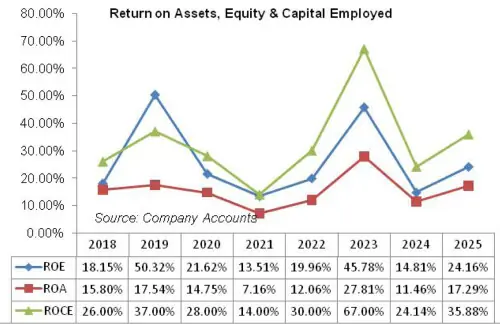
Operating profit rose by a meager 1.92 percent in 2020 while OP margin climbed up to 25.37 percent. Finance cost ticked up marginally by 2.8 percent on the back of high discount rate in the initial quarters of 2020.
The company significantly settled its outstanding debt during the year which culminated into a debt-to-equity ratio of 10:90. The intercompany borrowings were settled by issuing shares to Descon Engineering Limited. DOL’s bottomline posted year-on-year growth of 6.13 percent in 2020 to clock in at Rs.418.42 million with EPS of Rs.3.42. The decline in EPS is due to increase in the number of shares during the year. NP margin rose to 15.84 percent in 2020.
The signs of COVID-19 were not completely subsided in 2021, yet DOL managed to attain improvement in its off-take during the year.However, reduction in prices due to COVID-19 resulted in topline growth of only 6.18 percent year-on-year in 2021 to clock in at Rs.2804.90 million. Cost of sales posted a sharp rise of 23.1 percent year-on-year in 2021 on the back of depreciation expense due to capacity expansion, shut down expense, and increase in utility charges.
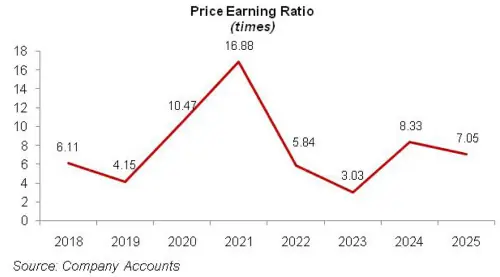
This trimmed down the gross profit by 28.83 percent year-on-year in 2021 with GP margin dropping down to 21.85 percent. Distribution expense surged by 11.65 percent in 2021 on the back of Royalty paid to Descon Private Limited for common directorship coupled with loss allowance for doubtful debt booked during the year. Administrative expense marched down by 3.31 percent in 2021 due to lower payroll expense as workforce was streamlined to 101 employees. Other income grew by 145.55 percent in 2021 on the back of dividend income from short-term investments and exchange gain. Other expense shrank by 36.34 percent in 2021 on the back of low provisioning done for WWF and WPPF. Operating profit tapered down by 32.47 percent during the year with OP margin slipping to 16.14 percent. Debt-to-equity ratio of DOL moved to 35:65 during the year as the company availed syndicate finance facility to finance its capacity expansion project. However, efficient working capital management and improved cost of debt on account of low discount rate resulted in 20.55 percent year-on-year decline in finance cost during 2021. The bottomline shrank by 33.39 percent in 2021 to clock in at Rs.278.70 million with EPS of Rs.1.59. NP margin narrowed down to 9.94 percent in 2021.
The capacity expansion undertaken by the company in 2021 started bearing fruit as the company posted a stunning topline of Rs.4250.49 million in 2022, up 51.54 percent year-on-year. The improved sales were the result of higher production, better pricing, and enhanced product placement. The capacity expansion blessed the company with economies of scale which improved its GP margin to 25.92 percent in 2022 with a spectacular 79.76 percent year-on-year growth in gross profit. Operating expenses grew mainly on the back of increased salaries and wages expense due to additional workforce hired for increased production capacity coupled with high freight and forwarding expense, royalty expense, fee, and subscriptions as well as assets written off during 2022. Other income grew by 10.30 percent in 2022 on the back of write-off of liabilities, higher profit on bank deposits and greater scrap sales made during the year.
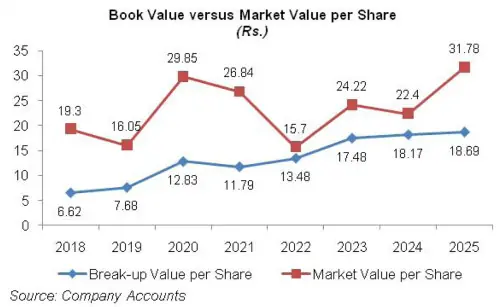
Other expense grew by 145.51 percent year-on-year in 2022 on the back of higher provisioning for WWF, WPPF as well as exchange loss made during the year. Operating profit managed to post a tremendous year-on-year rise of 88.90 percent in 2022 with OP margin recorded at 20.12 percent. Finance cost thinned down by 18.74 percent in 2022 due to long-term debt repayments. The debt-to-equity ratio nosedived to 13:87 in 2022. DOL’s bottomline grew by 68.95 percent in 2022 to clock in at Rs.470.88 million with EPS of Rs.2.69 and NP margin of11.08 percent.
With the highest topline growth of 58.13 percent year-on-year, 2023 stands out from all other years under consideration. DOL’s net sales stood at Rs.6721.35 million in 2023. While the company didn’t make any trading general sales during the year, hydrogen peroxide sales rebounded by 3.9 percent in 2023 to clock in at 42,131 MT. Despite unfavorable movement in gas and packing material cost, DOL was able to improve its gross profit by 150.17 percent in 2023 with GP margin mounting to 41.01 percent on the back of price progression and scalability of operations. Administrative expense spiked by 36.67 percent in 2023 on account of higher payroll expense in line with inflation. Workforce expanded by just two employees to clock in at 115 employees at the end of 2023. Distribution expenses escalated by 183.84 percent in 2023 due to increased salaries, freight & forwarding, fee & subscriptions, royalty as well as elevated travelling and advertisement expense. Other income grew by a hefty 306.26 percent in 2023 due to higher profit on bank deposits and sizeable dividend earned on short-term investments. However, other income was conveniently gobbled up by 220.51 percent bigger other expense incurred during the year, which was the consequence of higher profit-related provisioning and exchange loss. Operating profit grew by 163.14 percent in 2023 with OP margin rising up to 33.47 percent. Despite high discount rate, finance cost shrank by 50.7 percent in 2023 due to efficient working capital management, long-term debt repayments and DOL’s ability to hedge against interest rate hike. The company’s debt-to-equity ratio was squeezed to 5:95 in 2023. Net profit magnified by 197.45 percent in 2023 to clock in at Rs.1400.63 million with EPS of Rs.8 and NP margin of 20.84 percent.
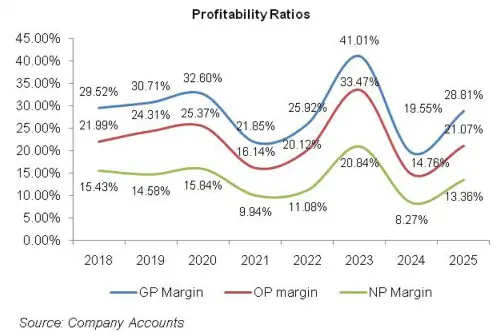
After registering staggering growth in net sales, profitability, and margins in 2022 and 2023, the company’s topline eroded by 15.28 percent year-on-year in 2024 to clock in at Rs5694.09 million. This was on the back of reduced demand and lackluster economic activity within and outside the home country. While export dispatches made some progress during the year, there was superfluous supply in the regional market due to the dumping of imported products. This didn’t allow the company to implement its pricing strategy. However, it diligently focused on improved product placement. Cost of sales hiked by 15.54 percent year-on-year in 2024 on the back of high global and indigenous inflation, hike in energy tariff and elevated commodity prices due to Russia-Ukraine crisis. DOL’s gross profit slumped by 59.62 percent year-on-year in 2024 with its GP margin drastically falling down to its lowest level of 19.55 percent. Administrative expense spiked by 10 percent in 2024 as a consequence of inflationary pressure and an uptick in workforce from 115 employees in 2023 to 117 employees in 2024. Distribution expense slid by 9.51 percent in 2024 due to lower freight charges anda downtick in fee & subscription charges and royalty paid to Descon (Private) Limited due to common directorship. Other income spiraled by 45.89 percent year-on-year in 2024 on account of higher dividend from investments and excess liability written back during the year. Lesser profit related provisioning and no exchange loss incurred during the year is the reason behind 73.25 percent plunge recorded in other expense in 2024. Operating profit waned by 62.64 percent in 2024 with OP margin contracting to its lowest level of 14.76 percent. Finance cost plummeted by 8.18 percent during the year due to efficient management of cash conversion cycle and payment of long-term debt. Net profit tumbled by 66.37 percent year-on-year to clock in at Rs.471.039 million with EPS of Rs.2.69 and NP margin of 8.27 percent.
In 2025, DOL’s net sales inched up by 3.90 percent year-on-year to clock in at Rs.5916.32 million. This came on the back of better and higher volume placement as well as improved pricing strategy implemented during the period. Cost of sales shrank by 8 percent in 2025 due to lower repair & maintenance charges and no shut down expense incurred during the year. Packaging charges also plunged during the year as the company is increasingly focusing on bulk packaging tominimize waste. The company also focused on reducing energy and chemical consumption during the year.These efforts translated into 53.16percent improvement in DOL’s gross profit in 2025 with GP margin jumping up to 28.81 percent. Administrative expense spiked by 30.57 percent in 2025 due to increase in minimum wage rate which pushed up the payroll expense despite workforce staying intact at 117 employees in 2025. Distribution expense inched up by just 2 percent as export sales fell during the year on the back of geopolitical conflicts in Asia and the Middle East.Other income dwindled by 38.89 percent in 2025 due to lower income from financial assets on the back of monetary easing. No liabilitieswritten back also squeezed other income in 2025. Greater provisioning done for WWF, WPPF, ECL and obsolete stores &spares was the reason of 87.19 percent higher other expense recorded by DOL in 2025. Operating profit strengthened by 48.33 percent in 2025 with OP margin jumping up to 21 percent. Finance cost slid by 58.39 percent in 2025 due to lower discount rate. Unlike last year, the company obtained working capital loan in 2025. This resulted in gearing ratio of 0.64 percent in 2025 versus no gearing in the previous year as cash & bank balances were higher than borrowings. DOL recorded 67.75 percent year-on-year improvement in its net profit which clocked in at Rs. 790.159 million in 2025. This translated into EPS of Rs.4.51 and NP margin of 13.36 percent in 2025.
Recent Performance (1HFY26)
During the first half of the ongoing fiscal year, DOL recorded 23.18 percent year-on-year slide in its net sales, which clocked in at Rs.2423.66 million. This was due to intensified pricing pressure from foreign suppliers especially from Bangladesh. This greatly reduced the demand of locally produced hydrogen peroxide. In order to stay competitive, the company focused on cost optimization initiatives such as bulk packaging, installation of solar power plant and efficient usage of gas, energy, and chemicals. Despite these initiatives, thinner sales volume took its toll resulting in 51.67 percent thinner gross profit in 1HFY26 with GP margin of 19.65 percent versus GP margin of 31.23 percent recorded in 1HFY25. Administrative expense spiked by 19.26 percent in 1HFY26 due to higher payroll expense. Increased focus on export sales, particularly premium food grade volume, pushed up distribution expense by 50.69 percent in 1HFY26. Lower provisioning done for WWF and WPPF appears to be the cause of 74.15 percent decline in other expense in 1HFY26. Other expense was conveniently offset by 98.54 percent stronger other income recorded in 1HFY26, likely due to increase in short-term investments. DOL’s operating profit deteriorated by 62.57 percent in 1HFY26 with OP margin clocking in at 11.51 percent versus OP margin of 23.62 percent recorded in 1HFY25. Finance cost escalated by 279.65 percent in 1HFY26 despite monetary easing. This was due to a massive spike in running finance loans obtained during the period. DOL posted net profit of Rs.215.57 million in 1HFY26, down 53 percent year-on-year. This translated into EPS of Rs.1.23 in 1HFY26 versus EPS of Rs.2.62 recorded in 1HFY25. NP margin also deteriorated from 14.55 percent in 1HFY25 to 8.89 percent in 1HFY26.
Future Outlook
The company is actively engaged with the relevant authorities for more stringent EFS policies and introduction of non-tariff barrier to discourage dumping by international suppliers and foster healthy competition in the local market.
In the international market, the company is undertaking channel development initiatives, particularly in the Arabian region. However, the demand is expected to remain subdued in the short to medium term due to ongoing tension in the Asian region coupled with no major capacity expansion expected in the downstream segments like textile and pulp paper. This indicates further increase in competition and drop in pricing. Amid demand slowdown, the company’s focus on operational efficiency and cost competitiveness will enable it to achieve better margins.

























Comments
Comments are closed for this article.