


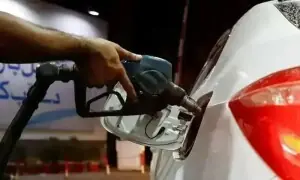
Petrol prices were hiked by Rs55 per liter last week. Urgently. Out of turn. Oil had moved, the arithmetic had changed, and consumers were told the adjustment could not wait.
A week later, the arithmetic looks even less forgiving.
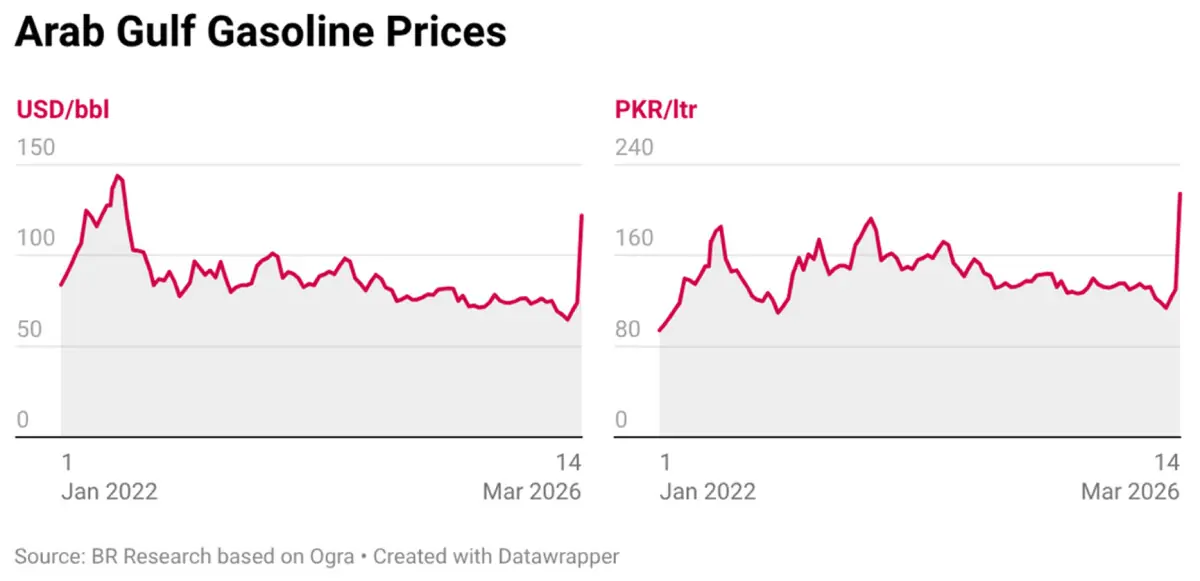
Arab Gulf gasoline has jumped from roughly $95 per barrel to about $122 per barrel in a matter of days. At the earlier $95 level, the government felt compelled to raise domestic prices by Rs55 per liter for both petrol and high speed diesel. At today’s levels, and with the petroleum levy left untouched, the numbers would normally demand another increase of roughly Rs50 per liter on petrol and closer to Rs75 per liter on diesel.
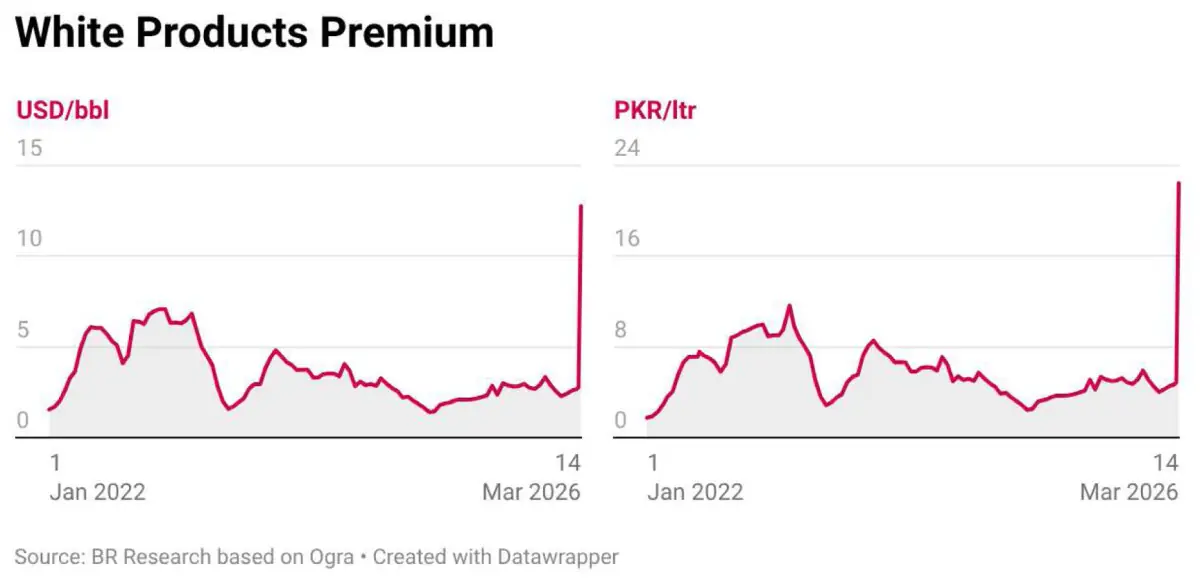
The speed of the latest jump in Arab Gulf gasoline prices alone tells most of the story.White product premiums have shot up sharply, suggesting the spike is not merely crude driven but increasingly a product market squeeze as well. Yet prices have been left unchanged this week.
Instead, the message from the Prime Minister’s Office is that part of the increase will be absorbed to provide relief to consumers. Which is a polite way of saying the Price Differential Claim (PDC) has quietly returned to the policy toolkit.
For the current week alone, the bill is expected to be around Rs23 billion.
The phrase carries baggage. The last time Pakistan leaned heavily on PDC was in early 2022, when the government of the day froze petroleum prices in the face of rising global oil markets. The decision triggered sharp criticism from economists and policymakers alike.
Some critics went as far as arguing that the two months of PDC pushed Pakistan back by a decade economically. That may be overstating the damage, but the episode certainly gave PDC a reputation as the fiscal equivalent of pulling the emergency brake.
Fast forward to today and the policy has made a quiet return. This time under a very different government and under a very different geopolitical storm.
The twist, however, is interesting.
Back in 2022, the petroleum levy had effectively been brought down to zero. The state was absorbing the entire shock directly through the budget. This time the levy has been left untouched. The government is paying a price differential claim while continuing to collect the tax embedded in the fuel price.
Both exist at the same time.
From a purely fiscal standpoint, the government might feel it has some breathing room. Petroleum levy collections during the first half of FY26 have already reached Rs823 billion. That is roughly 60 percent of the full year target already in the bag. Even if demand softens as prices climb, the annual target still appears within reach.
But that comfort rests on one very fragile assumption. That the oil shock remains short-lived.
Because the rope here is tighter than it looks.
At roughly Rs23 billion a week, maintaining current prices through PDC would translate into nearly Rs100 billion in a single month. That is assuming prices do not rise any further from here. If markets decide to push oil even higher, the arithmetic worsens quickly.
A Rs100 billion PDC bill in one month would effectively mean giving up a large chunk of the petroleum levy collected over the same period. Stretch that scenario further and the government could find itself surrendering nearly the entire levy just to keep pump prices from moving.
That would leave a noticeable hole in the fiscal pocket. And petroleum revenues are not exactly a minor line item anymore. The federal government has become heavily reliant on the petroleum levy as a steady stream of non-tax revenue.
In other words, the balancing act works only as long as the shock remains temporary.
Energy markets, however, rarely offer that courtesy. The conflict now involving the United States, Israel and Iran has placed one of the world’s most sensitive energy corridors under severe tension. Oil prices have already reacted sharply and refined fuel markets are showing signs of stress.
If the war drags on for a few more weeks, even without another dramatic spike in prices, the fiscal math could start looking uncomfortable very quickly.
For now, the government appears to be walking a careful line between economic orthodoxy and political reality. Passing through the entire increase would have been economically neat but politically explosive. Absorbing a slice of it through PDC buys some time.
Just not a lot of it.








Comments
Comments are closed for this article.