


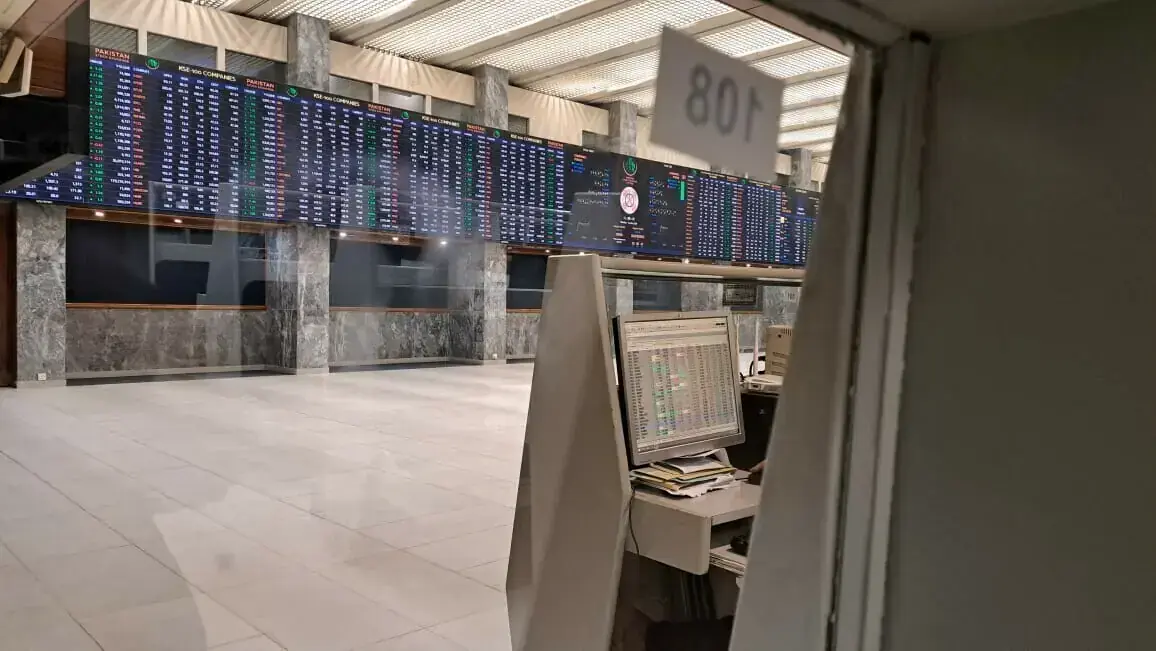

KARACHI: Pakistan’s stock market extended its sharp decline during the week ended March 6, 2026, as heightened geopolitical tensions, domestic security concerns and macroeconomic uncertainty weighed heavily on investor sentiment.
The benchmark KSE-100 Index dropped 10,566.08 points, or 6.3 percent week-on-week, closing at 157,496.09 points compared with 168,062.17 points last week. The decline follows a 5,108-point fall recorded in the previous week, bringing the cumulative drop from the January 2026 peak of 189,167 points to nearly 17 percent. Market participants remained cautious throughout the week, trimming exposures amid rising regional tensions and uncertainty surrounding key economic developments.
The BRIndex100 opened the week at 19,046.57 points and closed at 17,723.96 points, recording a decline of 1,322.61 points over the period. During the week, total turnover in the BRIndex100 stood at approximately 2.64 billion shares. Similarly, the BRIndex30, opened the week at 68,534.27 points and ended at 62,680.60 points, registering a drop of 5,853.67 points during the period. Total turnover reached around 1.79 billion shares.
The broad-based selling pressure significantly eroded market value. Total market capitalization declined to Rs17.70 trillion, down from Rs18.93 trillion in the previous week, reflecting a 6.5 percent contraction. In dollar terms, market capitalization also fell 6.5 percent to USD63.34 billion from USD67.74 billion.
Despite falling prices, trading activity in the ready market remained relatively strong. Average daily traded volume (ADTO) on the ready board rose 9.8 percent to 657.99 million shares, compared with 599.50 million shares in the previous week.
Similarly, average daily traded value increased 17.6 percent to Rs36.22 billion, up from Rs30.80 billion previously, while in dollar terms turnover climbed 17.6 percent to $129.63 million from $110.19 million.
The downturn was broad-based, with most major sectors closing the week in negative territory. The engineering sector recorded the steepest decline of around 11.5 percent, followed by pharmaceuticals which dropped 11.3 percent and textile composite companies which fell 10.9 percent. The cement sector declined 10.0 percent, while technology and communication stocks lost 9.3 percent.
Other sectors also witnessed notable declines, including chemicals (-8.1 percent), fertilizer (-7.4 percent), banks (-7.1 percent), automobiles (-6.8 percent) and oil marketing companies (-5.4 percent). The food sector slipped 4.2 percent, the power sector declined 3.7 percent, while exploration and production companies posted a smaller loss of 1.1 percent. The refinery sector was the only segment to post a modest gain of 0.5 percent, standing out amid the otherwise bearish market environment.
From a trading perspective, the power sector led market activity, accounting for 18 percent of total traded volume during the week. The technology and communication sector contributed 12 percent, followed by investment banks with 10 percent. Both the food sector and banking sector accounted for 9 percent each, while other sectors collectively represented 42 percent of total market volumes.
Individual stock performance remained mixed. Among the top gainers, ATRL led the list with a 4.4 percent increase, followed by MARI, which gained 2.0 percent. KEL also advanced 2.0 percent, while DHPL rose 1.7 percent and HUMNL posted a 1.1 percent gain. JDWS recorded a modest 0.8 percent increase, while DCR ended slightly lower with a 0.5 percent decline, despite being included among the week’s notable movers.
On the losing side, several stocks witnessed steep corrections. JVDC emerged as the biggest laggard, plunging 19.8 percent, followed by KTML, which fell 19.5 percent. AKBL declined 18.1 percent, while SSOM dropped 17.2 percent. Other major losers included PAEL, which slid 16.8 percent, TGL, down 15.9 percent, and INIL, which lost 15.8 percent during the week.
Investor sentiment was further influenced by a series of macroeconomic developments. According to the Pakistan Bureau of Statistics, the country’s inflation rate rose to 7 percent year-on-year in February 2026, marking the highest reading since October 2024. Analysts expect the State Bank of Pakistan (SBP) to keep the policy rate unchanged at 10.5 percent in the upcoming monetary policy meeting, although rising global oil prices could exert additional inflationary pressure in the coming months.
Energy supply concerns also surfaced during the week. Pakistan is reportedly exploring options to manage a potential gas shortfall after QatarEnergy halted LNG production following Iran-related attacks, raising concerns about fuel availability. However, in a positive development, Saudi Arabia assured continued oil supplies to Pakistan through the Port of Yanbu on the Red Sea, which could help support the country’s energy needs in the near term.
In the money market, the government successfully raised Rs555 billion through treasury bill auctions during the week, although cut-off yields increased between 21 and 39 basis points across tenors, reflecting tighter liquidity conditions and rising inflation expectations. Meanwhile, the State Bank of Pakistan’s foreign exchange reserves stood at $16.3 billion, providing some support to the country’s external position.
Overall, the week remained dominated by risk aversion and heightened uncertainty, with investors closely monitoring geopolitical developments, macroeconomic indicators, and the ongoing engagement between Pakistani authorities and the International Monetary Fund (IMF) regarding the third review of the economic program.
Market participants expect volatility to persist in the near term as these factors continue to shape investor sentiment and the direction of the equity market.
Copyright Business Recorder, 2026




















Comments
Comments are closed for this article.