


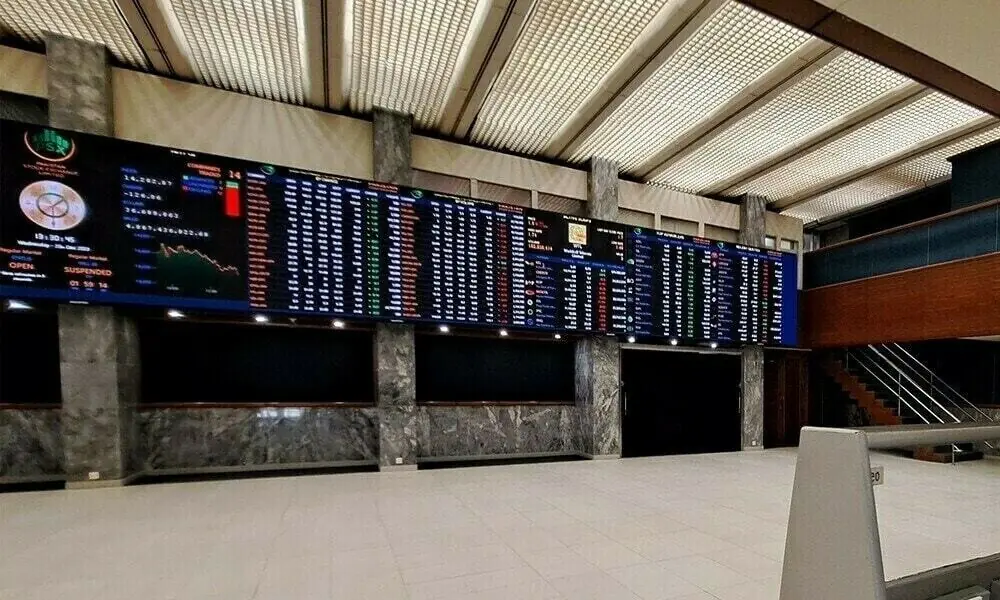
KARACHI: Pakistan’s equity market remained under sustained pressure during the week ended February 27, as rising geopolitical tensions and domestic security concerns continued to weigh heavily on investor sentiment, extending the benchmark index’s correction from its January peak despite a partial recovery toward the end of the week on improving diplomatic signals.
The benchmark KSE-100 Index at the Pakistan Stock Exchange declined by 5,107.53 points, or 2.9 percent week-on-week, to close at 168,062.17 points, compared with 173,169.70 points a week earlier.
The index opened the week at 173,169.70 points and remained under pressure for most of the period before staging a partial recovery on reports of constructive progress in negotiations between the United States and Iran, with further diplomatic talks scheduled in Vienna next week. Despite the late recovery, the market has now declined by 11.2 percent from its January 2026 peak of 189,167 points, highlighting the extent of the recent correction.
The prolonged weakness reflected a combination of global uncertainty and domestic concerns, as investors remained cautious amid evolving geopolitical developments and security-related risks within the country. The cautious sentiment resulted in continued portfolio adjustments and reduced risk-taking by institutional and retail investors alike.
Overall market capitalization declined significantly during the week.
Total PSX market capitalization fell 3.4 percent to Rs18.93 trillion, down from Rs19.60 trillion in the preceding week, reflecting a loss of roughly Rs672.56 billion in equity value. In dollar terms, market capitalization also declined 3.4 percent to US$67.74 billion, compared to USD70.12 billion previously, underscoring the broad-based decline in equity prices.
Investor participation remained subdued during the week, with trading volumes and turnover declining across the ready market. Average daily traded volume on the Ready Board fell 8.3 percent to 599.50 million shares, compared to 653.53 million shares in the previous week. In value terms, activity declined more sharply, with average daily traded value falling 18.0 percent to Rs30.80 billion, down from Rs37.57 billion a week earlier.
The sharper decline in traded value relative to volumes indicated reduced institutional participation and cautious positioning in higher-priced index constituents.
On the macroeconomic front, the arrival of the International Monetary Fund (IMF) mission marked a key development. The mission has arrived in Pakistan for the third review of the Extended Fund Facility (EFF) program, with formal discussions scheduled to begin next week.
The IMF acknowledged Pakistan’s ongoing policy stabilization efforts but reportedly highlighted concerns regarding the one-year rollover of US$2 billion in deposits from the United Arab Emirates. However, the finance minister expressed confidence regarding the rollover, citing an existing short-term arrangement and ongoing negotiations aimed at securing a longer-term extension of the deposits.
Separately, Pakistan’s planned USD250 million Panda bond issuance has been delayed, reportedly due to the country’s weak credit profile, limiting immediate access to Chinese debt markets.
Meanwhile, State Bank of Pakistan data showed mixed external sector trends. Profit repatriation by foreign investors increased 26 percent to US$1.7 billion, while foreign direct investment declined 41 percent during 7MFY26, indicating weaker long-term capital inflows despite rising outflows.
Meanwhile, SBP foreign exchange reserves remained broadly stable on a weekly basis at US$16.2 billion, indicating steady external buffers despite financing challenges.
In a notable development in the energy sector, the power minister announced that Pakistan expects to complete its first 200-megawatt electricity transaction under a competitive wheeling auction by June 2026. The initiative represents a significant step toward electricity market liberalization and private-sector participation in power distribution.
Sector-wise performance remained largely negative during the week. Fertilizer stocks showed marginal resilience, rising 0.4 percent, making the sector the only major gainer. Power stocks declined 1.3 percent, while Refineries fell 1.8 percent and Textile Composite stocks dropped 1.9 percent. Technology and Communication stocks declined 2.9 percent.
Oil and Gas Marketing Companies fell 3.0 percent, while the Food sector also declined 3.0 percent. Autos slipped 3.1 percent, cement declined 3.2 percent, and banks fell 3.3 percent. chemicals dropped 3.4 percent, exploration and production declined 4.4 percent, engineering stocks fell 4.7 percent, while Pharmaceuticals suffered the steepest decline at 5.6 percent, reflecting broad-based selling across sectors.
Trading activity remained concentrated in a few sectors. The Power sector accounted for 14 percent of total traded volume, followed by Technology and Communication with 13 percent, Banks with 11 percent, Investment Banks with 11 percent, and the Food sector with 9 percent, while other sectors collectively accounted for 42 percent of total activity.
Among individual stocks, SSOM emerged as the top gainer, rising 19.7 percent to close at Rs613.44. AKBL gained 7.2 percent to Rs101.43, while THALL advanced 6.8 percent to Rs693.50. POL and BAFL each rose 5.1 percent, closing at Rs657.64 and Rs129.09, respectively. FATIMA gained 4.2 percent to Rs163.33, while GHGL increased 4.1 percent to Rs34.96.
On the losing side, UNITY recorded the steepest decline, plunging 29.8 percent to Rs10.67. SSGC dropped 19.8 percent to Rs24.57, while TRG declined 14.2 percent to Rs49.72. YOUW and IBFL each fell 12.7 percent, closing at Rs4.19 and Rs213.22, respectively. TGL declined 12.6 percent to Rs173.49, while MLCF dropped 12.4 percent to Rs95.00.
Analysts observe, the Pakistan equity market remained under sustained pressure amid geopolitical uncertainty, domestic security concerns, weakening foreign investment flows, and continued risk aversion among investors.
Copyright Business Recorder, 2026











Comments
Comments are closed for this article.