


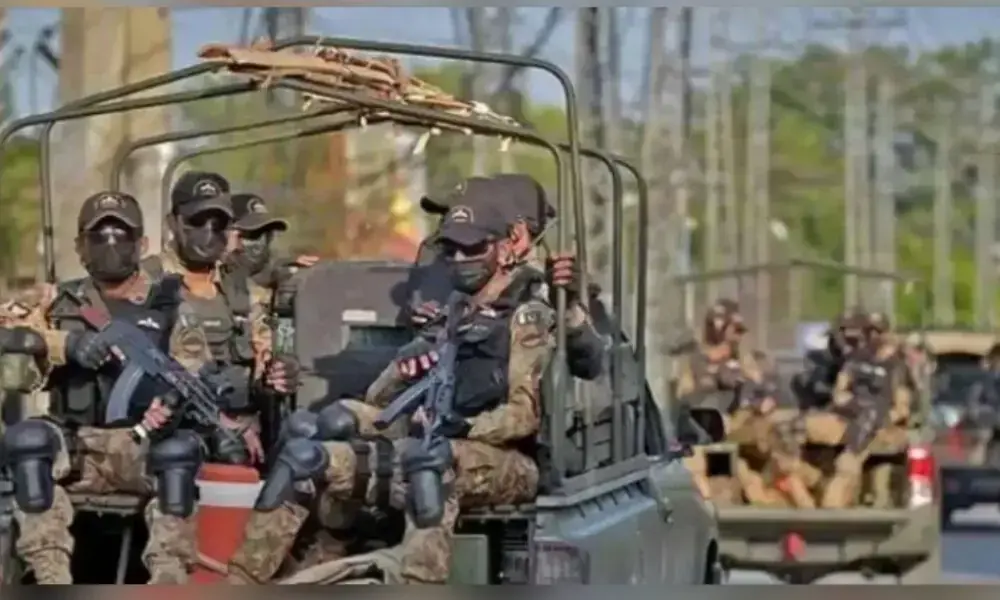
EDITORIAL: The decision by the federal government and the Khyber Pakhtunkhwa (KP) administration to finally agree on a joint strategy to combat terrorism is a long-overdue and necessary step. For months, public disagreements and political point-scoring between Islamabad and Peshawar projected the image of a divided house at a time when unity was most urgently required. The consensus reached on Wednesday at a high-level meeting chaired by Minister of State for Interior Talal Chaudhry, therefore, comes as a very welcome development.
The security environment in KP and Balochistan has deteriorated markedly in recent months, with attacks carried out by groups the state rightly describes as Fitna Al-Khawarij (Tehreek-e-Taliban Pakistan – TTP) and Fitna Al-Hindustan (India-backed Baloch insurgent outfits). Whatever terminology is employed, however, the underlying reality is stark: militant or terrorist networks have regrouped, adapted and expanded their operational footprint. The surge in violence across KP and Balochistan, coupled with the February 6 suicide bombing at an Imambargah on the outskirts of Islamabad that claimed 31 lives and injured 169 others, underscores the gravity of the threat. The attack, claimed by the Islamic State-Khorasan (IS-K), highlights the increasingly complex and evolving nature of militancy. Investigations have revealed troubling details. Subsequently killed in a police raid, the suicide bomber’s main handler — the IS-K leader in Bajaur with a Rs12 million bounty on his head — reportedly was linked to a series of assassinations and bombings before relocating his network across various urban centres, including Gujranwala and Lahore, the major cities of Punjab province. This pattern of movement points to newly emerging security problems: militant groups are no longer confined to remote or formerly tribal districts. They have demonstrated the capability to embed themselves in densely populated urban areas, exploiting anonymity, technological tools and innovative financing methods to evade detection.
Beyond the domestic dimension lies a major regional factor. Islamabad has repeatedly urged the Taliban authorities in Kabul to take verifiable steps to prevent Afghan soil from being used for attacks against Pakistan. But the Taliban deny responsibility, characterising the violence as Pakistan’s internal issue. The latest UN sanctions monitoring report — echoing previous assessments — lends support to Pakistan’s longstanding concerns about the presence of TTP and IS-K terrorists in Afghanistan. Russia and China, too, have expressed unease over the activities of militant groups operating from Afghan territory. This convergence of concerns among regional stakeholders should help create space for more structured diplomatic engagement and enhanced intelligence cooperation.
What distinguishes IS-K from other violent extremist entities, according to security assessments, is not only its brutality but also its operational sophistication. The group reportedly uses crypto currency for financial transactions and encrypted communication platforms for planning and coordination. Its network extends beyond Afghanistan and Pakistan into Central Asia and parts of the Middle East. Such transnational connectivity enhances its resilience and capacity to carry out high-casualty attacks. Given its organisational and technical capability, and ideological rigidity, it is unsurprising that many security experts increasingly regard IS-K as a much bigger threat than the TTP. In this context, the agreement between the Centre and provinces to pool resources, improve intelligence-sharing and extend technical support assumes special significance.
Contemporary counterterrorism demands far more than kinetic operations. It requires financial tracking expertise, cyber-surveillance capabilities, effective border management and sustained community-level de-radicalisation initiatives. Above all, it requires political cohesion and continuity.
Copyright Business Recorder, 2026




















Comments
Comments are closed for this article.