


Gold jewellery export value-addition: NA panel asks MoC to talk to SBP to resolve issue
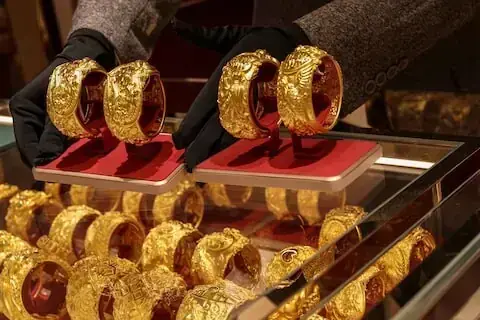

ISLAMABAD: The National Assembly Standing Committee on Commerce has directed the Ministry of Commerce to immediately resolve the issue of irrational value-addition norms for gold jewellery exports in consultation with the State Bank of Pakistan (SBP).
A key representative of the gold industry, Arif Patail, informed the committee that SRO 760(I)/2013 serves as the legal framework governing Pakistan’s gold jewellery export sector.
However, he argued that several provisions — particularly Clause 10 — are counterproductive as they prescribe unrealistic value-addition norms linked to international gold prices.
READ MORE: ‘Irrational’ value addition: Gold industry urges NA panel to step in for revision
Under SRO 760, value-addition requirements are fixed at: (i) 8 percent of the prevailing international gold price for plain bangles and chains; (ii) 12 percent for other plain jewelry; and (iii) 13 percent for studded or embedded jewellery.
Jewelry, according to industry sources, is globally sold on the basis of making charges per gram rather than as a percentage of gold prices, making Pakistan’s approach irrational and unjust.
When SRO 760 was issued in 2013, the international gold price was around USD 1,380 per ounce (USD 44 per gram).
Currently, gold prices have surged to over USD 4,100 per ounce (USD 132 per gram) — an increase of nearly 300 percent — while value-addition norms remain unchanged.
At current prices, a 13 percent value-addition requirement translates into making charges of about USD 17 per gram, whereas exporters can fetch only USD 4–5 per gram in international markets. This forces exporters to remit an additional USD 13 per gram, rendering the business commercially unviable.
“Due to the unfriendly provisions of the SRO, jewelry exports are hovering around USD 30–40 million, which is negligible compared to India’s exports.
The already dismal export performance will further deteriorate as exporters are unable to sustain such high value-addition requirements,” Patail said, urging immediate remedial measures to make the sector sustainable and growth-oriented.
The Standing Committee took serious notice of the unresolved issues facing the gold industry, which are adversely affecting exports.
Industry representatives further argued that these prescribed percentages do not accurately reflect international market realities for high-karat jewelry and are inconsistent with customs valuation principles of the World Trade Organization (WTO). They maintain that value addition should reflect actual transformation costs plus normal profit margins, rather than arbitrary percentages.
During the meeting, a Joint Director of the SBP attempted to shift responsibility for the issue on to the Ministry of Commerce. However, he was strongly reprimanded by the Chairman of the Standing Committee, who ordered his Zoom connection to be switched off.
The committee directed that the Deputy Governor of the SBP must attend the next meeting on the issue and stated that junior officials not well conversant with the matter may not be permitted to represent the central bank.
The industry contended that the existing framework makes compliance practically impossible for legitimate exporters and exceeds the statutory authority of the Ministry of Commerce (MoC). It pointed out that Schedule IV of the Export Policy Order (EPO) prescribes minimum export prices only for surgical instruments; therefore, fixing value-addition norms for jewelry is ultra vires and beyond the MoC’s mandate.
Moreover, no country — except Pakistan and India — imposes minimum export price or similar restrictions on gold jewelry exports. Comparing regional practices, the industry noted that India’s value-addition norms stand at 3 percent for plain jewellery and 6 percent for studded or embedded jewelry, whereas Pakistan’s corresponding rates are 6 percent, 8 percent, and 13 percent.
As a result, Pakistan’s rates are significantly higher, severely undermining the competitiveness of Pakistani exporters in the international market.
The industry urged the Ministry of Commerce to regulate exports without imposing conditions that render lawful business unviable. It emphasized that value-addition requirements must be evidence-based and consistent with Pakistan’s commitments under the WTO and the Trade Facilitation Agreement, noting that arbitrary benchmarks violate principles of proportionality and reasonableness under Pakistani administrative law.
Additionally, the industry raised multiple legal and policy concerns, including: (i) violation of provisions related to minimum export prices under the Export Policy Order; (ii) breach of WTO principles of non-discrimination, transparency, and trade facilitation; (iii) infringement of constitutional rights under Articles 18 (freedom of trade), 25 (equality before law), and 4 (right to be dealt with in accordance with law); (iv) excessive use of delegated legislation beyond statutory mandate; and (v) encouragement of informal financial activity, contrary to FATF/AML compliance objectives.
Copyright Business Recorder, 2026




















Comments
Comments are closed for this article.