


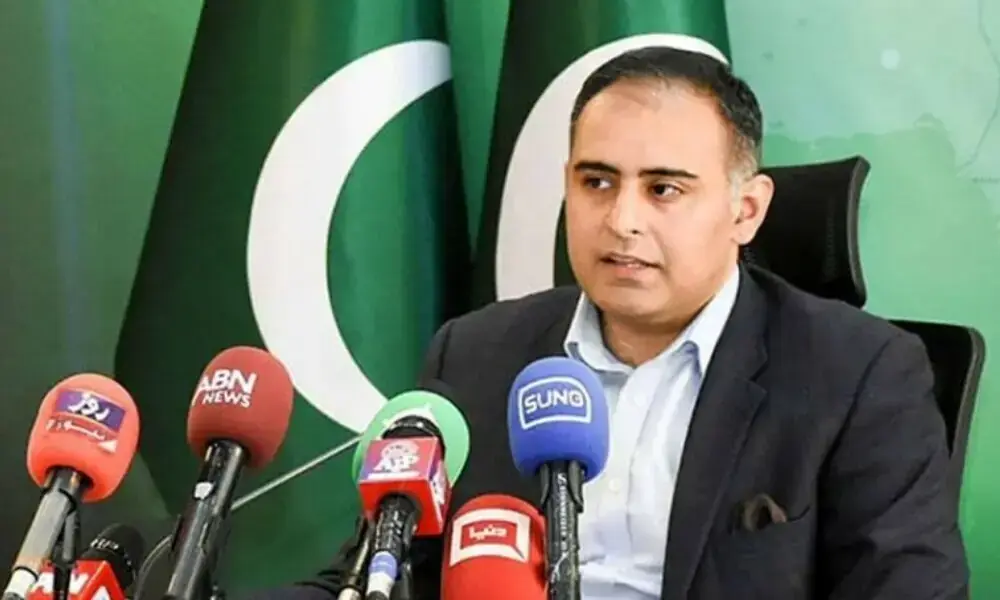

ISLAMABAD: Minister of State for Finance Bilal Azhar Kayani has said that import tariffs have been rationalised under the five-year plan to remove distortions on the imports of inputs, raw materials, and intermediate goods.
He was addressing to a high-level policy dialogue that brought together leading policymakers, economists and business leaders to deliberate on Pakistan’s economic direction ahead of the forthcoming national budget, organised by the American Business Forum (ABF) in collaboration with LUMS.
Kayani defended the government’s reform trajectory, pointing to the National Tariff Policy as a major structural initiative. He said tariffs are being rationalised over a five-year horizon to reduce distortions, particularly on raw materials and intermediate goods, while strengthening the National Tariff Commission.
READ MORE: Pakistan’s trade deficit rises 28% to $22bn in July-January
He also underscored ongoing privatisation efforts and digital monitoring measures aimed at broadening the tax base and improving compliance in key sectors. Kayani said the government is committed to reducing its footprint in economy and creating an enabling environment for private investment, particularly in export-oriented and technology-driven sectors.
He acknowledged the need for greater coherence in long-term economic planning and stressed that sustained dialogue with business and academia remains central to policy formulation.
In his keynote address, Dr Stefan Dercon, development economist and Professor of Economic Policy at the University of Oxford, acknowledged recent macroeconomic stabilisation, noting that inflation has declined and foreign exchange reserves have improved compared to the crisis period of early 2023. However, he cautioned that stabilisation alone is insufficient without structural reform.
He warned that under the current economic structure, growth beyond four per cent risks triggering external imbalances and renewed reliance on International Monetary Fund (IMF) programmes. He stressed that improving the trade balance, ensuring greater policy certainty and consistency, and simplifying regulatory processes would be essential to sustain higher growth.
Dr Dercon highlighted persistently low exports, around 10 per cent of GDP, and weak investment levels, with public investment at roughly four per cent of GDP and private investment below 10 per cent.
Productivity growth over the past three decades, he said, has lagged behind regional peers. He argued that successful low-income economies since the 1990s achieved rapid growth by engaging more deeply with global markets, reducing regulatory burdens, strengthening property rights, and aligning industrial policy with export competitiveness.
The session concluded with a consensus that while macroeconomic stability provides breathing space, durable growth will require difficult but necessary structural reforms, including trade liberalisation, improved regulatory quality, export competitiveness, institutional strengthening, and greater policy continuity to avoid repeating past cycles of boom and external crisis.
Copyright Business Recorder, 2026




















Comments
Comments are closed for this article.