


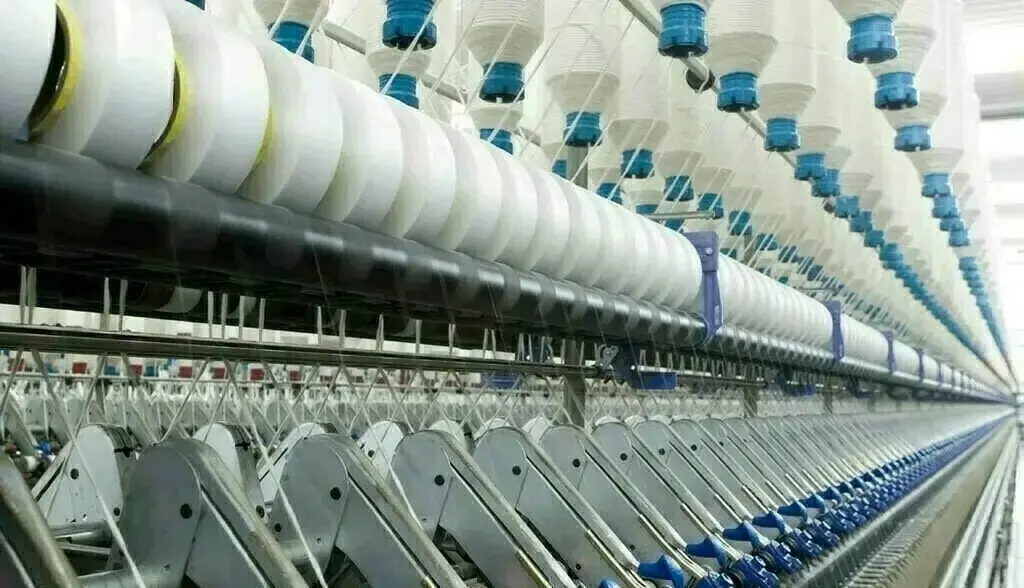

KARACHI: Quality cotton prices have shown an overall trend toward stability. However, business activities remained limited.
Pakistan Textile Council Chairman Fawad Anwar has stated that if an export agreement is finalized between India and the European Union, Pakistan’s exports will be extremely negatively affected.
Prime Minister Shehbaz Sharif has announced major concessions for exporters. On the other hand, due to an increase in sugarcane cultivation, there are concerns about a reduction in cotton cultivation area in the year 2026.
Ginners Forum Chairman Ehsan-ul-Haq has said that the provision of duty-free market access to India by the European Union will severely impact Pakistan’s cotton and textile exports.
The honourable Sindh High Court has granted permission to tenants and 320 registered cotton brokers to access the Karachi Cotton Exchange building. However, representatives of the Evacuee Properties Trust Board have refused to allow them to sit in the offices and have only permitted them to collect essential items. This matter concerns the cotton brokers and tenants of the Karachi Cotton Association.
For the past two months, the highly important daily cotton spot rate has not been issued.
During the past week, quality cotton prices showed an improvement trend in the local cotton market. Trading volume remained limited. Textile mills are acquiring quality cotton because the availability of quality cotton is decreasing day by day as the arrival of raw cotton is very limited.
The season is also nearly over. On the other hand, negotiations are ongoing between the government and APTMA to provide relief to the textile sector. Due to the export agreement between India and the European Union, Pakistan’s exports will be significantly affected. APTMA has demanded that the government address the textile sector’s issues immediately, warning that if these problems are not resolved promptly, the country’s textile sector, which is already in a deteriorating condition, will worsen further. Without immediate attention, the textile sector could face complete destruction.
The patron-in-chief of the textile sector, Gohar Ejaz, has appealed to the Prime Minister and Finance Minister, noting that last year exports to the European Union worth nine billion dollars benefited from zero tariff facility. Options to reduce energy costs are now under consideration. The Finance Minister has given good news to the APTMA delegation.
In a meeting between Federal Finance Minister Muhammad Aurangzeb and a delegation from the All Pakistan Textile Mills Association, the APTMA delegation briefed the Finance Minister about the challenges facing the export sector.
The textile industry is facing difficulties due to rising business costs. Energy expenses, taxes and regulatory costs are affecting competitiveness. There is a need for continuity and stability in policy. Finance Minister Aurangzeb stated during discussions with APTMA leaders that the textile industry serves as the backbone of national exports and employment. The government will support the textile sector within the framework of economic reforms. A favourable and fair environment for business is the government’s priority.
Major announcements have been made for industries and exporters. Electricity rates have been reduced by 4.04 rupees, wheeling charges have been decreased by 9 rupees, the export refinancing rate has been set at 4.5 percent, and the blue passport facility has been extended for two years.
Furthermore, the dispute between ETPB, KMC and KCE regarding the sale of the Cotton Exchange Building continues in court. It has been learned that Reliance Spinning and KCA have filed cases in the honourable court. According to sources, the court has granted KCA staff and cotton brokers’ access to the building in both cases. Meanwhile, a petition hearing for another case is scheduled for February 4th, while the petition filed on January 29th will be heard on February 12th.
The KCE building has been sealed by ETPB with the assistance of FIA since December 12th, which has prevented the highly important daily cotton spot rate from being issued for the past two months.
In the provinces of Sindh and Punjab, cotton prices per maund are ranging from 15,200 to 16,200 rupees depending on quality and payment conditions. The prices of cotton seed, cake and oil have remained relatively stable.
Naseem Usman, Chairman of the Karachi Cotton Brokers Forum, has reported that international cotton prices are experiencing fluctuations. The New York cotton futures price is currently trading between 63 and 68 US cents per pound.
According to the USDA’s weekly export and sales report, sales totalling 203,700 bales were recorded for the year 2025-26.
Pakistan led the purchases with 52,000 bales. Vietnam ranked second with 45,600 bales. China came third with 38,800 bales.
For the year 2026-27, sales of 15,000 bales were recorded. Nicaragua topped the list with 6,600 bales. El Salvador came second with 5,800 bales. Guatemala ranked third with 5,600 bales.
Meanwhile, a twenty-five percent increase in sugarcane prices (500 rupees per 40 kilograms) and attractive incentives from sugar mills are drawing farmers away from cotton for the 2026 season. This shift, combined with weak enforcement of crop zoning laws, could reduce national cotton production to as low as 5.6 million bales, representing approximately a 45 percent shortfall from the federal target of 10.18 million.
Beyond reduced cultivation, moisture generated by the water-intensive sugarcane crop is degrading cotton quality and intensifying pest infestation pressure, rendering local cotton less suitable for premium exports. While Pakistan’s production stagnates, India has raised its target for 2025-26 to 31.7 million bales. With domestic supply falling to less than half of the textile industry’s consumption of 10.6 million bales, reliance on expensive imported fibre is creating a severe liquidity crisis for mills.
Furthermore, following the European Union’s announcement of duty-free market access for Indian exports, Pakistan’s ginning industry faces a growing crisis that threatens to accelerate the decline in Pakistan’s cotton and textile exports.
Shedding light on the broader crisis, Cotton Ginners Forum Chairman Ehsan-ul-Haq stated that Pakistan’s textile sector is experiencing its worst economic period due to exorbitant electricity and gas tariffs, expensive credit, delays in refunds worth billions, a 2 percent advance tax on exports, and the imposition of super tax.
The increasing practice of tax authorities seizing account books and directly withdrawing funds from ginners’ bank accounts has sent waves of concern through the industry.
Expressing grave concern over this trend, Haq warned that many ginners will be unable to operate in the coming season. He urged the federal government to reduce electricity rates, eliminate monthly fixed charges for peak hours, end unwarranted interference by federal and provincial departments, and restore the ginning sector.
He noted that limited availability of quality cotton was a significant factor in declining textile exports, adding that the lack of enforcement of crop zoning laws has caused environmental damage through sugarcane cultivation in the cotton belt.
Pakistan currently exports approximately 9 billion dollars annually to the European Union, compared to India’s 140 billion dollars.
Haq expressed concern that this gap is likely to widen further following the European Union’s decision. He urged the government to immediately address the issues facing the ginning and textile sectors. He also pressed the government to revise import policies regarding the billions of dollars spent annually on imported cotton yarn and fabric, which would help stabilize foreign exchange reserves and protect Pakistan’s exports.
The cotton ginning industry, which supplies raw materials to the textile sector, currently bears an effective sales tax burden of 86 percent, including 18 percent on seed cotton, cottonseed, cottonseed oil, and oil waste, and 14 percent on oil cake. Due to non-enforcement of crop zoning laws and increased sugarcane cultivation, the number of active ginning factories has declined from 1,200 to approximately 500 in recent years, with fears of further closures next year.
Sohail Mahmood Hural, a ginner from Punjab, explains that through the Mother of All Agreements, India has equalized European Union tariffs on its products to match those on Pakistani products under GSP Plus status.
He stated that the critical issue now is the difference in the cost of doing business between the two South Asian states. The Indian industry does not rely solely on domestic cotton. New Delhi provides subsidized cheap electricity to the industry and offers exemptions to exporters, while interest rates on loans in India are also 3 to 4 percent lower than in Pakistan. Where half of the textile industry’s requirements are the highest, the textile industry’s greatest needs are met through imports from around the world. The question of exemptions does not even arise. These disparities will certainly impact Pakistan’s cotton industry.
Moreover, Prime Minister Muhammad Shehbaz Sharif, while announcing major concessions including reducing the export refinancing rate for exporters from 7.5 percent to 4.5 percent, a further reduction of four rupees and four paisa in electricity tariffs, a reduction of 9 rupees in wheeling charges, and blue passports for two years for major exporters demonstrating outstanding performance, stated that the unwavering hard work of exporters has brought billions of dollars into the country. The economy is moving from stability toward sustainable development. After demonstrating our rightful position, we have established our presence in the world. Those who previously would not even greet us now embrace us. Political and military leadership are working together for the country’s development and prosperity. We have the capability to transform the country’s economy within a few years. To succeed in the difficult journey of economic success, we will have to work day and night, shedding blood and sweat. Prime Minister Shehbaz Sharif, while praising Field Marshal Asim Munir’s efforts for the country’s economic recovery, described the partnership between the government and army as excellent for the country. He said that if the partnership between the government and army continues in this manner, Pakistan will emerge as a strong nation on the world map. He wanted to make electricity cheaper by 10 rupees but his hands are tied. He will discuss the elimination of advance tax with the IMF. He also advised the State Bank Governor to make tough decisions. He expressed these thoughts while addressing a ceremony held in honour of prominent exporters and business personalities of the country on Friday. Deputy Prime Minister and Foreign Minister Muhammad Ishaq Dar, Finance Minister Muhammad Aurangzeb, Federal Ministers Khawaja Muhammad Asif, Ataullah Tarar, Jam Kamal, Ahsan Iqbal, Rana Tanveer Hussain, Shaza Fatima Khawaja, Musaddiq Malik, Abdul Aleem Khan, Hanif Abbasi, along with other federal ministers, special assistants, advisers, and prominent exporters and business personalities were also present at the ceremony. The Prime Minister presented awards to prominent exporters and business personalities based on their performance in 2024 and 2025. While addressing the ceremony, the Prime Minister said he welcomes the distinguished business personalities from across Pakistan who have brightened the country’s name through day and night hard work and significantly increased the country’s exports. The Prime Minister said that exporters did excellent work in difficult circumstances, and the entire nation congratulates them. The unwavering hard work of exporters has brought billions of dollars into the country. The Prime Minister reminded participants that in the recent past, there was talk of Pakistan going bankrupt.
Copyright Business Recorder, 2026















Comments
Comments are closed for this article.