


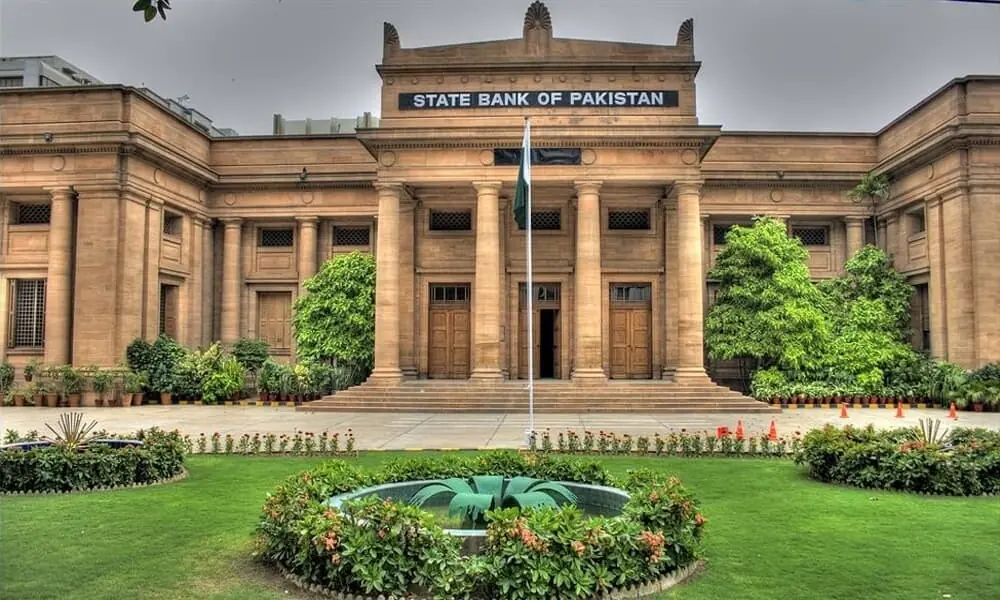

KARACHI: As against the market expectations, the Monetary Policy Committee (MPC) of the State Bank of Pakistan (SBP) has decided to keep the policy rate unchanged at 10.50 percent in its meeting held on Monday, citing an improving growth outlook, stable inflation trajectory, and strengthening external sector indicators.
However, the MPC also emphasised the need for coordinated and prudent monetary and fiscal policy mix, as well as, productivity-enhancing structural reforms, to increase exports and achieve high growth on a sustainable basis.
At its previous meeting, the committee surprised the market with a 50-bps cut, bringing the policy rate down to 10.5 percent; this time, it opted to hold the rate steady.
SBP Governor Jameel Ahmad announced the decision at a press conference held after the meeting at the SBP head office.
READ MORE: MPC meeting today
The MPC noted that the outlooks for inflation and the current account are broadly unchanged from its previous assessment, while the outlook for economic growth has improved significantly.
Based on this, the Committee deemed it prudent to hold the policy rate unchanged at the current level to ensure price stability and support sustainable economic growth.
According to a policy statement issued by SBP, the Committee projects inflation to stabilise within the target range of 5-7 percent in FY26 and FY27, after temporarily exceeding the upper bound for a few months during this calendar year.
However, this outlook is subject to risks emanating from volatility in global commodity and domestic wheat prices, unanticipated adjustments in administrative energy prices, and a sharper than assumed pickup in domestic demand.
The Committee also noted that the trade deficit has widened in the wake of a substantial increase in imports, particularly import volumes, and a decline in exports. Nonetheless, based on the resilient workers’ remittances and benign global commodity prices, the current account deficit remained relatively contained.
Meanwhile, as reflected by the recent high frequency indicators (HFIs), including large-scale manufacturing (LSM), economic activity continues to gain momentum faster than anticipated, mainly led by domestic-oriented sectors.
In view of these developments, the MPC assessed the real policy rate to be adequately positive to stabilize inflation within the target range of 5-7 percent over the medium term.
The external current account registered a deficit of USD244 million in December 2025, leading to a cumulative deficit of USD1.2 billion during H1-FY26 mainly led by a widening in the trade deficit due to a substantial growth in imports and a decline in exports.
The weak export outturns were driven by a sharp drop in food exports, particularly of rice, while HVA textile exports remained resilient.
FBR tax revenues grew by 9.5 percent in H1-FY26 as compared to 26 percent in the same period last year. This growth was lower than the target, resulting in a shortfall of Rs329 billion. This indicates that a significant acceleration in growth would be required in H2-FY26 to achieve the FBR revenue target.
Nonetheless, estimates from the financing side suggest an improvement in the fiscal balance during H1-FY26, indicating relatively contained expenditures.
In particular, interest payments remained significantly lower than the same period last year, which is likely to help achieve the full-year fiscal deficit target. However, achieving the annual primary surplus target seems challenging.
In this backdrop, the MPC acknowledged the supportive role of fiscal consolidation in achieving recent macroeconomic stability. At the same time, the Committee emphasized that, for the economy to grow on a sustainable basis, recent fiscal discipline should be entrenched through durable progress on structural reforms, especially to broaden the tax base and to privatize loss-making SOEs.
Headline inflation (y/y) eased to 5.6 percent in December from 6.1 percent in November amidst a moderation in food prices, notwithstanding the sharp uptick in wheat and allied product prices.
Meanwhile, energy inflation increased, mainly due to fading of favourable base effect in electricity tariffs. At the same time, the Committee noted that after declining steadily during FY25, core inflation has persisted at around 7.4 percent in the first half of FY26.
However, inflation expectations of both consumers and businesses continue to ease. On balance, the Committee projects inflation to remain within the target range of 5-7 percent in FY26.
Copyright Business Recorder, 2026




















Comments
Comments are closed for this article.