


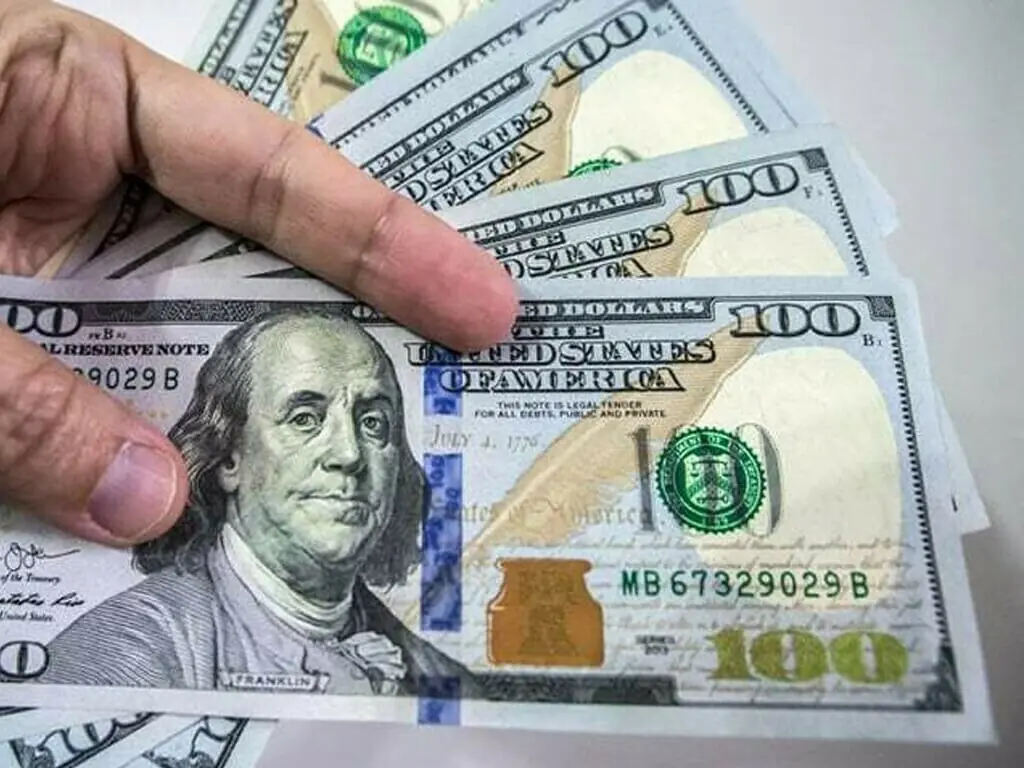

NEW YORK: The US dollar was lower on Thursday as the “sell America” trade faded after President Donald Trump dropped tariff threats and ruled out seizing Greenland by force, and was little changed by US inflation data that was in line with market expectations.
New Personal Consumption Expenditures inflation data - the Federal Reserve’s preferred inflation gauge - were unveiled, showing that US consumer spending increased solidly in October and November, likely keeping the economy on track for a third straight quarter of strong growth.
Consumer spending, which accounts for more than two-thirds of economic activity, rose 0.5 percent after rising by the same margin in October, the Commerce Department’s Bureau of Economic Analysis said on Thursday. Economists polled by Reuters had forecast consumer spending increasing 0.5 percent in November.
The greenback recovered versus the euro on Wednesday on Trump’s remarks about Greenland, after losing a bit less than 1 percent between Monday and Tuesday. It was last down 0.35 percent to USD1.1726 per euro, following a 0.35 percent rebound in the prior session. The dollar weakened 0.52 percent to 0.7913 Swiss francs.
The Australian dollar rose to a 15-month high, buoyed by data showing an unexpected decline in the jobless rate. The yen remained under pressure after Japanese Prime Minister Sanae Takaichi this week called a snap election and pledged measures to loosen fiscal policy.
Trump’s threat to levy tariffs on allied nations resisting his ambition to control Greenland had spooked markets, triggering a broad selloff of US assets. Still, some analysts said there was little evidence of a real move out of the US dollar.
“This whole argument about European investors selling US assets is very hard to sustain,” said Bob Savage, head market strategist at BNY.
“This isn’t a ‘sell America’ story, it’s a risk-management story,” he added. “We’re just seeing more hedging because volatility has risen after being at very low levels at the end of last year.”
Details of a framework for an agreement on Greenland were not yet known. However, “the most likely outcome is still that the next wave of excitement will pass us by after a brief period of volatility and that the market will refocus on central banks and interest rate differentials,” Savage said.
The Aussie was last up 0.83 percent to USD0.6818, touching its strongest level since October 2024, and headed for a fourth straight daily gain, outperforming even as risk assets came under pressure this week.
“The strength of both the Australian and the New Zealand dollar is the latest example that speculation about moves in short-term interest rates in relation to central bank policy remains alive and well,” said Jane Foley, senior forex strategist at Rabobank.
The Japanese currency weakened 0.07 percent at 158.415 per US dollar, near last week’s 18-month trough of 159.45.
Markets.Energy
Oil prices slide
REUTERS
NEW YORK: Oil prices slid about 2 percent on Thursday after US President Donald Trump softened threats against Greenland and Iran, and as investors assessed the supply-demand outlook.
Brent futures fell USD1.01, or 1.6percent, to USD64.23 a barrel at 11:26 a.m. EDT (1626 GMT). US West Texas Intermediate (WTI) crude fell 96 cents, or 1.6percent, to USD59.66 a barrel, headed for its lowest close since January 15.
Trump said he had secured total and permanent US access to Greenland in a deal with NATO, whose head said allies would have to step up their commitment to Arctic security to ward off threats from Russia and China.
Trump also backed off tariff threats and ruled out taking Greenland by force, moderating a stance that had caused a rupture in transatlantic ties. “There is a deflation of risk premium related to the Greenland debacle and Iran supply risk has also been reduced,” said Ole Hansen, chief commodity analyst at Saxo Bank.
Trump said he hoped there would be no further US military action in Iran, but added the US would act if Tehran resumed its nuclear programme.
Iran, operating under sanctions, is the third biggest crude producer in the Organization of the Petroleum Exporting Countries (OPEC) organization behind Saudi Arabia and Iraq. With less tension around Greenland and Iran, oil prices should hold at around USD60 a barrel, said Tony Sycamore, an analyst with online broker IG.
Trump called for an end to the war in Ukraine, and reported “good” talks with Ukrainian President Volodymyr Zelenskiy in Davos. US and Ukrainian officials have spent weeks in shuttle diplomacy. Trump has pressured Kyiv to secure peace after nearly four years of war, despite few signs Moscow wants to stop fighting. A deal to bring peace to Ukraine and lift sanctions on Russia, the world’s third-biggest crude producer, could reduce oil prices by making more fuel available on global markets.
The French navy intercepted a Russian tanker in the Mediterranean suspected of being part of a shadow fleet that enables Russia to export oil despite sanctions.
Russian oil output fell 0.8percent to 10.28 million barrels per day (bpd) last year, around a tenth of global production, according to data published on Thursday.


























Comments