


DAVOS 26: Pakistan economy stabilised, set for export-led growth: PM
- The prime minister said key macroeconomic indicators are showing a clear positive trend
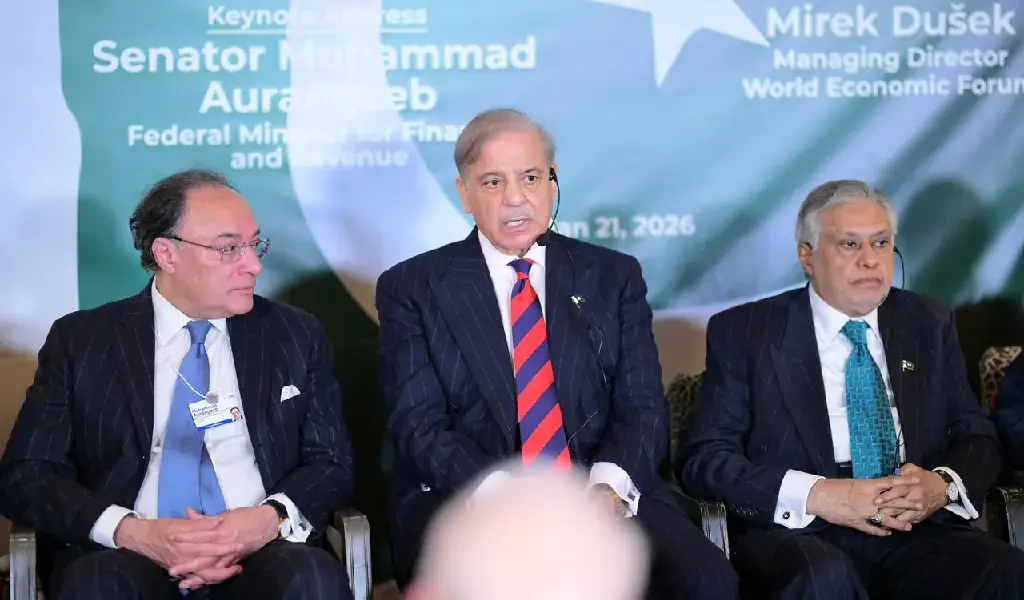

Prime Minister Shehbaz Sharif on Wednesday said Pakistan’s economy has stabilised after tough reforms and is now firmly positioned for export-led growth, citing sharp improvements in inflation, interest rates, and revenue collection.
Addressing an event at the Pakistan Pavilion on the sidelines of the World Economic Forum’s 56th annual meeting in Davos, the prime minister said key macroeconomic indicators were showing a clear positive trend, reflecting disciplined economic management.
“Our inflation has come down sharply from 30 percent to 5.5 percent, while the policy rate has been reduced from 22.5 percent to 10.5 percent,” he said, calling the progress a result of difficult but necessary reforms.
READ MORE: Trump says US will not use force to acquire Greenland
Shehbaz said Pakistan had achieved macroeconomic stability and was now focused on sustainable growth driven by exports. He noted that IT exports had shown encouraging momentum and currently stood at around $3 billion annually through offshore channels.
While acknowledging challenges in the export sector, the prime minister said the direction was clear.
“Pakistan has to pursue export-led growth,” he said, highlighting reforms in revenue collection as a central pillar of the government’s strategy.
He said the tax system was being fully digitised, leading to an increase in the tax-to-GDP ratio to 10.5 percent from 9 percent a few years ago, terming it a significant milestone.
READ MORE: Finance minister, Visa president discuss innovation in payments sector
Highlighting sectoral opportunities, Shehbaz said agricultural exports had performed well over the past year, while Pakistan was entering the mining and minerals sector. He said agreements had been signed with American and Chinese companies to explore untapped resources in Gilgit-Baltistan, Azad Jammu and Kashmir, Khyber Pakhtunkhwa and Balochistan.
The prime minister said Pakistan was also moving rapidly in emerging fields such as information technology, artificial intelligence and crypto, describing the country’s large youth population as both a challenge and a major opportunity.
He said federal and provincial governments were jointly implementing programmes to equip young people with vocational and technical skills, citing the National Vocational and Technical Training Commission (NAVTTC), whose initiatives undergo third-party audits and international certification to help youth secure employment abroad.
On foreign relations, Shehbaz said Pakistan enjoyed strong economic ties with China and was expanding cooperation with the United States in areas including mining, minerals, counterterrorism and technology.
He also highlighted the government’s push for transparent privatisation, including Pakistan International Airlines, and said further privatisation and outsourcing were planned in airports, power distribution companies and transmission infrastructure.
Referring to the IMF programme, the prime minister said Pakistan had implemented strict conditions “in letter and spirit,” adding that the Fund was now citing Pakistan as a success story among developing countries.
On structural reforms, he said the government had taken politically difficult decisions to shut down loss-making state entities, including Utility Stores Corporation, PASSCO and the Pakistan Public Works Department, resulting in savings of billions of rupees despite resistance from vested interests.
“We are at a point where Pakistan is about to take off,” Shehbaz said, stressing that unity, transparency and sustained reforms were essential to achieving long-term economic growth and prosperity.




















Comments
Comments are closed for this article.