


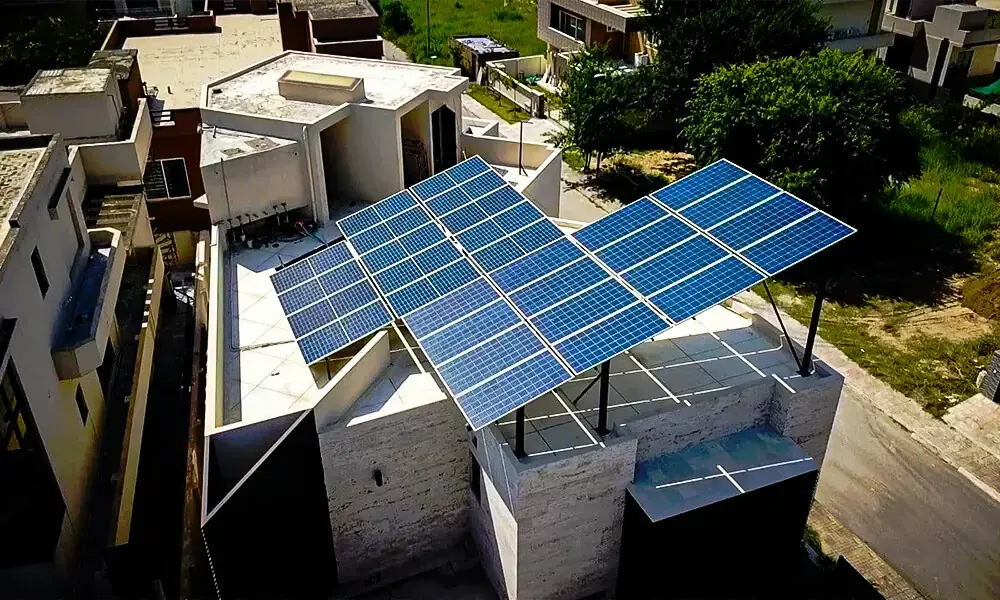

Pakistan’s rooftop solar revolution has delivered cleaner power at record speed, but without urgent policy resets, it risks destabilising the very grid it depends on. The scale and speed of adoption have exposed structural faults in a system designed for one-way power flows from large, centralized generators. While policy responses are now emerging, failure to align incentives with system realities could still trade short-term gains for long-term grid fragmentation and inequity.
The numbers are eye-opening. With over 50 GW of solar panels imported into Pakistan in just five years, the country has witnessed one of the fastest market-driven clean energy transitions in the region. This surge has dramatically reshaped daytime electricity demand while leaving evening peaks largely unchanged, creating the classic “duck curve” that forces utilities to maintain costly standby capacity.
At the same time, a rapid influx of battery energy storage systems (BESS) is emerging alongside rooftop solar installations. Industrial and commercial consumers, in particular, are increasingly deploying BESS to manage load-shedding, avoid peak tariffs, and insulate operations from grid volatility.
While this shift can improve reliability and flatten demand peaks, its system-wide impacts on load forecasting, tariff recovery, grid operations, safety standards, and end-of-life management have yet to be fully assessed or reflected in regulation.
Yet the financing behind this transformation remains largely opaque. The solar-and-storage boom is being driven primarily by households and firms with access to upfront capital, while lower-income consumers remain effectively locked out of the transition. As a result, the benefits of reduced bills, energy autonomy, and resilience accrue disproportionately to better-capitalized users, even as the fixed costs of maintaining the grid are increasingly borne by consumers with no access to distributed generation.
The release of draft revisions to the NEPRA (Prosumer) Regulations, 2025 reflects an emerging regulatory consensus that Pakistan’s rooftop solar expansion is beginning to strain grid operations and cost recovery. The regulations codify a shift from net metering to net billing, replacing retail-rate compensation with credits based on the national average energy purchase price. This change recognizes that exported rooftop electricity has a system value distinct from retail consumption and must be priced accordingly.
That change in demand has material consequences for the financing of the power system. Transmission and distribution networks, capacity charges, and system-balancing services represent largely fixed or lumpy costs; they do not shrink in proportion to the kilowatt-hours an individual household consumes.
When affluent consumers install rooftop PV and export surplus during daylight hours, they reduce their bills but continue to rely on the same wires, substations, and balancing services every evening. The residual cost must therefore be recovered from a shrinking pool of consumers, many of whom cannot afford distributed generation.
The new prosumer regulations partially address this imbalance by delinking export compensation from retail tariffs. However, they stop short of introducing explicit grid-access or capacity charges. As a result, fixed network costs remain socialized across non-solar consumers, leaving unresolved the equity concerns that accompany rapid rooftop adoption.
READ MORE: Pakistan’s solar rush unlocked $17-19bn in private investment in 8 years: study
Recognizing technical constraints, the regulations also empower distribution companies to refuse new connections where distributed generation capacity reaches 80% of a transformer’s rated capacity, and to require load-flow studies for larger installations. These safeguards implicitly validate the concern that unmanaged rooftop growth can overload local networks, reinforcing the need for planning tools that anticipate not react to distributed generation impacts.
The revised framework reflects a broader fiscal reality. Pakistan’s power sector continues to carry legacy liabilities and circular debt, and the federal government has recently relied on substantial financing packages to stabilize sector finances. In this context, policies that further erode distribution company revenues without addressing cost recovery risk deepening fiscal stress and political backlash.
None of this should be read as an argument against rooftop solar. Distributed PV reduces fuel imports, cuts emissions, and improves resilience. The challenge is no longer whether rooftop solar should grow, but how it should be integrated so that private benefits do not undermine collective infrastructure.
To that end, three pragmatic policy directions remain essential.
First, remuneration must be aligned with system value through the continued rollout of net billing combined with time-of-use tariffs. Net billing alone reduces regressive cross-subsidies, but without temporal price signals it cannot address the mismatch between daytime exports and evening demand.
Second, transparent and modest grid-access or capacity charges should be introduced to ensure all connected users contribute fairly to fixed network costs. Such charges should be carefully designed, with exemptions or lifeline thresholds for low-income consumers, to avoid undermining energy access while preventing cost shifting from large exporters to vulnerable households.
Third, incentives must pivot toward storage and demand-side management. Battery prices have fallen sharply, yet the current regulatory framework remains silent on encouraging hybrid solar-plus-storage systems or compensating prosumers for providing grid services. Without these incentives, the duck curve will persist, merely flattened rather than resolved.
The regulations provide procedural clarity through defined timelines and renewable five-year agreements, but the ability to revise export rates during the agreement term introduces uncertainty for investors. Predictable transition pathways rather than discretionary revisions will be critical to channeling investment toward grid-friendly technologies such as storage, smart inverters, and managed electric-vehicle charging.
These reforms are not unprecedented. Mature markets in Europe and North America have moved away from flat retail net metering toward net billing, dynamic tariffs, and grid-usage fees while preserving strong solar uptake. Citizen empowerment was not extinguished; it was redirected into models that are technically sound and economically sustainable.
For distribution companies, the imperative is to engage constructively with regulators and consumers to implement reforms that are evidence-based, transparent, and phased. Sudden reversals or opaque policymaking invite uncertainty and backlash; predictable transitions mobilize investment in storage, smart meters, and grid-edge services that benefit all users.
For consumers, the message remains straightforward: rooftop solar is a public good, but it is also part of a shared system. Individual energy independence should not erode the collective infrastructure that guarantees supply for everyone.
One critical issue still waiting in the wings is the end-of-life management of solar panels. With an average lifespan of 25-30 years, today’s installations will become tomorrow’s waste stream. The absence of any provision for environmentally sound disposal, recycling, or extended producer responsibility in the current regulatory framework risks replacing fuel imports with unmanaged solar waste undermining the sustainability narrative that solar power promises.
Pakistan’s new prosumer regulations mark a necessary evolution from unpriced exports toward system-aware compensation. But regulation alone is not reform. Without complementary measures on storage, grid-access pricing, demand management, and lifecycle responsibility, the country risks solving yesterday’s tariff problem while sowing tomorrow’s technical, fiscal, and environmental challenges.
Copyright Business Recorder, 2026
The writer has served at the Energy Conservation Fund, NEECA. He can be reached at: [email protected]

























Comments
Comments are closed for this article.