


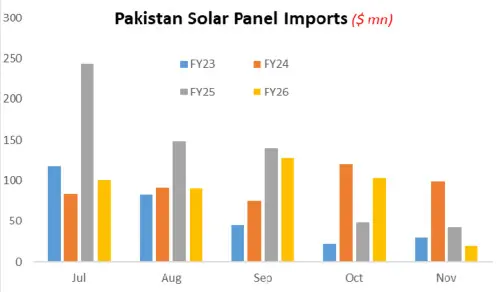
Pakistan’s imports of solar panels have cooled off in the first five months of FY26, coming in at $442 million compared to $622 million last year. The 29 percent year on year drop has set off alarms in some corners of the solar community, prompting claims that the country’s solar boom may already have peaked. That conclusion is premature.
Pakistan Single Window data shows that November 2025 recorded only $20 million worth of panel imports, the lowest monthly tally in years. It was also the first month in FY26 in which imports in wattage terms fell below the 1000 megawatt threshold. November clocked just 200 megawatts. Critics have quickly linked the decline to the government’s push to alter net metering rules in an attempt to lengthen payback periods for rooftop systems.
It is true the power ministry has been lobbying for changes to buyback rates and metering specifications. It is also true that the conversation has added uncertainty to the market. But nothing under discussion makes rooftop solar unviable for any consumer with a reasonable degree of self-consumption. Even under revised assumptions, grid tariffs remain high enough for solar to stay competitive.
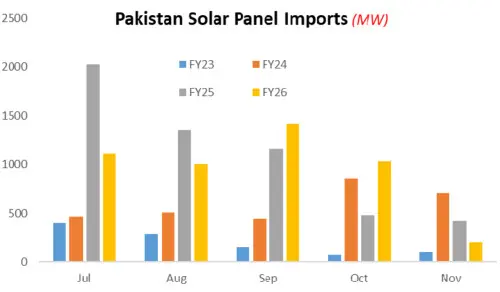
The broader numbers also tell a more grounded story. On a megawatt basis, the year-on-year decline in the first five months is only 12 percent. Imports of 4770 MW are still 60 percent higher than the same period in FY24. Cumulatively, Pakistan has imported close to 50 GW of solar panels to date. Industry estimates suggest nearly a third of that stock has yet to be deployed.
With global module prices stabilizing around 9 cents a watt, the incentive to aggressively build inventory has softened. Many importers are sitting on sizeable stocks and are now pacing their orders. The slowdown reflects the digestion of earlier purchases more than a collapse in demand.
One soft month does not make a trend. November’s figures may well be revised upward, as trade data often is. The underlying economics of solar remain intact. There is still ample capacity waiting to be installed and strong demand drivers across households, businesses, and farms.
Pakistan’s solar momentum will not turn on the back of a single month’s dip in imports. The sun is still shining.


















Comments
Comments are closed for this article.