


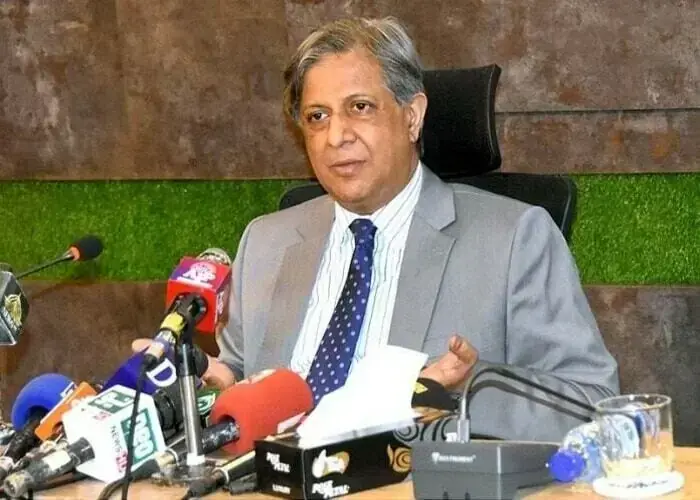

ISLAMABAD: The government is set to amend the Alternative Dispute Resolution (ADR) Act, 2017, making it mandatory for courts to refer cases involving specific subject matters to settlement through Alternative Dispute Resolution (ADR) mechanisms, well-informed sources told Business Recorder.
The draft amendments proposed by the Ministry of Law and Justice have been approved by the Cabinet Committee on Disposal of Legislative Cases (CCLC), chaired by Minister for Law and Justice Azam Nazir Tarar.
The Law and Justice Division informed the CCLC that the ADR Act, 2017, was enacted to ensure inexpensive and expeditious justice.
READ MORE: Private sector credit swells as Advance-to-Deposit Ratio climbs to roughly 38%
The ADR system facilitates the swift settlement of disputes without resorting to formal litigation and provides a comprehensive legal framework for mediation, conciliation, and arbitration, empowering courts to refer disputes to ADR mechanisms.
However, despite providing a sound foundation, the Act’s primary limitation has been the absence of a mandatory requirement for court referrals. As a result, traditional litigation continues to dominate, and the use of ADR remains limited.
The Law and Justice Division further apprised the committee that the National Judicial (Policy-Making) Committee (NJPMC), chaired by the Chief Justice of Pakistan and comprising the Chief Justice of the Federal Shariat Court and the Chief Justices of the High Courts, had addressed this issue.
At its 54th meeting, the NJPMC decided that legislative measures must be taken to introduce mandatory pre-trial mediation. At the 55th meeting, the committee was informed that the Ministry of Law and Justice had prepared a draft of the proposed amendments to the ADR Act, 2017.
The NJPMC appreciated the efforts of the Federal Secretary for Law and Justice and directed the Ministry to take the lead by engaging with the provincial law departments.
In light of the decisions taken at the 54th and 55th meetings of the NJPMC, the Law and Justice Division proposed amendments to make it mandatory for courts to refer cases of specified subject matters to ADR. The objective is to reduce the burden on courts, facilitate speedy and cost-effective dispute resolution, and promote a culture of reconciliation.
In accordance with Rule 27 of the Rules of Business, 1973, the draft amendment bill was submitted to the CCLC for consideration and recommendation to the federal cabinet for approval. The CCLC subsequently considered the summary submitted by the Ministry of Law and Justice regarding the Alternative Dispute Resolution (Amendment) Act, 2026.
Separately, disputes arising from private foreign trade—imports and exports—have historically been resolved in Pakistan through conventional litigation, an approach now considered outdated internationally.
The Trade Dispute Resolution Organisation (TDRO) is functioning under the Trade Dispute Resolution Commission (TDRC), chaired by Umar Dad Afridi, along with its members. The Trade Dispute Resolution Operational Rules and Regulations have already been approved by the Commission and are currently under consideration by the Law Division.
Under Section 7 of the Trade Dispute Resolution Act, 2022, the TDRC has been vested with exclusive jurisdiction over private foreign trade disputes between Pakistani traders and their foreign trading partners, and vice versa.
Consequently, the Commercial Courts of District and Sessions Judges established under Section 5 of the Imports and Exports (Control) Act, 1950, have ceased to exist.
Appeals under the previous regime lay before the High Courts and, in some cases, the Supreme Court under civil procedure law. For the first time in over 75 years, Pakistani exporters will be able to file claims against defaulting foreign trading partners within Pakistan, instead of pursuing litigation abroad.
The establishment of the TDRC is expected to be particularly beneficial for micro, small, and medium exporters by providing accessible, credible, and internationally recognised dispute resolution mechanisms within the country.
Copyright Business Recorder, 2026


























Comments
Comments are closed for this article.