


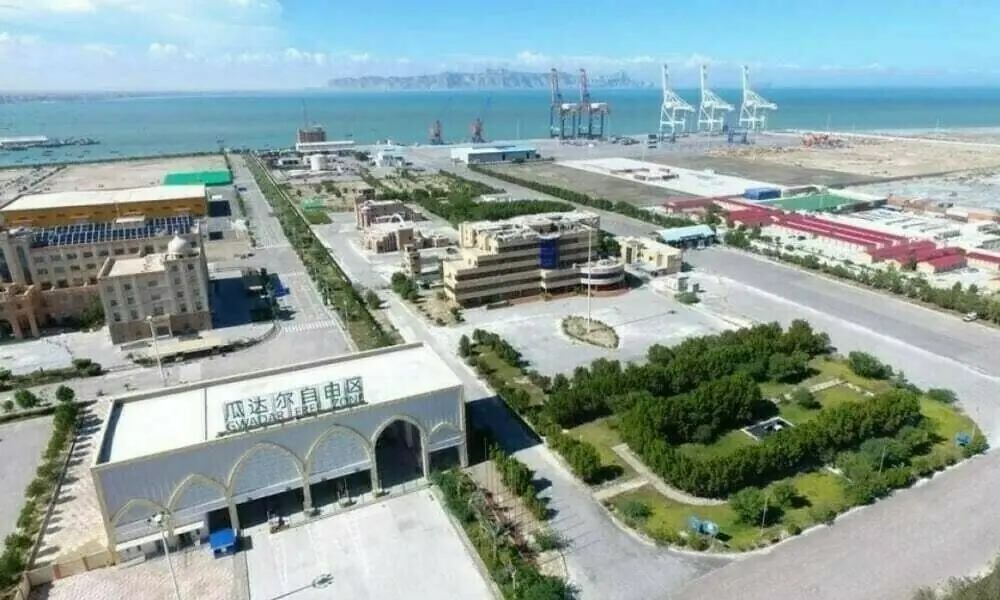

The Pakistani government has recently proposed the establishment of three new deep-sea ports, targeting the expansion of country’s maritime footprint, expecting it to help in enhancing the country’s trade and regional connectivity.
For this purpose, a 12-member committee has also been constituted, under the chairmanship of the Maritime Minister Muhammad Junaid Anwar Chaudhry, tasked with providing a comprehensive feasibility report within three months, including identification of possible new port locations, technical findings, and investment recommendations.
However, expanding our port capacity by including new port sites, although seems attractive on paper, the timing of these highly ambitious plans can raise some serious concerns.
The Gwadar Port was also initially envisioned as a transformational asset for the country’s economy due to its strategic location on the Arabian Sea near the Strait of Hormuz.
The port was projected to provide a strategic gateway to the Central Asian Republics (CARs), and the Middle East nations. Due to its strategic importance, the Gwadar Port was thus one of the flagship components of the China Pakistan Economic Corridor (CPEC).
Nevertheless, despite really ambitious plans and even marketing the port as a transshipment hub, the ground reality presents an unambiguously different story. Currently, all three of the country’s existing ports are operating below capacity; however, where the two major ports are operating at around half of their capacities—Karachi port at about 52 percent and the Port Qasim at approximately 65 percent—the Gwadar Port’s operations are not even close to the halfway mark, operating at about 5-10 percent annually.
According to the latest port performance data, Gwadar Port had only handled around 34,000 tonnes of cargo in 2024, down from 592,000 tonnes in 2023, which was already far below the potential envisioned. Even with regards to vessel traffic, Gwadar Port lags behind its regional counterparts, with only 17 movements recorded in 2023.
Analyzing these numbers exposes a basic economic truth, i.e., just building a sea port will not guarantee its proper utilization. Even with massive strategic dialogues and long-term development goals to expand Gwadar Port’s capacity to hundreds of million tonnes per year, the reality presents otherwise, and the port’s actual utilization still remains negligible.
The underperformance of Gwadar reflects deeper structural issues, including logistical bottlenecks, lack of consistent shipping lines and inadequate hinterland connectivity, all of which are further supplemented by regional competition and our policy shortcomings. Evidence of which lies in the fact that multiple CPEC projects, including utilities, hospitals, water systems and expressways, are still unfinished, adding to the reasons for the port’s limited usability.
Yet, instead of focusing on activating the existing infrastructure to its full capacity, the government is once again entertaining fresh projects, through acting on expansion-first approach. While ignoring the simple fact that Gwadar is already underutilized, despite introducing sizeable investments on different projects, over more than a decade. Nevertheless, at this stage, strengthening operations at the Gwadar Port could yield far more greater returns than investments in new ports.
Addressing the existential gaps to activation of Gwadar port would not only help the country generate more trade — an estimated USD 850 million per year in annual exports through local value-added fisheries and date exports — but would also ease traffic pressure on the Karachi Port and Port Qasim. Working on enhancing Gwadar’s operationalization would not only allow the port to realize its long-promised potential, but will also help the country to learn from previous mistakes, i.e. rather than initiating new maritime projects and spreading the resources thin, completing and activating the existing Port infrastructure, enhancing hinterland connectivity through road and rail, and marketing the port as commercially viable to the international shipping lines, should be the government’s top most priority for now.
Furthermore, the current realities depict country’s container traffic to be hovering around 2.8-3.3 million TEUs, among which the majority is dominated by the Karachi Port, whereas the Gwadar Port’s contribution is almost negligible.
Additionally, in a time of already tightening fiscal constraints and the economic challenges being faced by the country, practical prioritization is highly essential. The government needs to shift from ambitious expansions to realistic implementation. With this backdrop, it makes little economic sense to chase additional ports without first ensuring that the country’s existing deep-sea asset is functioning at a level that justifies its strategic price tag. Thus, activating Gwadar Port should be the first step and not an afterthought, and only when Gwadar can prove to be worthwhile for handling significant commercial traffic should new ports be considered.
For now, the debate should not be about how many ports Pakistan can build, but how effectively the country can make use of the one it already has.
Copyright Business Recorder, 2026
The writer is a Research Economist at the Pakistan Institute of Development Economics (PIDE). She can be reached at: [email protected]


















Comments
Comments are closed for this article.