


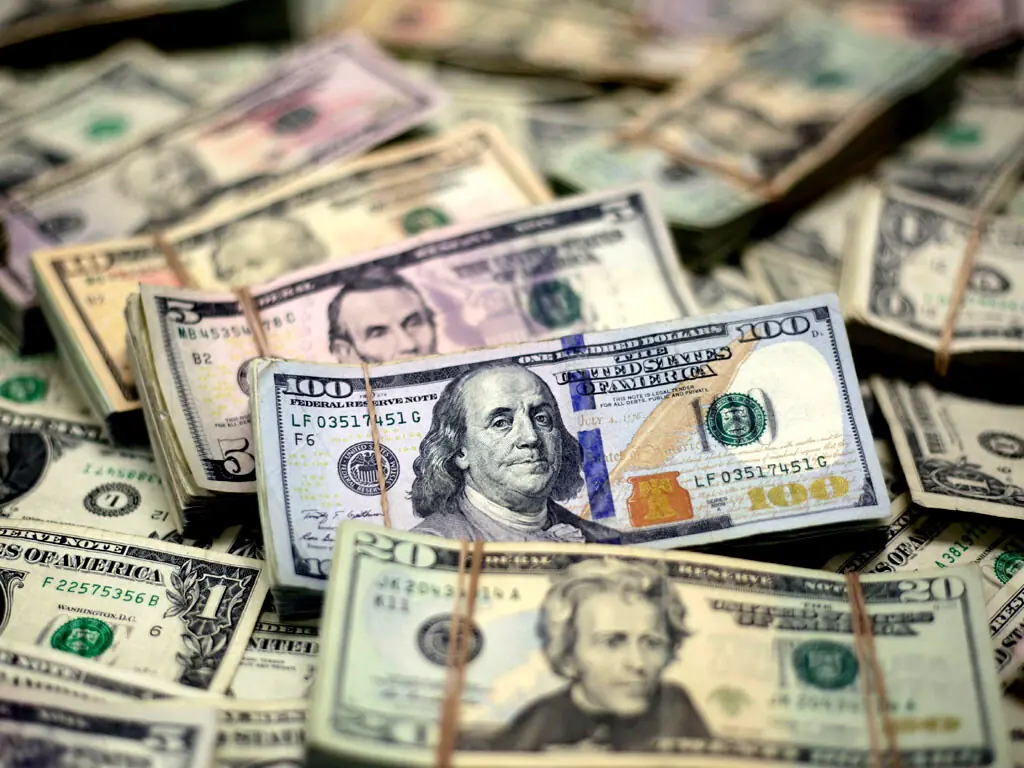

NEW YORK: The US dollar fell on Tuesday in a holiday-shortened week, weighed down by expectations of more rate cuts next year, though it trimmed losses against the yen and euro after data showed strong third-quarter growth in the world’s largest economy.
The report bolstered views that the Federal Reserve will hold off on cutting rates at its January meeting, with the odds currently at 87 percent, according to LSEG estimates. US rate futures now expect the next Fed easing to occur in June, with two rate cuts of 25 basis points each priced in for 2026.
“We could see a lower dollar, at least in the first quarter next year, because the Fed is going to be increasingly forced to admit that the labor market is not in a good place,” said Erik Bregar, director, FX & precious metals risk management at Silver Gold Bull in Toronto.
“You have these inflation hawks on the committee that are keeping US rates on the long end a little bit higher than they should be,” he added.
Tuesday’s data showed that US gross domestic product rose at a 4.3 percent annualized rate in the last quarter, the first estimate from the Commerce Department’s Bureau of Economic Analysis showed. Economists polled by Reuters had forecast GDP would rise at a 3.3 percent pace in the third quarter.
Brian Jacobsen, chief economic strategist at Annex Wealth Management in Brookfield, Wisconsin, however, said the strong GDP number was misleading.
“Health care spending drove the GDP gains, which isn’t necessarily healthy. It is consistent with where employment gains has been, though,” Jacobsen wrote in emailed comments after the data was released.
“Businesses are eating through their inventories that they stocked up on earlier in the year so we should see a topping-off of inventories going into 2026.”
Following the report, the dollar cut its losses against the yen to 156.39 yen, still down 0.4 percent.
The yen earlier gained against the dollar after the strongest indication yet from authorities of Tokyo’s readiness to intervene.
The Japanese unit hovered near recent lows against major peers, with the threat of intervention keeping yen bears at bay for now. But near-term yen weakness is likely to persist, analysts say, as the cautious tone from the Bank of Japan last week hinted at a slow pace of rate hikes next year.
Finance Minister Satsuki Katayama said Japan has a free hand in dealing with excessive moves in the yen.
“I would call it an un-hawkish rate hike last week from the Bank of Japan. It feels like every time we go into a BOJ meeting, the market gets too excited that we’re going to have the start of a rate-hiking cycle but the officials always tamp down those expectations,” said Silver Gold Bull’s Bregar.
“So a lot of the price action is really just people getting out of those bets on the yen going up, after they just keep getting disappointed.”
The euro also slid, paring gains against the dollar to USD1.1786, still up 0.2 percent on the day.
The dollar index, which measures the US currency against six rivals, slipped 0.2 percent to 98.07, extending losses into a second day. The index is at its lowest level since early October and on course for a 1.4 percent decline for the month, its biggest since August, and a 9.6 percent drop for the year, its steepest annual fall since 2017.




















Comments
Comments are closed for this article.