


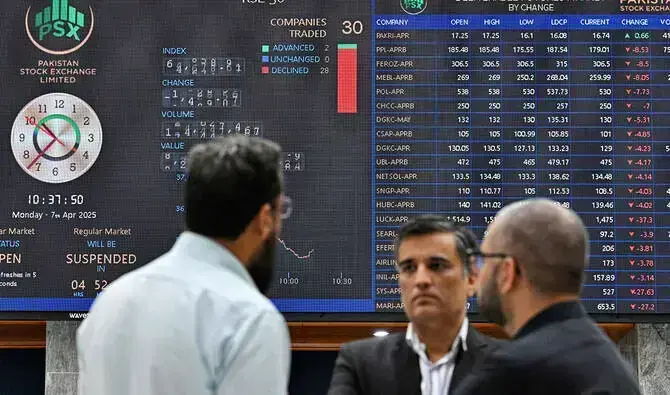

KARACHI: Pakistan’s equity market extended its upward trajectory for another week, with the benchmark KSE-100 Index closing at 171,404 points, up 0.91 percent week-on-week, as a surprise policy rate cut, improving external buffers and sustained strength in banking stocks helped offset softer trading volumes and selective profit-taking.
The index climbed to an all-time intraday high near 171,960 points during the week before retreating modestly in the final session, a move analysts described as healthy consolidation following a sharp rally. Overall, the benchmark gained 1,539 points, taking its calendar-year advance to nearly 49 percent, firmly positioning the PSX among the world’s best-performing equity markets in 2025.
Meanwhile, The BRIndex100 rose from 17,934.60 points at the start of the week to close at 18,185.87 points, with cumulative turnover of 3.57 billion shares and an average daily volume of 713.28 million shares. The BRIndex30 also ended higher, advancing from 58,301.95 to 58,588.02 points, as total traded volume reached 2.04 billion shares, translating into an average daily turnover of 407.21 million shares.
Investor sentiment was decisively reshaped after the State Bank of Pakistan (SBP) unexpectedly cut the policy rate by 50 basis points to 10.5 percent, surprising a market that had largely priced in a pause.
In its policy statement, the SBP pointed to contained inflation dynamics, noting that headline inflation remained within the 5–7 percent target range during July–November FY26, while any near-term uptick from base effects was expected to ease in FY27. The central bank also highlighted that flood-related disruptions this year had been significantly less severe than in past episodes, supporting its growth outlook.
While prices moved higher, market participation showed signs of moderation. Average daily ready-market volumes declined 5–6 percent week-on-week, reflecting a pause in aggressive retail activity after recent record turnover levels.
However, the value of trades edged higher, suggesting that institutional investors continued to deploy capital selectively.
On the macroeconomic front, Pakistan recorded a current account surplus of USD100 million in November, reversing a deficit in October. The turnaround was driven largely by a sharp contraction in imports, including a decline in petroleum inflows.
A more decisive confidence boost came from the reserve position. SBP foreign exchange reserves jumped by US$1.3 billion to nearly USD15.9 billion, following inflows from the IMF under the Extended Fund Facility and Resilience and Sustainability Facility.
The Pakistani rupee appreciated marginally during the week, closing near Rs280.25 per US dollar, with reduced volatility.
On the fiscal front, the government reiterated that there would be no mini-budget, signalling confidence in revenue collection and expenditure discipline. Market participants viewed the stance as supportive of stability.
In parallel, authorities approached the Asian Development Bank to refinance Rs1.7 trillion in power-sector circular debt at improved terms. “Addressing circular debt remains one of the most important structural challenges, and progress on this front is critical for medium-term fiscal and corporate stability,” analysts said.
Meanwhile, the government raised Rs445 billion through Pakistan Investment Bonds, exceeding its auction target. Yields declined by 25 to 75 basis points across maturities, reinforcing expectations that inflation and interest rates are on a downward path.
Data released during the week showed Large-Scale Manufacturing growth exceeding 8 percent year-on-year in October, lifting cumulative growth for the first four months of FY26 to around 5 percent.
However, foreign direct investment declined 25 percent year-on-year to US$927mn in 5MFY26, highlighting persistent challenges in attracting long-term capital.
Sector-wise, commercial banks led the rally, gaining nearly 4 percent over the week, supported by easing yields, stable asset-quality expectations and strong dividend prospects.
Engineering, power, food and closed-end funds also posted solid gains, benefiting from falling interest rates. In contrast, textile-linked sectors, modarabas and select industrial segments underperformed due to margin pressures and cost dynamics.
At the stock level, Rafhan Maize Products surged about 20 percent, while PIBTL, NBP, UBL and Dolmen City REIT also featured among top gainers. On the downside, SSGC, Pioneer Cement and select leasing and woollen stocks lagged.
Data showed individual investors as net buyers, while foreign investors and insurance companies booked profits, reflecting rotation rather than broad-based exit.
Looking ahead, analysts remain constructively bullish, citing monetary easing, IMF engagement, rising reserves and declining bond yields as durable tailwinds. However, they cautioned that sustained upside will depend on reviving foreign inflows, maintaining external discipline and translating macro stability into durable growth and earnings delivery.
Copyright Business Recorder, 2025























Comments
Comments are closed for this article.