


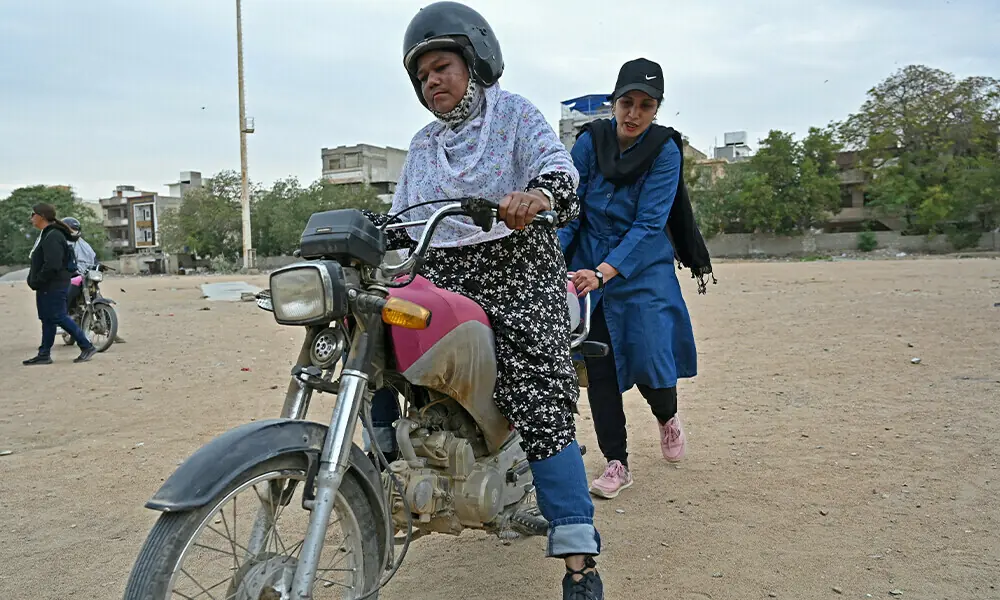
EDITORIAL: The Punjab Police’s proposal to amend the Provincial Motor Vehicle Ordinance, 1965, and the Motor Vehicle Rules, 1969, to introduce a Juvenile Driving Permit (JDP) for 16- to 18-year-old motorcyclists marks a troubling and ill-timed policy direction. The move is being presented as a response to a regulatory gap that has allowed widespread unlicensed juvenile riding. In reality, however, the timing raises serious concerns. The proposal emerged mere days after a tragic incident in which a 16-year-old son of an Islamabad High Court judge, driving an SUV, fatally struck two young women on a scooter. Instead of prompting a tightening of the legal framework to protect the public, the government appears poised to loosen it for millions of teens.
Punjab’s Inspector General of Police, Dr Usman Anwar, has argued that the absence of a legal pathway for juvenile riders leads to unsafe, unregulated driving. Therefore, a juvenile driving permit would formalise and regulate youth mobility. This reasoning presumes that the possession of a licence will somehow eliminate the well-documented safety risks associated with adolescent driving. But licences do not change adolescent psychology. A piece of paper cannot temper risk-taking behaviour, nor can it substitute for the maturity, judgment, and emotional regulation that individuals generally develop only in adulthood. There is a reason why many countries maintain strict minimum age limits for operating motor vehicles. Teenagers, particularly those aged 16 to 18, are biologically predisposed toward impulsivity and high-risk behaviour. Neurological studies show that while physical growth may be complete by mid-teens, the parts of the brain responsible for judgment, foresight and impulse control continue developing into the early twenties. Expecting teenagers to safely handle heavy, fast-moving machinery in unpredictable traffic conditions ignores basic developmental science.
What is conspicuously absent from the official account is any meaningful concern for the safety of other road users – pedestrians, cyclists, motorcyclists and car or heavy-vehicle drivers – who will now be compelled to share already dangerous roads with an estimated seven million newly eligible teen riders. Pakistan’s roads are already plagued by poor enforcement, lax compliance and infrastructural deficiencies. Introducing such a massive influx of inexperienced and impulsive riders into this environment is not reform; it is a sure recipe for more loss of life. Motorcycles, often treated casually in our society, are in fact among the most dangerous vehicles on the road. Unlike cars, they provide no structural protection. Even minor mistakes can be fatal. Allowing 16-year-olds – already prone to thrill-seeking – to operate them legally will legitimise and increase risky behaviour.
Instead of legalisation, the solution to widespread underage riding is stricter enforcement. The current age limit of 18 reflects a minimal threshold of cognitive and emotional maturity. It should apply universally to all motorised vehicles— lorries, cars, motorcycles and everything in between. Rather than lowering standards, Punjab should strengthen them. In a country already battling preventable road carnage, the priority must be public safety, not some administrative considerations. The proposed JDP is a step backwards that the provincial authorities must reconsider before formalising a policy that could endanger millions.
Copyright Business Recorder, 2025




















Comments
Comments are closed for this article.