



The latest fortnightly report by the Pakistan Cotton Ginners Association (PCGA) now carries the most decisive datapoint of the season.
Arrivals as of 15 November have crossed just over 4.4 million bales (of 155kg), but the cumulative pace is slower than both FY24 and FY25 at this stage. The gap may appear modest on paper, yet the seasonality pattern is unmistakable: the crop has already entered the stage where accelerationshould be visible. It is not, indicating zero expectation of any uptick in late picking.
Cotton rarely recovers after mid-November if momentum is missing. By this point in the season, historically more than four-fifths of annual arrivals are already accounted for. The curve has already flattened instead of rising. Punjab, the province that typically sets the pace once the harvest settles, has recorded its weakest start in several years. Meanwhile, Sindh is holding position but behaving more like FY21 rather than the last two recovery cycles.
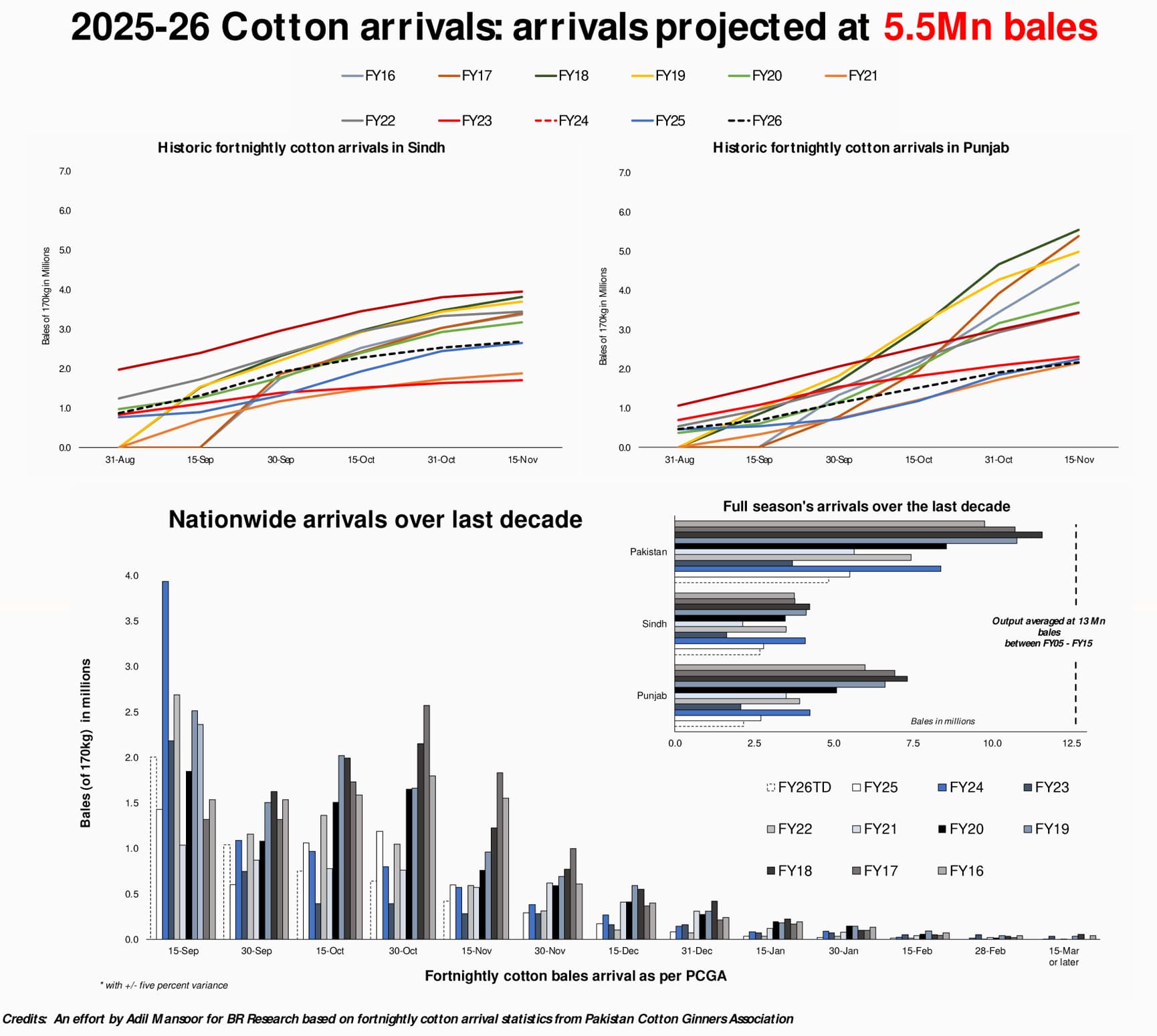
Punjab’s data confirms the shift clearly. Between 31 October and 15 November last year the province added close to 1.2 million bales. This year the increase is barely half of that. Sindh, which occasionally narrows the gap in late November has shown no material pickup either. With wheat sowingalready underway and input purchases showing signs of hesitation the probability of a late season rally is now slim.
Historically, Pakistan has never crossed six million bales when Punjab failed to reach three million by mid November. FY26 has already missed that threshold by a wide margin. If the current trajectory holds, nationwide arrivals may settle between 5-5.5 million bales. That places the ongoing season closer to FY21 than to FY22 or FY24 the years often cited as signs of an industry turnaround.
Some may claim that lower domestic arrivals will simply make imports more urgent thus keeping the supply chain intact. That logic may hold for exporters looking to secure raw material. But it cannot be sold as evidence of recovery. If cotton demand is being sustained mainly by foreign supply after two comparatively better seasons the issue is not variability, but instead missing farmer confidence. The season is still open on paper. In substance its tone has already been decided.




















Comments
Comments are closed for this article.