


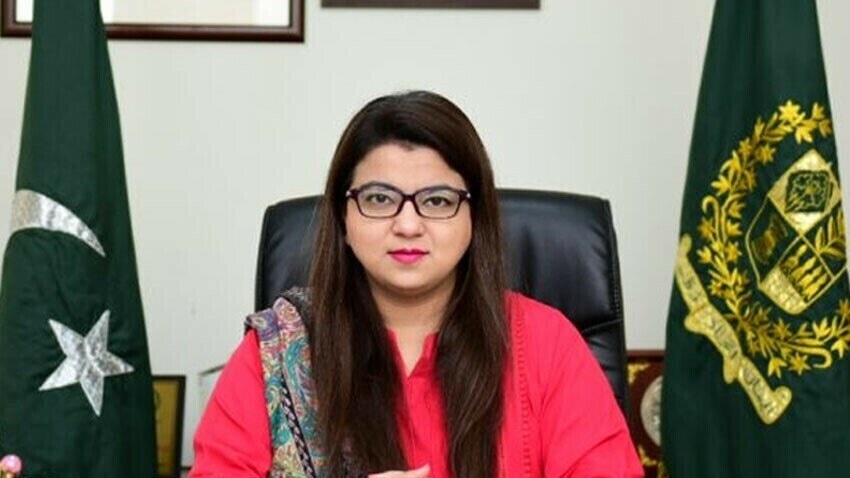
ISLAMABAD: Federal Minister for IT & Telecom Shaza Fatima Khawaja on Tuesday highlighted Pakistan’s growing role in the South Asia-Middle East Digital Corridor, noting the country’s significant strides in digital transformation.
Speaking at a high-level roundtable on Pakistan’s digital future, the minister pointed to the Prime Minister’s Digital Pakistan Vision 2030 as the cornerstone of the country’s digital strategy, supported by a clear policy direction and unified leadership.
She emphasised that Pakistan's mobile and broadband ecosystem is expanding rapidly, with 200 million mobile users, 60 percent broadband penetration, and a 210,000-kilometre fibre optic network.
Khawaja underscored that the digital transformation of the country has become a national priority, with strong backing from the Prime Minister, the Federal Cabinet, and the governance framework led by the Special Investment Facilitation Council (SIFC).
She also highlighted the recent signing of the CAREC Regional Fibre Connectivity Agreement in Bishkek, describing it as a major step toward regional digital integration.
This agreement, she added, positions Pakistan as a potential gateway for services, such as low-latency cloud computing, cross-border fintech, and artificial intelligence (AI) collaboration.
The minister noted that the removal of the right-of-way fee has cleared a key obstacle to nationwide fibre installation, facilitating the rollout of high-speed digital infrastructure.
She also discussed the upcoming Digital Nation Pakistan Act 2025, which aims to modernise the country’s economy, services, and governance frameworks.
Khawaja referred to the country’s National AI Policy, Cloud First Policy, and Data Governance Policy as foundational to Pakistan’s innovation ecosystem.
She added that initiatives like Pakistan Stack and its sectoral applications in health, agriculture, and governance are helping digitize public services.
On the issue of digital inclusion, she noted the provision of digital wallets to 800,000 women during Ramadan as a key milestone.
She also mentioned that Pakistani startups are growing rapidly, benefiting from support programs like PSF, cloud credits, BridgeStart, and NICs, and forging regional partnerships, particularly through events like GITEX.
She highlighted Pakistan’s improvement in cybersecurity, citing its Tier-1 global ranking and the reduction in the female mobile internet gap from 38% to 25% in the past year.
Additionally, the launch of the WebTrust-audited National Public Key Infrastructure (PKI) is a significant step toward securing the country’s digital infrastructure.
Referring to the Prime Minister’s recent visit to China, she noted the signing of major digital agreements with Alibaba, Huawei, ZTE, and others, which open new possibilities in AI, cloud computing, submarine cables, smart cities, and youth skills development.
Meanwhile, at the GSMA Mobile World Congress, Khawaja met with a delegation from the Islamic Development Bank (IDB) to discuss Pakistan’s digital development and technology-driven growth.
The meeting focused on Pakistan’s digital transformation, including connectivity expansion, inclusive access, and innovation.
Copyright Business Recorder, 2025




















Comments
Comments are closed for this article.