


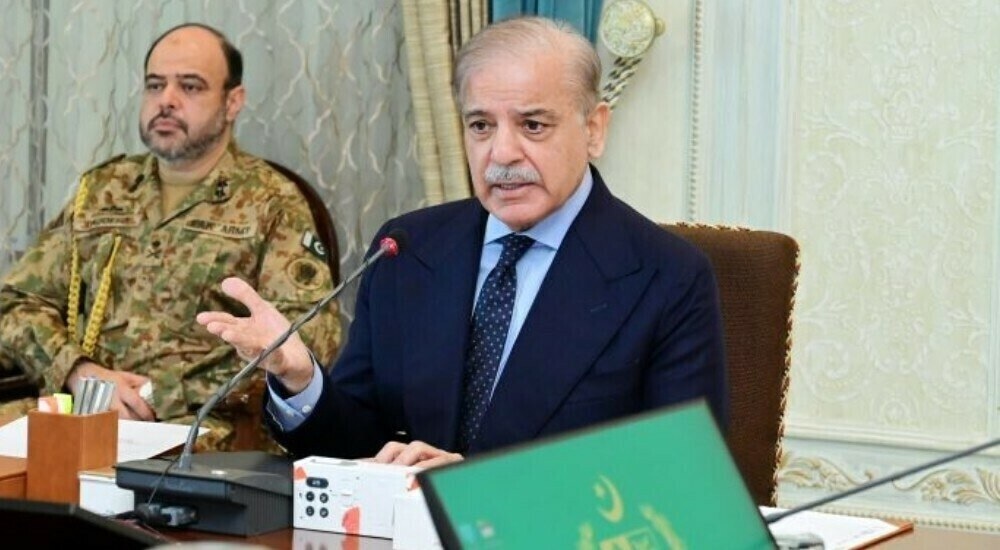
EDITORIAL: A review meeting held under the chairmanship of Prime Minister Shehbaz Sharif has taken the informed decision to scrap Export Development Surcharge (EDS) with immediate effect — a decision taken subsequent to the recommendations of a dedicated working group (set up by the Chief Executive) led by Musaddaq Zulkarnain and sector experts with the following terms of reference: to assess the effectiveness of the surcharge and propose measures to strengthen the country’s export competitiveness.
The EDS equivalent to 0.25 percent of the export value of all exports was levied through the Finance Act 1991, for distribution amongst various export associations for export development with the Export Development Fund Act promulgated in 1999 and amended in 2005. It was maintained in the federal treasury through a personal ledger account, and collected by National Bank of Pakistan.
The EDF website under the auspices of the Ministry of Commerce does not show in its website any projects that pre-date 2019. It is unclear whether this implies no projects were undertaken before 2019 or whether this reflects the failure to update the website.
The Prime Minister also directed a comprehensive third-party audit of the Export Development Fund, which again must be fully appreciated given the following projects funded through it. One project is identified as starting in 2019 titled technical assistance for better compliance and reporting of labour rights conventions necessary for continuation of GSP+, at a cost of six million rupees, which is marked as still in progress.
In 2020 four projects were undertaken, all under progress, including strengthening of Pakistan plant quarantine system, at a cost of 9.99 million rupees, trade development authority, 114 million rupees, empowerment of SMEs through e-commerce 64.4 million rupees, and even more inexplicably requirement for centralised office/residential accommodation for customs officers/staff to be posted at Angoor Adda, Kharlachi and Ghulam Khan at a cost of 8.8 million rupees.
Four projects were started in 2021, all in progress, notably the visit of a delegation of Afghanistan to Islamabad at a cost of 4.9 million rupees, 75 percent government subsidy for lab testing for leather at a cost of 69 million rupees, compliance to IOTCS resolutions for export of tuna and like species at a cost of 9.6 million rupees and introduction of long lining for tuna and product development at a cost of 19.4 million rupees.
To conclude, while one must appreciate the Prime Minister for taking this decision, yet this measure alone is not likely to be enough to fuel exports, which are grappling with input costs that are considerably higher than that of other regional competitors (electricity, gas rates) and on an 11 percent discount rate (that has been halved in recent months) but which is double the regional average. In addition, our exports remain traditional, with the high value adding items still not within our repertoire of exports.
The World Bank recently undertook a major study on how to raise exports and the Prime Minister would be well advised to direct his working group/task force to take those recommendations on board as well that include not only reforming trade agreements, but also addressing high energy and production costs through structural reforms.
Copyright Business Recorder, 2025























Comments
Comments are closed for this article.