




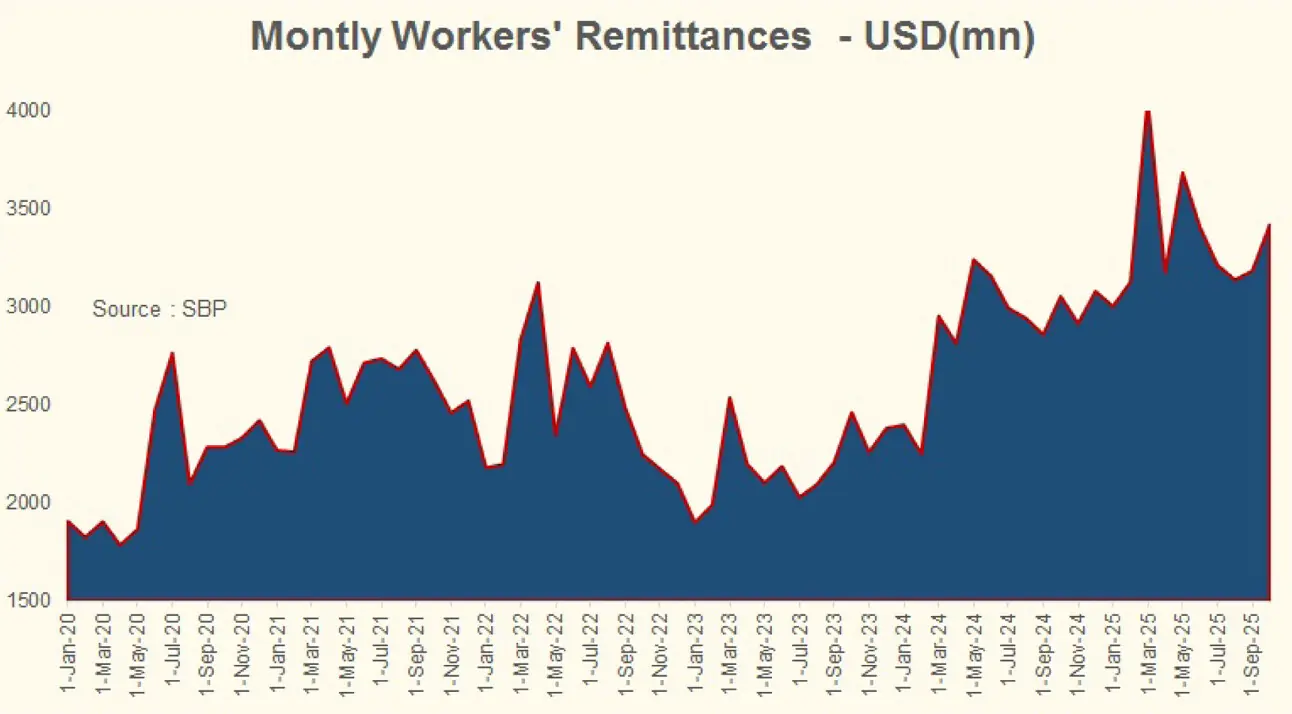
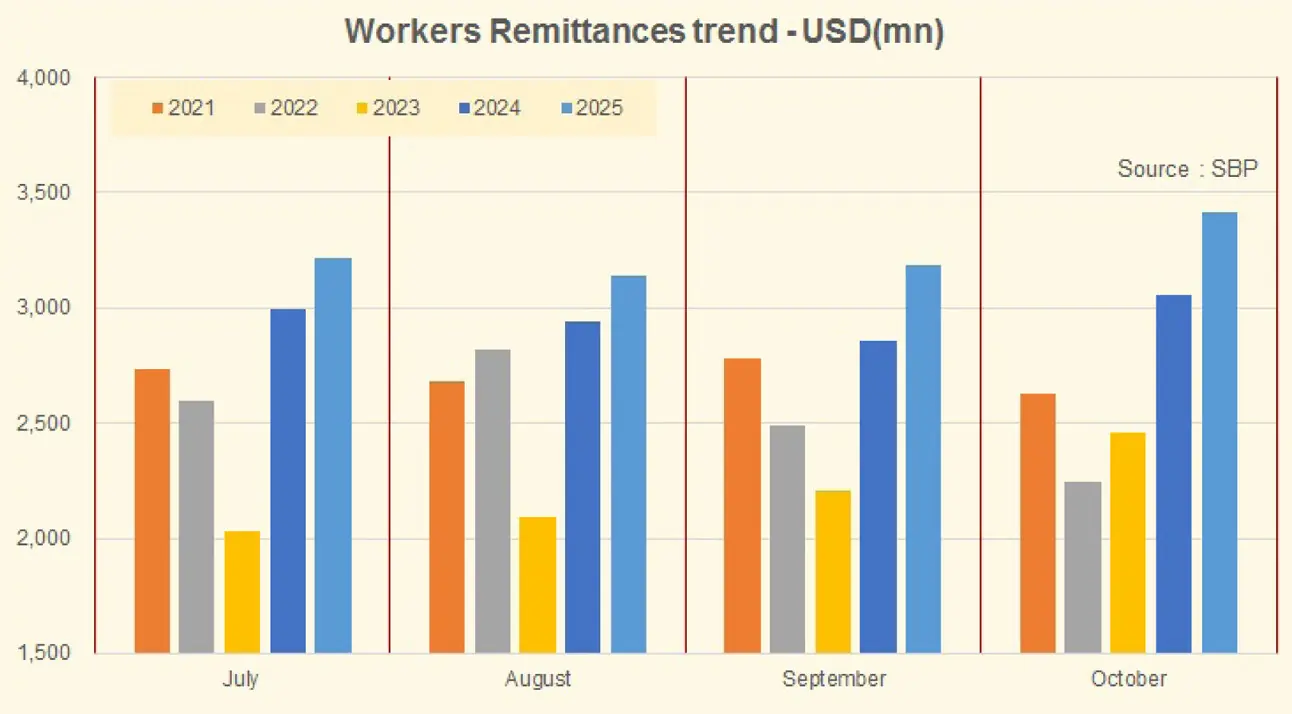
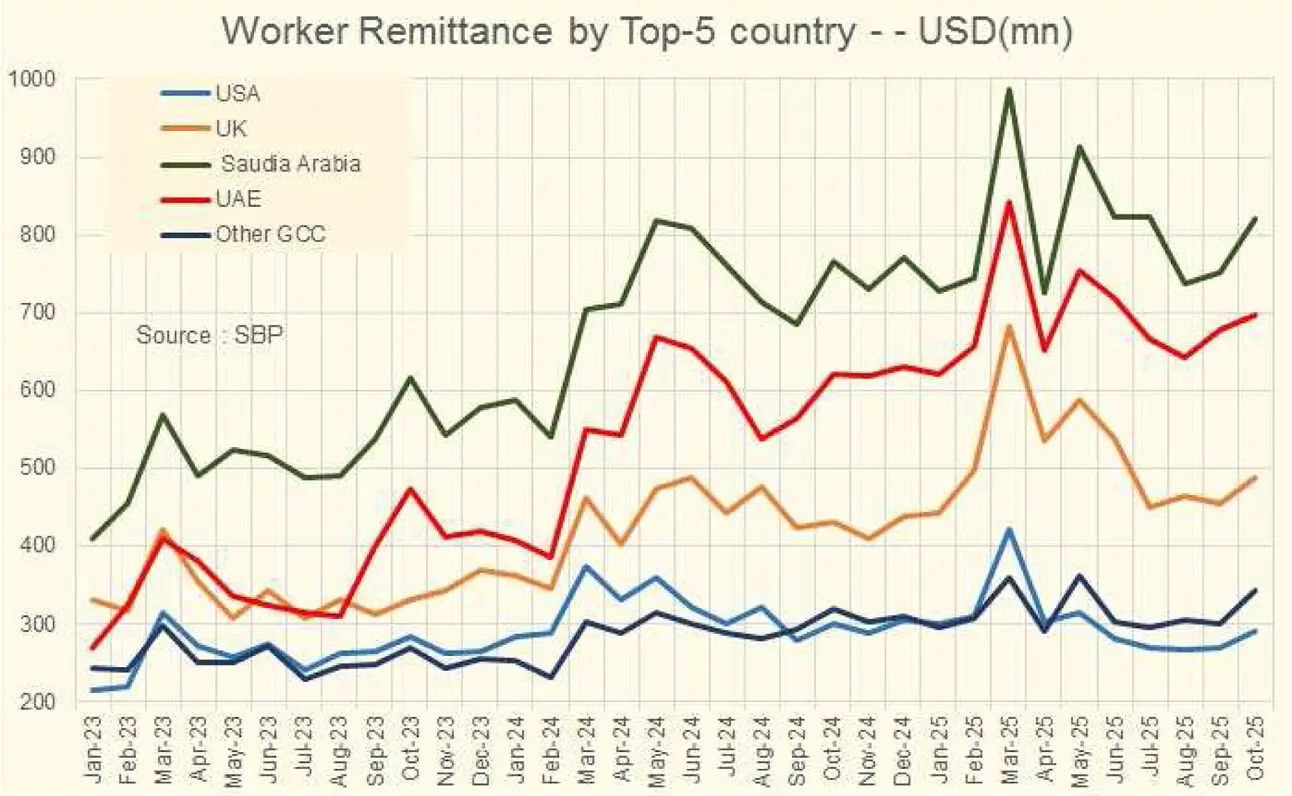
Remittances continued to show resilience in October 2025, reaching around $3.4 billion—up roughly 12 percent year-on-year and 7 percent from the previous month. The largest contributions came from Saudi Arabia ($821 million), the UAE ($698 million), the UK ($488 million), and the US ($290 million).
During 4MFY26, inflows totalled $12.9 billion, reflecting a 9.3 percent increase over the same period last year. These figures highlight the continued strength of remittances as a lifeline for Pakistan’s external accounts, cushioning the impact of a widening trade deficit and helping to stabilize the rupee amid rising import bills.
Yet, beneath this positive headline lies a deeper structural problem—the country’s growing dependence on remittance inflows rather than productive, export-led growth.
This dependence is increasingly being viewed through the lens of “Dutch disease,” a term originally coined to describe the Netherlands’ experience in the 1960s when natural gas exports led to an appreciation of the real exchange rate and the decline of its manufacturing base.
As the Centre for Development Policy Research notes, large and persistent foreign inflows—such as remittances—can create similar distortions. They strengthen the local currency in real terms, make exports less competitive, and divert resources toward consumption and non-tradable sectors like construction, retail, and personal services, while manufacturing and exports stagnate.
In recent years, this pattern has become increasingly visible. Despite healthy remittance growth, Pakistan’s export base remains narrow and underperforming.
Over the past three fiscal years, Pakistan received nearly $96 billion in remittances—more than its merchandise exports during the same period. Such a dynamic gives an illusion of external stability while masking fundamental weaknesses in competitiveness and productivity.
The inflows help meet consumption demand—often for imported goods—thereby fuelling import-based growth without expanding domestic industrial capacity.
The main issue is that this money comes from abroad, not from what the country produces itself. It raises household consumption but do little to spur domestic savings, investment, or technological advancement translating into stagnating labour productivity, low industrial diversification, and heavy reliance on external inflows to plug fiscal and current-account gaps.
The policy response has been largely passive: instead of channelling remittances toward productive investment, successive governments have treated them as a stabilizing buffer.
The result is a remittance-dependence trap. Breaking this cycle requires turning remittances from a consumption source into a development tool—through diaspora investment channels, incentives for export-oriented industries, and structural reforms that improve competitiveness.




















Comments
Comments are closed for this article.