


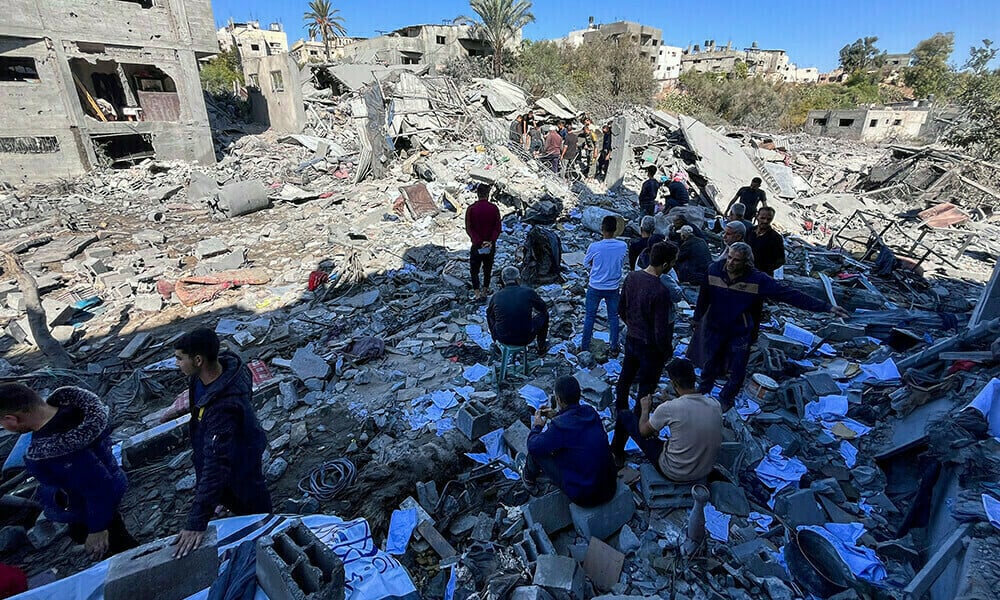
EDITORIAL: The meeting in Istanbul on Monday of foreign ministers from seven Arab and Muslim-majority countries marks a significant diplomatic effort to chart a post-war framework for Gaza. Coming amid a fragile ceasefire repeatedly violated by Israel, it could prove a turning point in the long and painful saga of the enclave.
Since the US-mediated truce was declared on October 10, at least 236 Palestinians have been killed in Israeli attacks, underscoring how tenuous the ceasefire remains.
Turkish Foreign Minister Hakan Fidan’s statement that all seven nations support Palestinian control over Gaza’s administration and security sends a clear political message: Gaza’s future must be determined by Palestinians themselves, not through external tutelage or occupation. As he pointedly remarked, “Nobody wants to see a new system of tutelage emerge.”
Those words carry a warning against any post-war arrangement that sidelines Palestinians or places them under indirect control — envisioned under the “Board of Peace”, headed by US President Donald Trump figures and Tony Blair as a member, to supervise a temporary Gaza governance structure. Such externally imposed frameworks have no legitimacy. Hamas, for its part, has said it is ready to hand over governance to a committee of Palestinians. This strengthens the case for an internal, nationally accountable transition mechanism rather than one dictated from outside.
Still, the situation remains precarious. Israel continues to violate the ceasefire and insists on retaining a veto over which Arab or Islamic countries may contribute troops to a proposed International Stabilisation Force (ISF). It is particularly opposed to Turkish participation — Turkiye being one of the few regional actors with both the capacity and the political will to play a constructive role in stabilisation efforts.
Israel’s desire to shape the composition of a force intended to operate under international authority undermines the very principle of impartiality such a mission would require. The foreign ministers’ insistence that the ISF’s mandate must be defined by the UN Security Council is therefore both prudent and necessary. Without a clear legal and political framework, any deployment would lack legitimacy and risk becoming entangled in competing regional agendas.
A UN-endorsed force, on the other hand, would command credibility and ensure transparency and accountability whether in supporting a Palestinian-led administration, ensuring humanitarian access, or facilitating the Gaza reconstruction plan unveiled earlier this year by the Arab League and the Organisation of Islamic Cooperation.
For that vision to advance, however, Israel must first honour the ceasefire and withdraw from all of Gaza. Without such steps, post-war planning risks becoming an exercise in futility. The Arab and Islamic countries meeting in Istanbul have shown readiness to shoulder responsibility for Gaza’s recovery within a framework that restores Palestinian sovereignty rather than perpetuates dependency.
The international community must match that resolve with genuine pressure for a lasting ceasefire and a UN-mandated stabilisation force that serves not as an instrument of control, but as a guarantor of reconstruction and Palestinian self-determination.
Copyright Business Recorder, 2025




















Comments
Comments are closed for this article.