


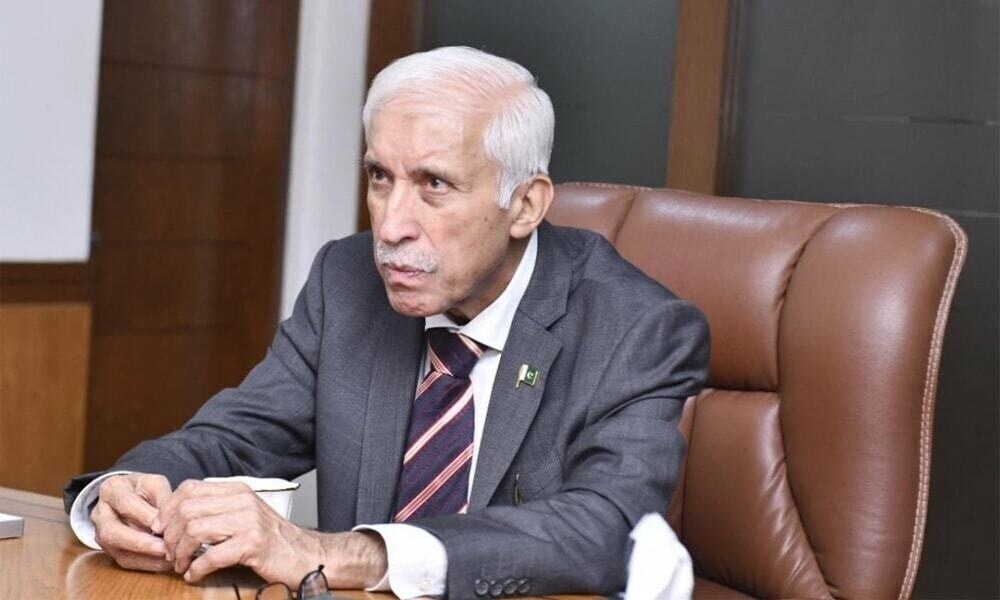

ISLAMABAD: Federal Minister for the Board of Investment Qaiser Ahmed Sheikh said that value-addition and export-led growth remain the only sustainable path to lift millions out of poverty and push Pakistan towards its target of becoming a USD 1 trillion economy by 2035.
“The current growth trajectory was insufficient to raise standards of living. The GDP is growing at 3.5 percent, and the population is increasing at 2.3 percent. Pakistan must accelerate growth to 5-6 percent to meaningfully increase per-capita income,” said the minister, while addressing a four-day 28th Sustainable Development Conference, titled: Sustainable Development in the Emerging World Dis/ Order, organised by Sustainable Development Policy Institute (SDPI) in collaboration with the Allama Iqbal Open University here on Tuesday.
The 16th South Asia Economic Summit (SAES), 3rd Sustainability Investment Expo (SIE), and 9th South and South-West Asia Sub-regional Forum on Sustainable Development (UNESCAP) were also held alongside this mega event.
“Countries with significant foreign direct investment and export-led growth succeeded in achieving sustainable development. Pakistan too has huge potential — from abundant natural resources to a young population that can convert challenges into opportunities,” the minister said.
He acknowledged recent improvements in Pakistan’s international credit rating but stressed the need for political consensus to sustain economic momentum. “We need a charter of economy, putting aside political differences to move the country forward. Collective wisdom and concrete efforts are essential for sustainable growth,” he added.
He reiterated the government’s commitment to reforms aimed at boosting investment, productivity, and export competitiveness to secure long-term development and resilience.
Federal Minister for Climate Change Musadik Malik accused the wealthy nations of “global hypocrisy” for demanding developing countries go greener while withholding climate finance, saying nations like Pakistan — among the lowest carbon emitters but hardest hit by climate disasters — are being unfairly punished in the new world order.
Malik criticised international lenders for asking Pakistan to “repurpose” funds meant for education and social welfare to rebuild infrastructure destroyed by climate disasters.
Bangladesh’s Advisor to the Ministry of Environment, Forest, and Climate Change, Syeda Rizwana Hasan, echoed the concerns, warning that multilateralism is “losing ground” amid growing political unrest in South Asia. She said worsening natural disasters, soil degradation, and regional disputes — particularly between upper and lower riparian nations — threaten millions of lives. “Pakistan has seen actions by upper riparian that violate international law,” she noted.
SDPI Executive Director, Dr Abid Qaiyum Suleri, said that the conference serves the region’s intellectual purpose where research meets policy, ideas meet responsibility, and optimism meets realism.
Suleri emphasised that sustainability is no longer a choice but an imperative for Pakistan’s long-term survival regarding socio-economic stability. He called for deeper collaboration among all stakeholders to build a climate-resilient and economically secure future. “Climate change is not merely an environmental issue — it is an economic, social, and political challenge. Sustainability is no longer a choice; it is the only way forward,” he remarked. “We must move from reactive disaster response to proactive, climate-smart planning.”
Peter Emil Nielsen, Deputy Head of Mission at the Embassy of Denmark, said the climate crisis is now a living reality and demands urgent and coordinated action.
“The climate crisis is no longer a distant concern; it is a reality for millions across Pakistan and the world,” he said, referring to recent devastating floods, heat waves, and economic vulnerabilities exposed by climate shocks.
Nielsen said Denmark will continue to work closely with Pakistan under the Green Framework Agreement and the upcoming three-year Strategic Sector Cooperation initiative launching in 2026, focused on energy transition, capacity building, and climate resilience.
Deputy Head of Mission at the German Embassy, Arno Kirchhof, said that Pakistan must move beyond simply fighting climate change and instead embrace a comprehensive shift toward sustainable, environment-friendly economic growth.
Kirchhof said that while climate action remains critical, long-term prosperity depends on embedding sustainability at the core of economic and policy decisions.
“It is not enough to just fight climate change — we must pursue sustainable growth,” he stressed, urging Pakistan to align development planning with climate resilience and green economic reforms.
Copyright Business Recorder, 2025
















Comments
Comments are closed for this article.