


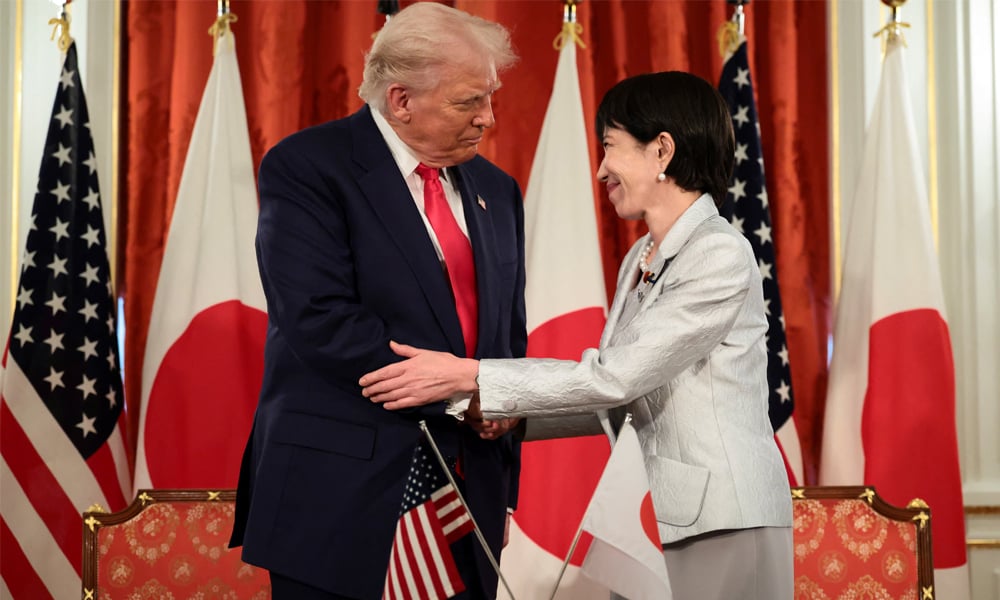

TOKYO: US President Donald Trump and Japanese Prime Minister Sanae Takaichi signed a framework agreement on Tuesday for securing the supply of rare earths, as both countries aim to reduce China’s dominance of some of the key electronic components.
The leaders signed the documents, which included critical minerals, at the neo-Baroque-style Akasaka Palace in Tokyo, beneath three chandeliers decorated from top to bottom with gold ornamentation, as aides applauded.
No direct mention was made publicly by the leaders about China, which processes over 90 percent of the world’s rare earths, making it the source of each country’s concern about its mineral supply chain.
Beijing has recently expanded export curbs. Trump and Chinese President Xi Jinping are set to meet on Thursday on the sidelines of the Asia-Pacific Economic Cooperation in South Korea to discuss a deal that would pause steeper US tariffs and Chinese rare earths export controls.
Japan and the US would use economic policy tools and coordinated investment to speed up the “development of diversified, liquid, and fair markets for critical minerals and rare earths”, and aim to provide financial support to selected projects within the next six months, the White House said.
Both countries would consider a mutually complementary stockpiling arrangement and cooperate with other international partners to ensure supply chain security, it added in a statement.
While dominated by China, the US and Myanmar control 12 percent and 8 percent of global rare earth extraction, according to Eurasia Group, and Malaysia and Vietnam cover another 4 percent and 1 percent of processing, respectively.
Japan has pledged a $550 billion investment into the US economy, part of the wider bilateral trade deal, which could include power generation and liquefied natural gas, among other areas, according to sources familiar with the talks.
Ahead of Trump’s Asia trip, the US called on Russian energy buyers, including Japan, to cease imports, and imposed sanctions on Moscow’s two biggest oil exporters - Rosneft and Lukoil - to push the Kremlin to the negotiation table to end the war in Ukraine.
Japan has stepped up US LNG purchases in the last few years as it tries to diversify away from its key supplier Australia and prepare for supply contract expirations from Russia’s Sakhalin-2 LNG project, which Mitsui and Mitsubishi helped to launch in 2009.
In June, JERA, Japan’s top LNG buyer, agreed to buy up to 5.5 million metric tons per annum of US LNG under 20-year contracts, with deliveries starting around 2030. This is roughly the same amount Japan imports annually from Sakhalin-2.




















Comments
Comments are closed for this article.