


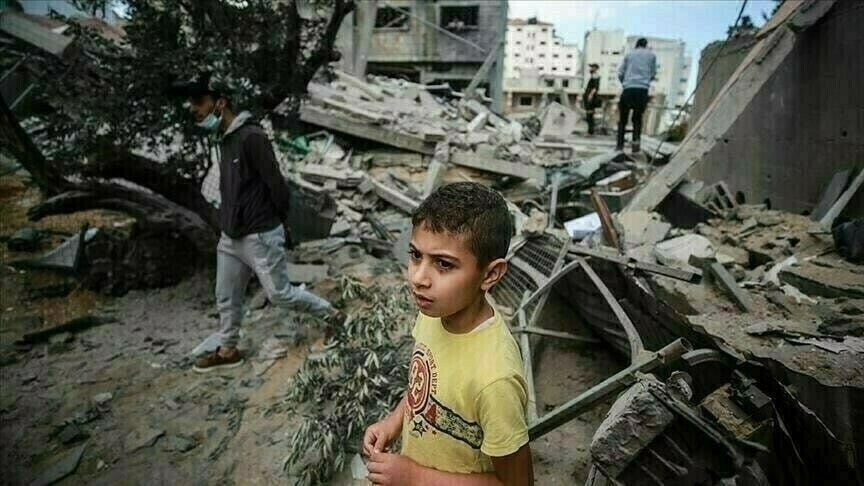

Tomorrow may dawn upon a sky momentarily calm over Gaza, yet beneath that silence lies the echo of agony — the cries of the displaced, the mourning of mothers, the haunting void of a generation lost to unending wars. The world witnesses another fragile ceasefire, a flicker of hope trembling amid ruins and despair. The guns may have fallen silent for now, but the silence itself is laden with stories of unimaginable suffering and unhealed wounds that call for justice, not merely the cessation of fire.
The International Conference on Gaza, held at Sharm el-Sheikh, Egypt, came at a time when the global conscience stood at its most tested crossroad. After months of relentless bombardment and starvation, with Gaza’s hospitals turned into graveyards and its schools into rubble, the world seemed desperate to halt the carnage. Convened under international pressure, the conference sought to consolidate the ceasefire into a durable peace.
The conference is brought together President Donald Trump, powerful European leaders, the UN chief and the leaders of Egypt, Jordan, Qatar, Türkiye, and Pakistan — each trying to balance political necessity with humanitarian urgency. The outcome was hailed as a “turning point,” yet the text of the communiqué revealed the same old choreography of power — diplomacy without courage, compassion filtered through self-interest, and peace weighed on scales of political expediency.
The communiqué pledged equal rights, opportunities, and mutual respect for all peoples of the region, but conspicuously avoided acknowledging the very cornerstone of the crisis — the Palestinian right to statehood and self-determination. This omission is not a minor diplomatic lapse; it is the moral fracture at the heart of every failed peace process. Without recognizing Palestine as a sovereign entity, no ceasefire can ever mature into genuine peace. Reconciliation without equality is capitulation. A peace built on the subjugation of one people and the privilege of another cannot endure — it merely rebrands occupation as order.
The truth that emerged in recent weeks is simple yet profound: what the deadliest of American weapons — funded by billions of US taxpayer dollars — could not achieve through destruction, displacement, and starvation, diplomacy accomplished through dialogue. After the world watched Israel impose a barbaric siege — cutting off food, water, fuel, and medicine to a besieged population — the October 13 prisoners’ exchange marked a rare moment when humanity prevailed over hubris.
As buses carrying Palestinian prisoners rolled into the occupied West Bank, mothers wept and the air resonated with ululations of relief. In Tel Aviv and occupied Jerusalem, Israelis too embraced the long-awaited return of their loved ones, echoing “Hayata” — homecoming in Hebrew. For a land long soaked in grief, it was a moment of collective catharsis — a reminder that diplomacy can succeed where destruction only multiplies despair.
But this moment of tenderness came tragically late. It could have come months earlier — had it not been for Prime Minister Netanyahu’s obstinacy and the Zionist establishment’s arrogance, both determined to sustain a war that served domestic politics more than security. Netanyahu’s survival depends on keeping his coalition’s extremist elements appeased — those who view peace as weakness and coexistence as betrayal. His intransigence delayed the possibility of life-saving negotiations, prolonging the agony of both peoples and extinguishing thousands of innocent lives.
In his address to the Israeli Knesset, President Trump declared with rhetorical flourish: “The skies are clear, the guns are silent, the sirens are still, and the sun shines on a holy land that is finally at peace.”
Beautiful words — but words alone cannot erase the scars etched into Gaza’s soul. The Trump peace framework, endorsed at the Sharm el-Sheikh conference, claims to pave the way for stability yet denies Palestine the status of a sovereign state and bars Hamas from future political participation. Such conditions are not foundations for peace but recipes for renewed conflict. The future of Palestine cannot be dictated in Washington or Tel Aviv; it must be decided by the Palestinian people themselves — those who have borne the bombs, the hunger, and the exile.
A peace process that silences legitimate voices and criminalizes resistance will only push despair underground, where it festers and returns in more tragic forms. If the Trump plan genuinely seeks enduring stability, it must correct its moral and political anomalies: acknowledge Palestine as a state within the 1967 borders, recognize Jerusalem as its capital, and allow all parties, including Hamas, to be part of the dialogue that determines their collective destiny.
For decades, Israel’s military might, generously financed by the West, has failed to secure peace because peace cannot be built on occupation. The same Western powers that preach democracy elsewhere remain complicit in apartheid in the Holy Land — their silence a betrayal of the principles they claim to uphold. The siege of Gaza, where civilians were starved into submission, will remain one of the darkest moral stains of our time — an experiment in cruelty that neither broke Hamas nor subdued the Palestinian spirit.
From this crucible of suffering emerges a simple truth: where the sword fails, the spoken word heals; where arrogance divides, empathy unites. The prisoner exchange proved that the path to peace does not run through structures of destruction but through corridors of dialogue.
Yet barely had the ink on the ceasefire dried when Israel, notorious for keeping its arrogant traditions, show of power, betrayal, and breach of promises, grossly violated the hard-won truce. With 51 Palestinians killed and about 150 injured in fresh strikes over Gaza, the world watched in disbelief as the fragile ceasefire — achieved after oceans of blood, ordeals, and unprecedented suffering — was trampled upon. In just within a week, Israel’s defiance mocked the very spirit of peace, telling the world yet again, for the forty-seventh time, that it seeks not coexistence but the total elimination of the “undesirable” Palestinians.
Hamas, reeling from massive destruction of infrastructure, men, and resources, stood alone rejecting the one-sided allegations of violation — a pretext conveniently sought by Zionist vandals to go on a rampage once more. The world was optimistically looking for the fulfillment of a long-awaited promise — not a tactical pause for renewed killing and genocide. This asymmetric arrogance, dominance, and unbridled liberty must stop. Peace must win.
A global protection force must now be activated for the return of life, smiles, education, and rebuilding of ruins — with Israel giving up its intransigence, hatred, and animosity, accepting the long-sought two-state solution to the 1967 borders, and embracing the divine followers of all faiths with greater harmony and magnanimity for a lasting and durable peace in the volatile Middle East.
The ceasefire, however, must not be misread as a triumph of diplomacy but rather as a reprieve won by exhaustion. Unless it evolves into a just political settlement, it risks becoming another pause before the next storm.
Was this ceasefire meant to be held in ridicule within mere a week of its announcement — to die an unceremonious death under Israeli aggression? The world must not allow this hard-won truce, earned through immeasurable suffering, to collapse. It must be preserved under all circumstances.
Any roadmap that ignores justice will keep the Middle East cauldron on the boil — feeding extremism, deepening alienation, and perpetuating the arms race that devours the region’s future.
Israel, with its immense technological and economic resources, has the capacity to turn hostility into harmony — if it dares to replace domination with compassion. By dismantling apartheid policies, ending segregation, and investing in rebuilding Gaza’s shattered infrastructure, Israel could win something its military has never achieved: the trust and hearts of its neighbours. Peace, after all, is not enforced — it is cultivated through respect and reciprocity.
To keep the skies permanently calm, the sirens still, and the sun shining over sacred lands, the path forward must rest on justice, equality, and mutual recognition. The soil of the Middle East — soaked in centuries of blood, resilience, and faith — demands no less. Let the followers of the three great Abrahamic religions — Islam, Christianity, and Judaism — rise beyond hatred and reclaim their shared moral inheritance: compassion, coexistence, and the sanctity of human life.
Only when justice replaces arrogance and empathy conquers prejudice will the Holy Land finally see peace not as rhetoric but as reality. Then, perhaps, the silence over Gaza will no longer be the silence of graves, but of a dawn where the children of both peoples can breathe freely under the same sun — equal, unafraid, and alive.
Copyright Business Recorder, 2025
The writer is a Shikarpur-based retired civil servant. The views expressed in this article are not necessarily those of the newspaper




















Comments
Comments are closed for this article.