



United Bank Limited’s (UBL) 9MCY25 performance is a case study in how to play the monetary cycle to perfection. In a year marked by a sharp reversal in policy rates —UBL not only preserved its earnings momentum but expanded profitability, rewarded shareholders handsomely, and reaffirmed its position as one of the most strategically managed balance sheets in the sector.
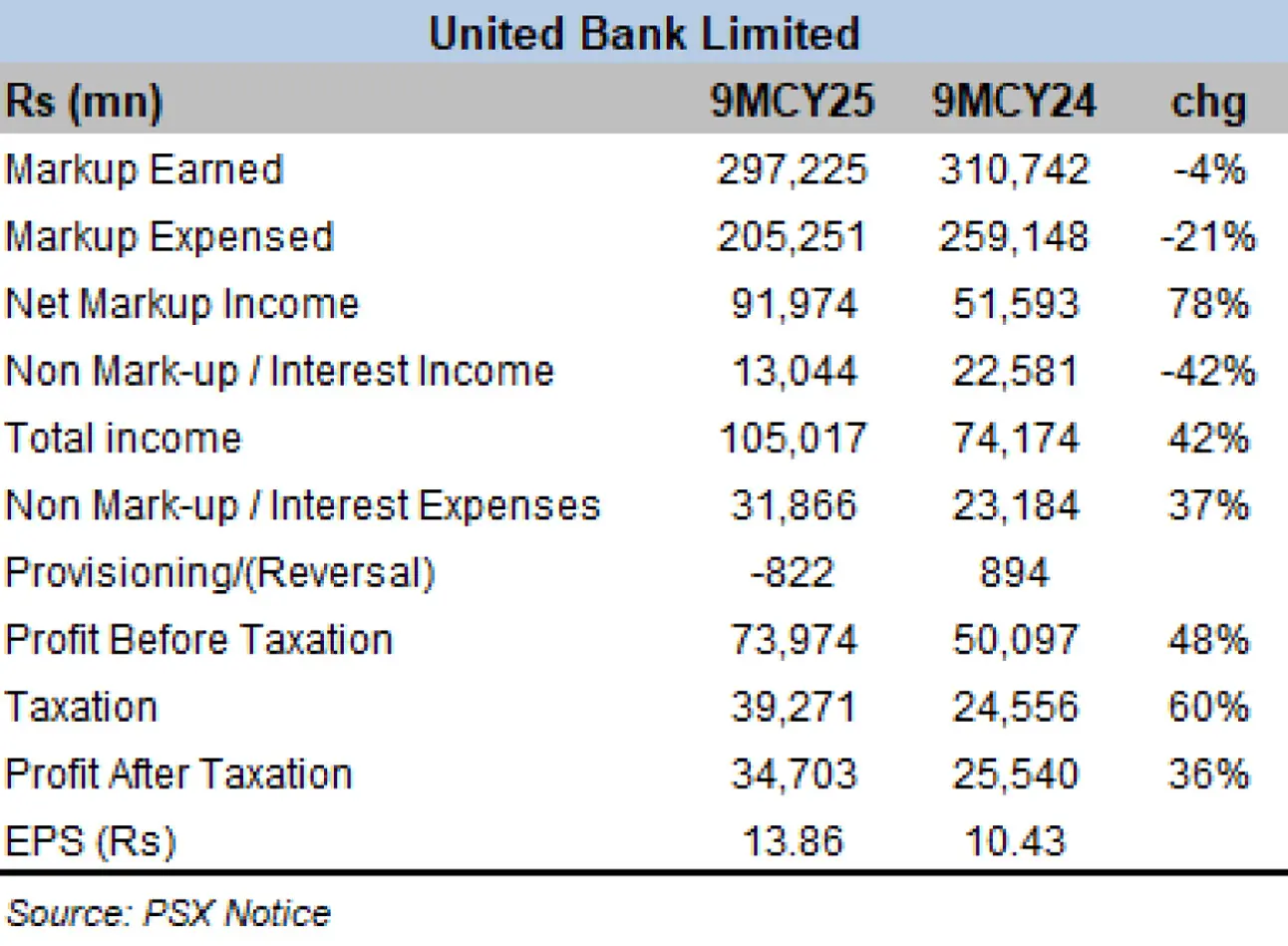
UBL reported a profit after tax of Rs34.7 billion for 9MCY25, up 36 percent year-on-year, with earnings per share rising to Rs13.86. The bank declared another interim cash dividend of Rs8 per share, taking total payouts for the year to Rs27.5 per share — among the highest in the banking industry.
At a time when most peers are cautiously watching their margins compress, UBL’s dividend policy signals management confidence and balance-sheet resilience.
The core of this strong performance lies in spreads that almost doubled compared to the same period last year. Despite the steep monetary easing, net markup income surged 78 percent to Rs91.7 billion. Markup expenses fell 21 percent, while markup earned declined only 4 percent — a testament to UBL’s ability to manage duration and funding costs with precision.
The timing has been exquisite: high-yield government paper booked during the tightening cycle has now turned into a goldmine as rates recede. In simple terms, UBL has executed a perfect carry trade — borrowing short and cheap, and earning long and high.
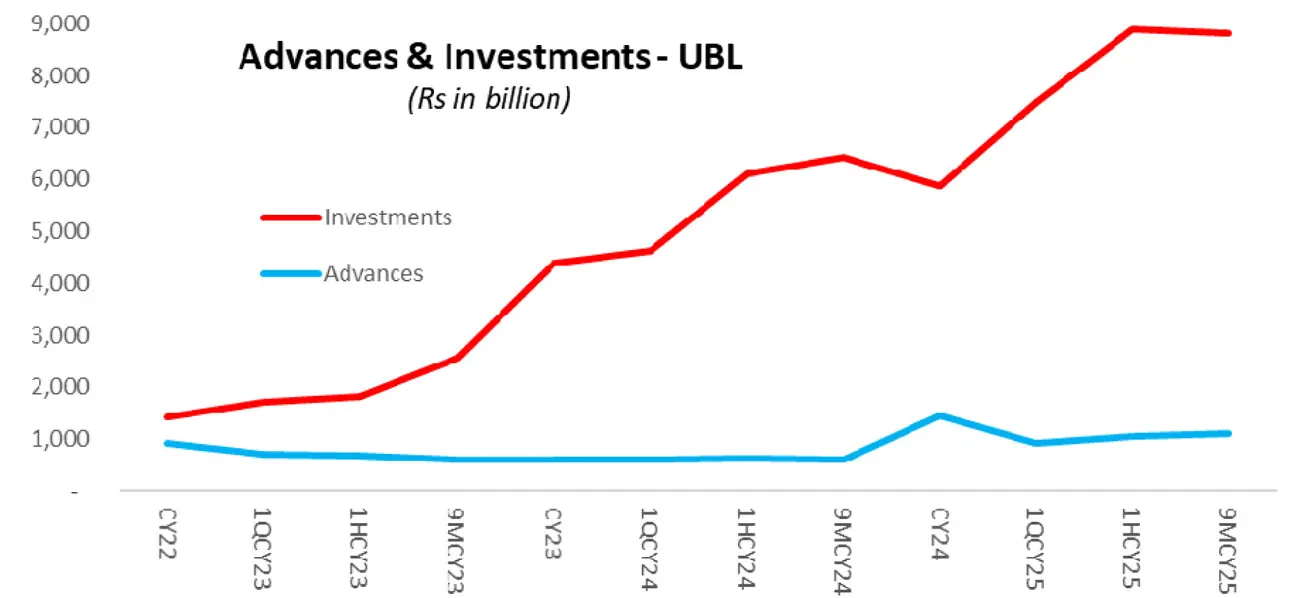
Part of the balance-sheet expansion also stems from the Silkbank acquisition, which added both heft and market presence. Yet the larger balance-sheet story remains consistent with the broader industry pattern: a pronounced tilt toward sovereign exposure. UBL’s investments now stand close to Rs9 trillion, while advances hover near Rs1 trillion — a staggering nine-to-one imbalance.
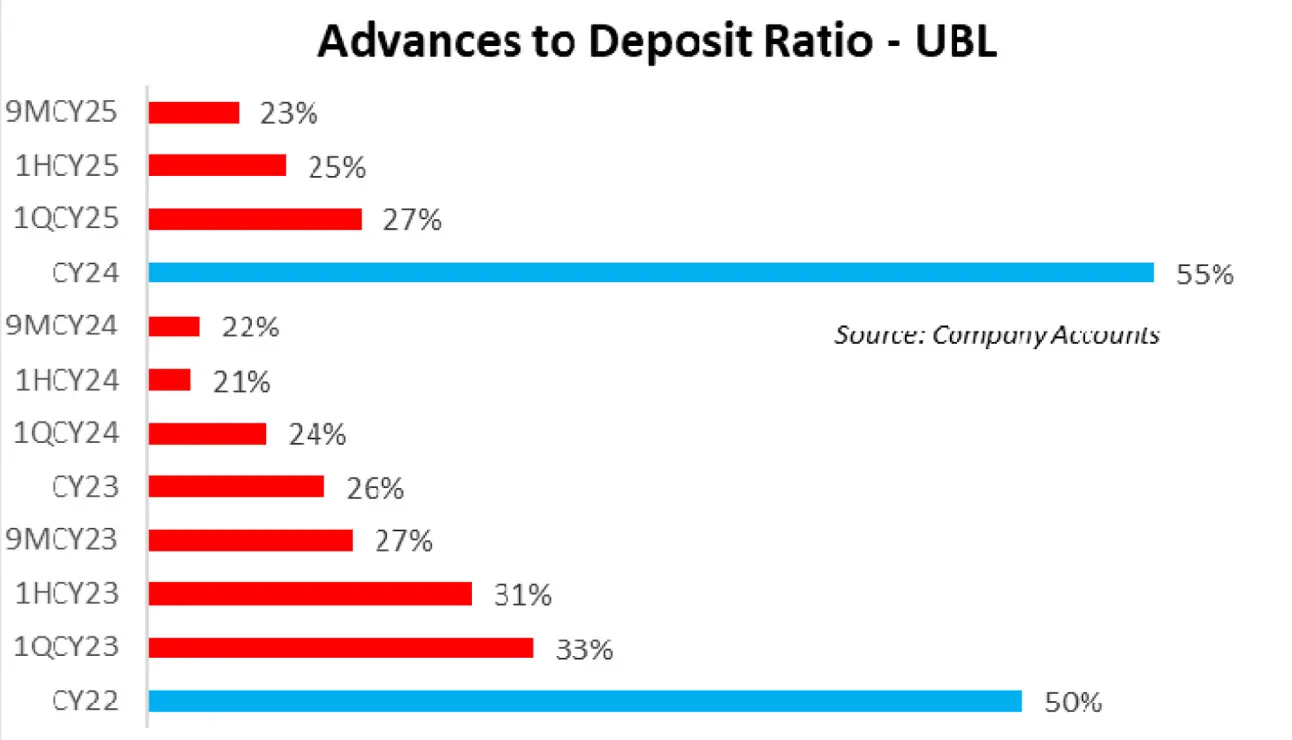
The advances-to-deposit ratio has slipped further to 23 percent, down from 27 percent a year earlier and just half the 50 percent level seen two years ago. Lending to the private sector continues to take a back seat as government paper provides an easier, risk-free route to profitability.
The funding side tells its own story. Borrowings exceed deposits, reflecting UBL’s extensive use of the State Bank’s Open Market Operation (OMO) window. What began as a short-term liquidity tool has evolved into a structural source of funding for the industry. Banks, including UBL, have effectively been borrowing short from the central bank through OMO REPOs and investing long in government securities — a liquidity loop that keeps the system stable and the banks flush with earnings.
For UBL, this has been less a problem and more a strategic edge. The bank’s treasury operations have taken full advantage of the rate transition, capturing high yields on the way up and capital gains on the way down. That has translated not only into record earnings but also into stellar investor returns. UBL’s share price has more than doubled year-to-date, outpacing every major private-sector peer on the Pakistan Stock Exchange. What critics once derided as “lazy banking” has, for now, proven to be shrewd balance-sheet management.
It is true that non-markup income fell 42 percent year-on-year, while operating expenses rose 37 percent — but these headwinds were dwarfed by the windfall from spreads. Provisioning remained marginally negative, indicating little asset-quality stress despite the economic slowdown. In essence, UBL’s profitability has been driven by rate positioning and liquidity management rather than credit expansion or fee-based growth.
The broader context, however, cannot be ignored. The industry’s growing dependence on SBP’s liquidity injections and its overwhelming preference for government lending reflect a financial system increasingly geared toward fiscal accommodation rather than private-sector intermediation. UBL’s results embody this structural reality, though the bank has clearly been better than most at navigating it.
The next challenge will come as the yield curve flattens and liquidity conditions begin to normalize. Sustaining such margins in a low-rate environment will test how well UBL can shift gears from sovereign comfort to organic credit growth. But for now, it stands at the sweet spot — liquid, leveraged, and laughing all the way to the bank.




















Comments
Comments are closed for this article.