


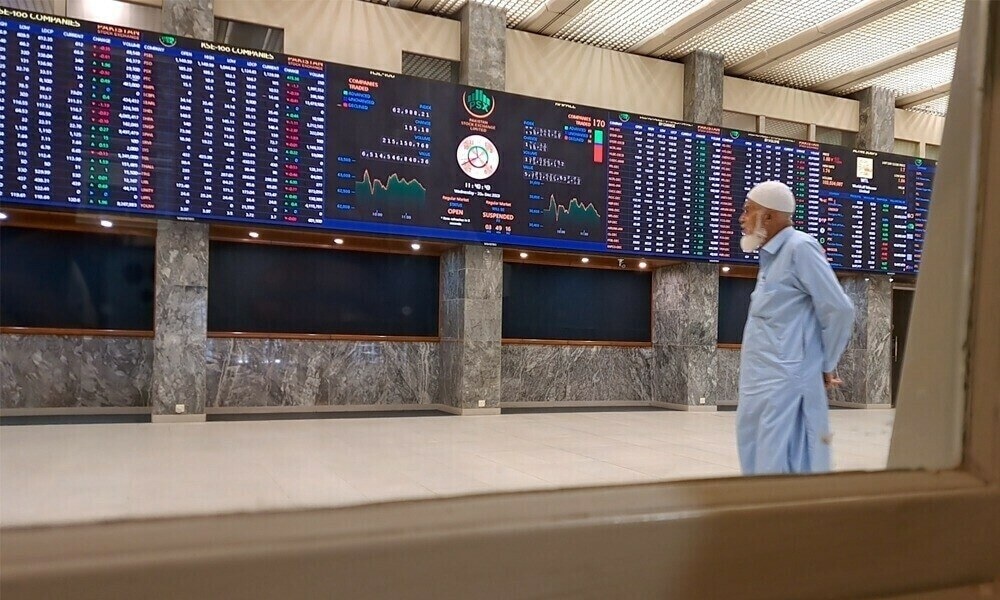

KARACHI: The Pakistan Stock Exchange ended the week lower, with declines across most sectors, reduced trading volumes, and weaker capitalisation following several weeks of sustained advances.
The benchmark KSE-100 Index declined 3.5 percent to settle at 163,098.19 points. The index opened at 168,990.06 points on Monday and lost 5,891.87 points over the week as profit-taking set in after an extended five-week bull run that had seen consecutive positive closings.
The BRIndex100 settled at 17,047.60 points, down 664.66 points, with an average daily turnover of 1,129.7 million shares. The BRIndex30 ended the week at 54,150.06 points, declining by 2,825.56 points, with an average volume of 817.26 million shares.
Selling pressure was evident across nearly all key sectors, bringing an end to the recent upward momentum. The Oil and Gas Exploration and Production sector posted the largest decline of 5.5 percent, followed by cement, which fell 4.6 percent, and banking, which decreased 3.4 percent.
Refinery stocks also came under pressure, losing 6.1 percent, while the power generation and distribution sector shed 5.6 percent. The technology and communication sector, however, bucked the trend and remained the only major segment to record gains, rising 5.2 percent during the week as renewed activity was observed in telecom and IT scrips.
Trading activity slowed during the week. Average daily trading volume on the ready board fell 9 percent to 1,357.38 million shares from 1,484.24 million shares recorded a week earlier. The average daily traded value also declined sharply by 24.1 percent to Rs54.84 billion from Rs72.21 billion in the previous week. In dollar terms, the traded value dropped from USD256.71 million to USD195.02 million, reflecting weaker investor participation.
Market capitalization decreased by 3.8 percent, falling to Rs18,908.95 billion, equivalent to USD$67.25 billion, from Rs19,660.88 billion or USD69.90 billion in the preceding week.
Sectoral data showed that most categories ended in negative territory. The Fertilizer sector declined 1.3 percent, Automobiles fell 2.4 percent, Oil and Gas Marketing Companies slipped 2.5 percent, Chemicals lost 2.7 percent, Food 2.8 percent, and Pharmaceuticals 2.9 percent. Banks were down 3.4 percent, Textiles 3.5 percent, Cement 4.6 percent, E&Ps 5.5 percent, Power 5.6 percent, Refinery 6.1 percent, and Engineering 7.1 percent. Only the Technology and Communication sector showed improvement with a gain of 5.2 percent.
Trading activity was led by a handful of sectors. The Technology and Communication sector accounted for the largest share of the week’s traded volume, representing 22 percent of total turnover. It was followed by Commercial Banks with 13 percent, Power with 12 percent, Investment banks with 9 percent, and Refineries with 6 percent. The remaining 39 percent of trading volume was contributed by other sectors.
Among individual performers, Pakistan Telecommunication Company Limited emerged as the top gainer, climbing 27.5 percent to close at Rs37.25. Allied Bank Limited increased 6.2 percent to Rs195.85, while Adamjee Insurance Company Limited advanced 5.7 percent to Rs83.77. Gains were also recorded in Ghani Global Holdings, which rose 2.7 percent to Rs867.27, Shifa International Hospitals, which gained 2.2 percent to Rs545, Askari Bank, which added 1.8 percent to Rs90.63, and Systems Limited, which increased 1.4 percent to Rs156.
On the losing side, Service Industries Limited recorded the steepest fall, declining 28.6 percent to Rs355.71. International Steels Limited followed with a 13.3 percent drop to Rs108.38, while Javedan Corporation Limited decreased 12.2 percent to Rs76.31. The Hub Power Company Limited lost 10.8 percent to Rs211.17, Tariq Glass Industries fell 10.1 percent to Rs228.20, Pak Elektron Limited declined 9.3 percent to Rs53.80, and Cnergyico PK Limited slipped 8.8 percent to Rs8.27.
On a macroeconomic level, the International Monetary Fund concluded its visit to Pakistan for the second review of the ongoing US$7 billion Extended Fund Facility and the first review under the Resilience and Sustainability Facility. Policy-level discussions are expected to continue in the coming days, focusing on fiscal adjustments related to flood expenditures, management of fiscal slippages, and broader economic reforms.
The country’s external position showed modest improvement as workers’ remittances rose 11 percent year-on-year to USD3.2 billion in September 2025. Cumulative remittance inflows for the first quarter of FY26 reached USD9.5 billion, reflecting an 8 percent annual increase. The State Bank of Pakistan’s foreign exchange reserves inched up by USD20 million during the week to reach USD14.4 billion.
The government’s privatization drive also progressed, with the process for Pakistan International Airlines entering its final stages. Bidding and key negotiations are expected to be completed by the end of the year. Parallel efforts continued for the privatization of electricity distribution companies, aligning with reform conditions under the IMF program.
AKD Securities, in its weekly report, noted that the KSE-100 index is likely to maintain its upward momentum amid the smooth completion of the IMF’s second review, limited flood impact, and improved credit ratings from global agencies alongside falling fixed-income yields. The brokerage added that investor sentiment is expected to strengthen further with the potential inflow of foreign portfolio and direct investments, supported by improving relations with the United States and Saudi Arabia.
Copyright Business Recorder, 2025


























Comments
Comments are closed for this article.