



Back in FY24, Hub Power Company Limited (PSX: HUBC) delivered strong financial results, reporting consolidated earnings growth of 22 percent year-over-year. Revenue growth was driven by higher dispatches from Thar Energy Limited (TEL), currency devaluation, and improved operational efficiencies.
While Thar coal-based plants (TEL & TNPTL) performed well, China Power Hub Generation Company (CPHGC) experienced a decline. Gross margins improved despite a significant rise in finance costs, supported by a jump in associate profits due to new plant operations and currency depreciation.
The power company closed FY25 with consolidated earnings of Rs46.1 billion, translating into a decline of 34 percent year-on-year.
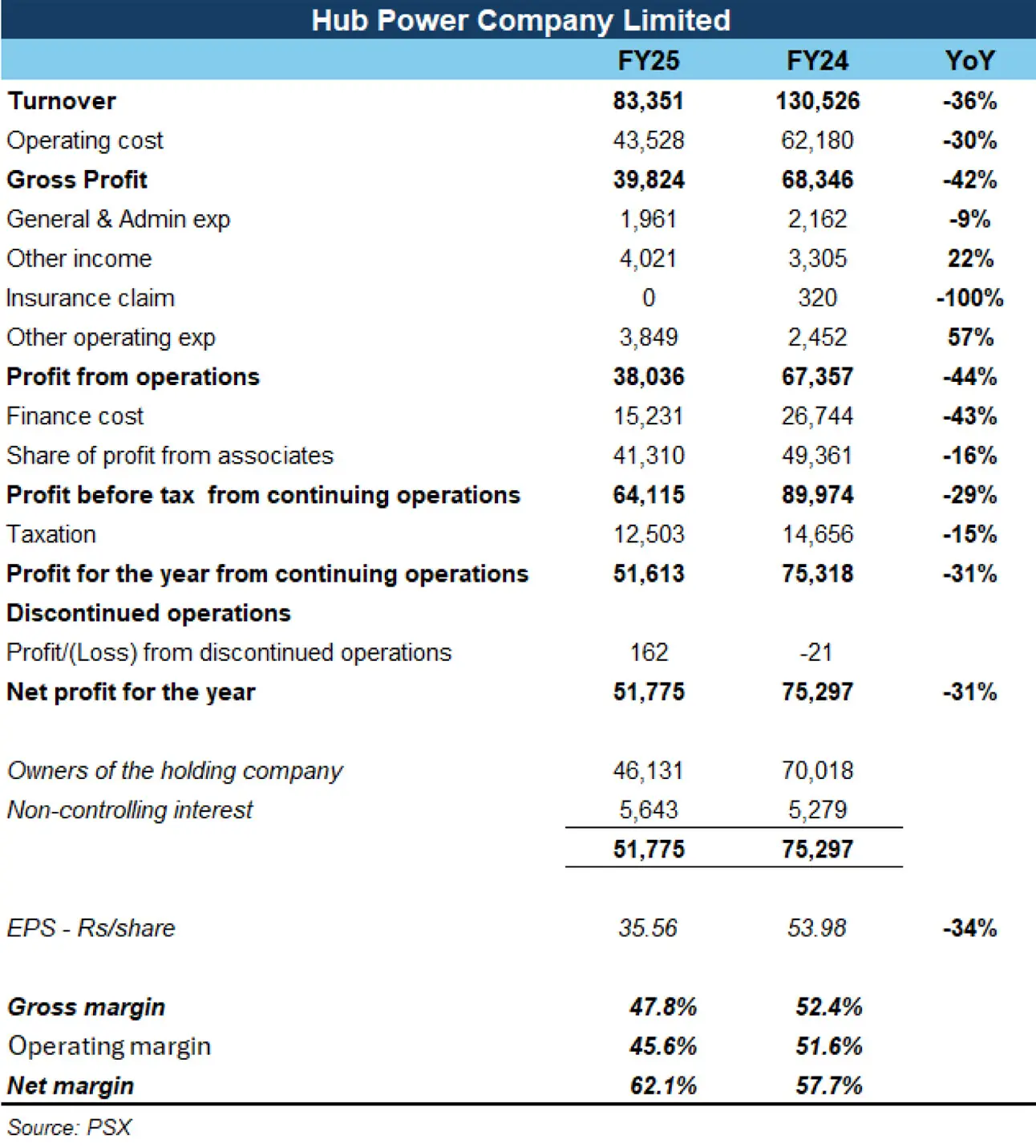
The primary driver of this drop was the expiry of the Hub base plant’s power purchase agreement (PPA) effective October 2024, along with revisions in Narowal Electric’s tariff that reduced cash inflows. Consequently, revenue fell 36 percent year-on-year, while gross profit contracted 42 percent.
Despite the earnings dip, the company maintained a strong payout profile, declaring a full-year dividend of Rs15 per share, supported by robust dividends from CPHGC and anticipated maiden payouts from TEL and ThalNova in 2HFY25.
The company’s performance during the year reflected both pressure on traditional generation assets and support from associate income and lower finance costs.
Share of profit from associates and JVs slipped 16 percent, mainly on account of lower earnings at Prime International, while other expenses rose 57 percent, largely due to a debt write-off at Narowal. On the positive side, finance costs dropped by 43 percent on the back of declining interest rates, partially cushioning the bottom line.
Operationally, HUBC’s power portfolio delivered high availability, particularly at its Thar coal plants, which contributed significant foreign exchange savings. Receivables from CPPA-G remained elevated, though the overdue cycle improved, aiding dividend flows.
FY25 also marked an acceleration in HUBC’s diversification strategy. Under its auto joint venture, Mega Motor Company, the group introduced BYD’s new models selling over 2,000 vehicles since the February 2025 launch.
Construction of a CKD assembly plant at Gharo has commenced, with Phase I capacity of 25,000 units annually (expandable to 50,000) and project capex of US$150 million under a 60:40 debt-equity structure. HUBC has also begun rolling out EV charging infrastructure along national motorways.
Beyond energy and automotive, HUBC is pushing into mining and exploration. Additionally, the company is evaluating conversion of the Hub plant’s oil infrastructure for white oil transport, a potential aluminum smelter, and even a data center subject to economic feasibility.
HUBC’s FY25 results thus capture a transitional year. While the termination of legacy PPAs and tariff adjustments weighed heavily on financial performance, the company’s strategy of diversification into coal mining, E&P, automotive, and EV infrastructure reflects its evolution from a power utility into a broader conglomerate.
Strong dividends from associates, improving receivables, and reduced finance costs provided resilience, while its new ventures, particularly in electric mobility, signal long-term growth beyond traditional power generation.
Copyright Business Recorder, 2025




















Comments
Comments are closed for this article.