



Ministry of Finance held a preparatory session on the National Finance Commission (NFC) award earlier this month followed by concerns voiced by the leadership of the Pakistan Peoples’ Party (PPP) that amendments must be within the parameters contained in Article 160 3 (A) of the Constitution, specifically that “the share of the provinces in each award of the NFC shall not be less than the share given to the provinces in the previous award.”
NFC was established in 1974 and given that Article 160 stipulates that the President constitute an NFC (consisting of the Minister of Finance of the Federal Government, the Ministers of Finance of the Provincial Governments, and such other persons as may be appointed by the President after consultation with the Governors of the Provinces at intervals) not exceeding five years to determine the resource sharing formula there ought to have been ten awards to date.
There are seven NFC awards with only four that were agreed by the NFC itself – all four during the tenure of civilian governments - in 1974 (Z A Bhutto), 1990 (Nawaz Sharif), 1996 (caretaker government led by Meraj Khalid) and 2009 (Zardari-led government).
The 1979 and 1985 awards were announced during the presidency of Ziaul Haq who did constitute the NFC with a civilian, Ghulam Ishaq Khan, as chair but a consensus was never reached. The change in the 1985 award as noted in the Table was due to the adjustment made subsequent to the 1981 census.
The 2000 and 2006 awards were announced during Musharraf’s tenure and met the same fate as those constituted during Ziaul Haq’s tenure with one rather key difference perhaps premised on implicit coercion: the civilian chief ministers vested the authority to announce the award to Musharraf who then issued Ordinance No. 1 of 2006, slightly amending the preexisting “Distribution of Revenues and Grants in-Aid Order, 1997.”
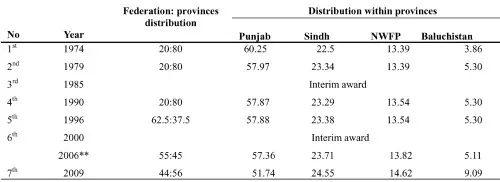
The NFC awards agreed during civilian rule were more far-reaching, as they envisaged greater devolution of resources. The 1990 award was made during the administration of Nawaz Sharif and it expanded the divisible pool to include income tax, sales tax, export duty and excise duty (particularly on sugar and tobacco) though custom duty was retained by the federal government. In total terms, the provinces received about 18 percent more than in the 1974 award.
Inexplicably, the caretaker set up led by Malik Meraj Khalid was allowed to constitute an NFC in December 1996, which included all taxes/duties in the divisible pool, including income tax, wealth tax, capital value tax, sales tax, export duties, customs duty, excise duty with the exception of excise duty on gas, charged at wellhead, and any other tax collected by the federal government. Additionally, the royalties on crude and net development surcharges on natural gas were also given to the provinces and the incentive of matching grant was introduced up to a certain limit notably that if any provincial government exceeds its revenue growth target of 14.2 percent it would be provided matching grants.
The 2009 award was announced during the Zardari-led PPP government and it made dramatic changes in distribution within provinces with Punjab accepting lower population criterion, leading to a reduction in its share of the divisible pool (with critics maintaining that this was agreed in exchange for amending the constitution to allow a four-time prime minister). Two extremely positive targets agreed in the seventh NFC award/eighteenth amendment do not get much mention and remain unmet to this day; notably, a one percent increase in the tax to GDP ratio each year for five years and devolution of subjects as agreed under the eighteenth constitutional amendment.
The following table provides data on the approved NFC awards.
Apart from Shaukat Tarin who resigned in 2010 as the Finance Minister for reportedly personal reasons, all his successors, including Hafeez Sheikh, lamented the resource distribution agreed in the seventh NFC as they contended that it disabled the Centre from meeting expenses other than debt servicing costs and defence.
Two observations are relevant. First, till the devolution of subjects and the attainment of one percentage increase in tax to GDP ratio by the Federal Board of Revenue as envisaged in the seventh NFC award, provinces were required to give an agreed surplus to the federal government. Today that amount is a whopping, 1464 billion rupees. And second, the petroleum levy, sales tax on a commodity that by definition should be credited to the divisible pool, is budgeted under other taxes, which makes it ineligible for the divisible pool. The envisaged revenue from this is 1468 billion rupees in the current year. Or, in total, the amount from these two sources is around 3 trillion rupees.
This additional revenue for the Centre changes the resource distribution math as follows: (i) total budgeted FBR taxes for the current year are 14131 billion rupees with the provincial share at 7988.5 billion rupees (minus straight transfers) with the remaining 6142 billion rupees earmarked for the federal government; (ii) total 3 trillion rupees under the post seventh NFC award added to the Centre’s 6142 billion rupees gives a total of 9 trillion rupees for the Centre which, if added to the FBR’s 14131 billion rupee total collections, gives the federal government share a 53 percent. Be that as it may, the clamour that the Centre requires a higher share of the NFC award persists though it is unclear whether the post-seventh NFC additions to the Centre will continue.
Today with a hybrid system in place, it is unclear which way the finance minister, reportedly supported by all key stakeholders, or the civilian chief ministers with party affiliations will vote in the NFC; however, Aurangzeb’s statement made in June this year can be supported in which he said that the NFC award must be delinked from population as the high growth rate - 2.5 percent - presents an existential threat to development.
To conclude, one would hope that discussions on the next NFC award focus on proactively implementing the two salutary unmet objectives of the seventh NFC award noted above, and an agreement reached on the fate of provincial surplus and the petroleum levy placement under other taxes.
























Comments
Comments are closed for this article.