


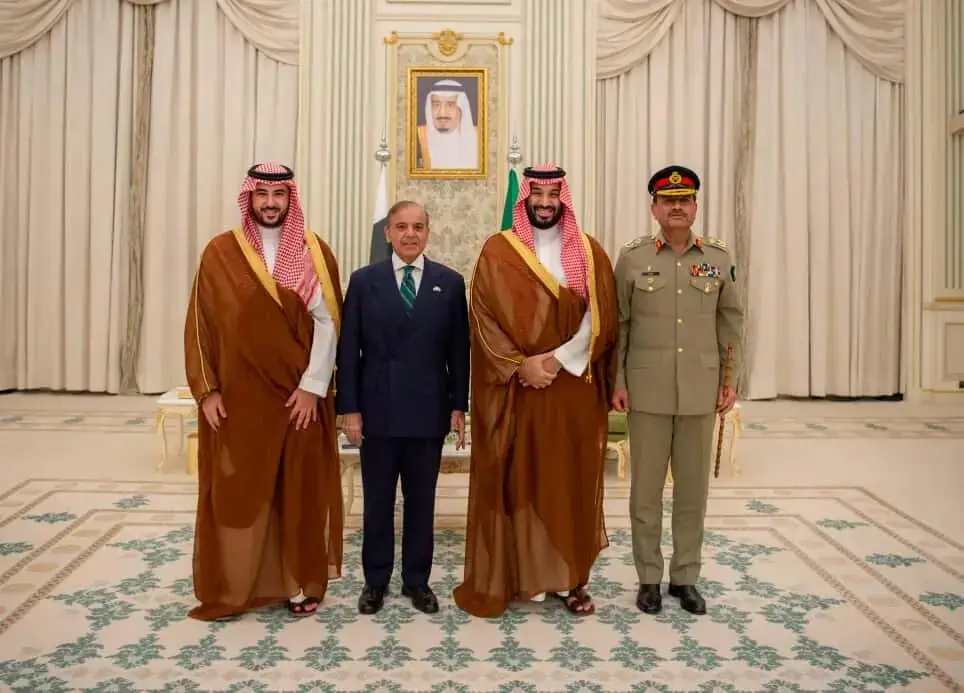

In a region already bristling with geopolitical tension, the recent signing of a Strategic Mutual Defence Agreement (SMDA) between Pakistan and Saudi Arabia has added a new layer of complexity to South Asia and the Middle East’s security architecture.
The pact, which pledges mutual defence in the face of external aggression, is more than a bilateral handshake—it is a strategic signal with implications that reverberate far beyond Islamabad and Riyadh.
For India and Israel, two regional powers with distinct but overlapping security interests, the accord raises critical questions about deterrence, diplomacy, and the shifting sands of alliance politics. For the broader region, it marks a pivot toward multipolar security arrangements, potentially reshaping alliances for years to come.
Pakistan, Saudi Arabia sign landmark strategic mutual defense agreement
At the heart of this development lies a verse from Allama Iqbal that captures the spirit of Islamic unity the pact seems to invoke:
Aik hon Muslim Haram ki pasbani kay liye
Neel kay Sahil say lay kar ta ba khaak-e-Kashgar
Iqbal’s call for Muslim solidarity from the banks of the Nile to the soil of Kashgar resonates with the symbolism of this pact—a vision of collective defence that transcends borders and sectarian divides. It evokes a pan-Islamic ethos that, while aspirational, carries real-world strategic weight in today’s fragmented geopolitical landscape.
To further underscore the moral and spiritual dimension of such unity, one may reflect on the Quranic verse:
“Indeed, this, your religion, is one religion, and I am your Lord, so worship Me.” (Surah Al-Anbiya, 21:92)
This verse not only reinforces the concept of unity among believers but also frames the defence of shared values and sacred institutions—such as the Haram—as a collective responsibility.
The strategic calculus behind the pact
The SMDA formalises decades of informal cooperation between Pakistan and Saudi Arabia. Pakistani troops have long served in the Kingdom, and Saudi officers have trained at Pakistani military academies. But the inclusion of a NATO-style clause—where an attack on one is considered an attack on both—elevates this relationship to a new strategic tier.
This move comes amid heightened regional tensions, including recent Israeli strikes on Qatar and Indo-Pakistani skirmishes. It also reflects Saudi Arabia’s growing desire to diversify its defence partnerships, especially as confidence in traditional Western allies wanes. The pact signals Riyadh’s intent to assert greater autonomy in its security calculus, while Islamabad gains a strategic backer with deep pockets and regional clout.
India’s response: strategic restraint and realignment
India’s initial reaction has been measured. The Ministry of External Affairs stated it would “study the implications” of the pact for national and regional security. But beneath the diplomatic calm lies a matrix of strategic recalibrations.
Diplomatic engagement:
India is likely to engage Riyadh through quiet diplomacy, emphasising its $42 billion trade relationship and long-standing energy interdependence. While Saudi Arabia may be tilting toward Islamabad militarily, it cannot afford to alienate one of its largest economic partners.
Defence posturing:
Expect increased military readiness along India’s western border. Joint exercises with Gulf states like UAE and Oman may be accelerated to signal deterrence and deepen regional defence ties.
Strategic Signalling:
India will likely avoid public escalation, opting instead for backchannel messaging that underscores its resolve. Media narratives may be managed to temper alarmist interpretations while keeping public opinion informed.
Regional outreach:
Renewed engagement with Iran could serve as a strategic hedge against Saudi influence. Simultaneously, India may deepen its involvement in groupings like the Quad and I2U2 to counterbalance emerging blocs.
Intelligence coordination:
India will likely enhance intelligence-sharing with allies such as the United States, France, and Israel to monitor any shifts in military posture or nuclear signalling from Islamabad or Riyadh.
Israel’s calculus: a new layer of deterrence
For Israel, the pact introduces a new variable in its regional security equation. The possibility of a Sunni nuclear umbrella—via Pakistan—adds complexity to its deterrence strategy.
Strategic deterrence:
Israel must now consider the implications of a defence pact that could, in theory, bring Pakistan’s nuclear capabilities into play in defence of Saudi Arabia. While speculative, the mere possibility alters the strategic landscape.
Diplomatic Isolation:
The pact may signal a shift in Arab solidarity, especially after Israel’s recent military actions in the Gulf. This could complicate efforts to expand the Abraham Accords and normalise ties with other Gulf states.
Intelligence coordination:
Israel is likely to intensify intelligence cooperation with allies like the US and India to monitor any shifts in military posture or nuclear signalling from Islamabad or Riyadh.
Regional implications: toward a multipolar security order
The SMDA reflects a broader trend: the erosion of US influence and the rise of alternative security arrangements.
Waning western guarantees:
Saudi Arabia’s pivot toward Pakistan suggests diminishing faith in Western defence guarantees, especially after Washington’s muted response to Israel’s Qatar strike.
Islamic NATO?
The pact could serve as a blueprint for similar agreements with UAE, Qatar, or Turkey, potentially leading to a bloc-like formation aimed at collective Islamic security.
China’s strategic windfall:
Beijing stands to benefit from the shifting alliances, deepening ties with both Riyadh and Islamabad. The accord may indirectly bolster China’s Belt and Road Initiative and its influence in the Indian Ocean region.
Energy and maritime security:
The pact may also influence maritime security dynamics in the Arabian Sea and Persian Gulf, with implications for global energy flows and naval deployments.
The symbolism and the substance
The invocation of Iqbal’s verse is not incidental. It reflects the ideological undertone of the pact—a vision of Muslim unity in defence of sacred values and shared interests. But in the realpolitik of today’s world, symbolism must contend with substance.
Saudi Arabia’s economic ties with India, its cautious engagement with Israel, and its strategic flirtation with China suggest a nuanced approach. The Kingdom is not abandoning its old partners; it is hedging its bets.
Pakistan, meanwhile, gains a strategic shield that could embolden its posture vis-à-vis India. But it must also navigate the risks of overextension and the expectations that come with such a pact. The burden of strategic maturity will fall on both signatories to ensure that the pact does not become a trigger for escalation, but a framework for stability.
Conclusion: a new chapter, not a final word
The Pak-Saudi defence accord is a chapter in a larger story of regional transformation. For India and Israel, it is a prompt to reassess, recalibrate, and reassert their strategic interests. For the region, it is a signal that the old certainties are fading, and new alignments are taking shape.
Iqbal’s vision of unity may inspire, and the Quran’s call to collective worship and shared purpose may guide, but the realities of diplomacy, deterrence, and development will ultimately shape the future. The challenge for all players is to ensure that strategic ambition does not outpace strategic wisdom.
The article does not necessarily reflect the opinion of Business Recorder or its owners.
The writer is a retired Group Captain of PAF, and now a security analyst




















Comments
Comments are closed for this article.