



ISLAMABAD: The National Institute of Health (NIH) Monday confirmed the detection of a new poliovirus case in southern Khyber Pakhtunkhwa (KP), raising Pakistan’s tally for 2025 to 24 cases, of which 16 registered in KP.
Sharing the details of the new polio case from KP’s Tank District, the Regional Reference Laboratory for Polio Eradication at the NIH said that the latest polio case involves a 20-month-old girl from Union Council Ping A. This is the 14th polio case from southern Khyber Pakhtunkhwa this year. With this detection, the total number of polio cases in Pakistan in 2025 has reached 24 – including 16 from Khyber Pakhtunkhwa, six from Sindh, and one each from Punjab and Gilgit-Baltistan (GB).
According to health officials, the affected child belongs to the Bettani tribe and resides in Tehsil Jandola, an area considered one of the most security-compromised regions of the country where vaccination campaigns remain severely restricted.
The victim girl has no travel history, suggesting that the virus continues to circulate locally within communities where immunisation is hindered. Laboratory findings on the genetic cluster of the virus are still awaited. “Security-compromised districts remain the biggest hurdle in countering polio transmission. These pockets allow the virus to survive and spread, putting the rest of the country at risk,” one official said.
This year, four cases have been detected from district Tank, three each from District Bannu and Lakki Marwat, two from North Waziristan districts; one each from Torgha, DI Khan, and Lower Kohistan. In Sindh, two cases have been reported from Badin while one each case from Larkana, Kambar, Thatta and UmerKot districts, while one case was reported in District Mandi Bahauddin of Punjab and one case was reported from GB’s Diamer district.
In 2024, Pakistan reported a total of 74 polio cases, of which, 27 in Balochistan, 23 in KP, 22 in Sindh, and one each in Punjab and Islamabad Capital Territory (ICT).
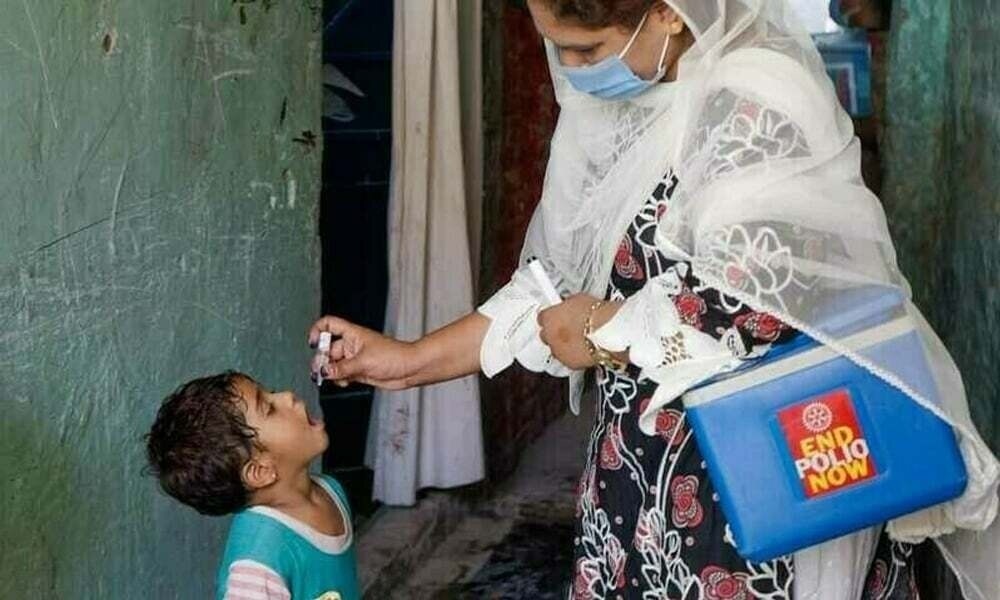
Polio is a highly infectious and incurable disease that can cause lifelong paralysis. The only effective protection is through repeated doses of the Oral Polio Vaccine (OPV) for every child under five during each campaign, alongside timely completion of all routine immunizations.
Despite notable progress, the persistent detection of polio cases, particularly in Southern Khyber Pakhtunkhwa, remains a matter of concern. This highlights that children living in hard-to-access areas and those with low vaccine acceptance continue to be at risk. However, the National and Provincial Emergency Operations Centres (EOCs) are taking all possible measures to ensure the implementation of high-quality vaccination campaigns.
In preparation for the September Sub-National Polio vaccination campaign, the National and Provincial Task Force meetings were held last week to review the current polio situation and assess campaign preparedness. These meetings were intended to ensure coordinated efforts, enhance operational readiness, and facilitate the effective implementation of high-quality immunization activities across all regions. A comprehensive strategic Roadmap for Polio eradication in Southern Khyber Pakhtunkhwa has been developed and finalized. The plan incorporates micro-planning innovations, gap analyses, targeted strategies, and interventions to address persistent challenges.
To interrupt poliovirus transmission, the National Emergency Operations Centre for Polio Eradication has developed a robust vaccination campaign schedule for the upcoming low transmission season, with the first campaign starting today. In southern Khyber Pakhtunkhwa, the campaign will be carried out from September 15-18. More than 28 million children under the age of five will receive polio drops in this door-to-door vaccination campaign.
The objective is to ensure that every child in these districts receives the polio vaccine, as part of ongoing efforts to rapidly strengthen immunity. Parents and caregivers are strongly encouraged to have their children vaccinated during this and all subsequent polio campaigns, as vaccination remains the sole effective measure to protect children against lifelong disability.
Polio eradication is a collective responsibility. While frontline health workers continue to provide essential vaccines to children, parents and caregivers play a crucial role by ensuring their children receive all recommended doses of the polio vaccine and complete their routine immunizations.
Communities and the media can protect children’s health by actively supporting vaccination efforts, addressing misinformation, and encouraging others to vaccinate, ensuring that no child is left unvaccinated.
Copyright Business Recorder, 2025




















Comments
Comments are closed for this article.