


European Organisation for Nuclear Research concludes review of Pakistan’s associate membership
- CERN assesses Pakistan’s progress in the field of science and technology
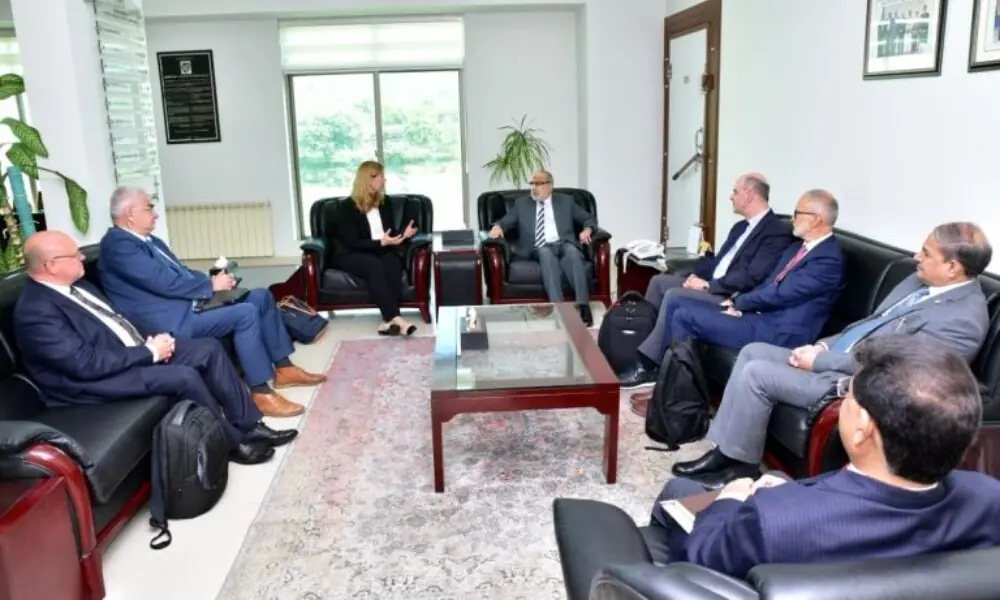

A team of experts from the European Organisation for Nuclear Research (CERN), consisting of five task force members, has concluded the review of Pakistan’s progress as an associate member of CERN.
The CERN is the premier scientific laboratory established by European member states in Geneva on the principle of “Science for Peace.”
It is primarily working to unravel the frontiers of knowledge, develop new technologies and train scientists and engineers for the future.
The CERN has evolved into the world’s largest Particle Physics laboratory with 25 members and nine associate members, including Pakistan.
While Pakistan’s collaboration with CERN spans over three decades, dating back to 1994 when a cooperation agreement was signed, Pakistan became an associate member of CERN in July 2015. Over the years, Pakistan has contributed to several CERN projects.
Pakistan Atomic Energy Commission (PAEC) is the lead agency in the PAK-CERN collaboration.
Some 500 scientists to be impacted when Europe lab CERN cuts Russia ties
Through its Associate Membership, Pakistan has gained significant benefits—advancing the frontiers of scientific knowledge, fostering technological development, and training a new generation of scientists and engineers.
The CERN task force’s visit to Pakistan was headed by Ms. Charlotte L. Warakaulle, Director for International Relations, CERN. Other members included Prof Joachim Mnich, Director for Research and Computing; Prof. Emmanuel Tsesmelis, Head of Relations with Associate Members and Non-Member States; Dr. Andrzej Charkiewicz, from the Experimental Physics Department and Prof. Tadeusz Lesiak, Polish Scientific Delegate to the CERN Council.
At the commencement of the five-day visit, the team called on Pakistan Atomic Energy Commission (PAEC) Chairman Dr Raja Ali Raza Anwar at the Headquarters in Islamabad.
The meeting was followed by detailed presentations from different research and development facilities of PAEC and other organisations.
Member (Science) PAEC Dr Masood Iqbal led the task force to various research centres and institutes, starting with High Energy Physics Labs at the National Centre for Physics (NCP), which was followed by a visit to the Pakistan Institute of Engineering and Applied Sciences (PIEAS), the premier engineering university of the country, Heavy Mechanical Complex-3 (HMC-3), Institute of Nuclear Medicine and Oncology (INMOL) and National Institute for Laser and Optronics (NILOP), among other advanced facilities. The purpose of these visits was to assess Pakistan’s progress in the field of science and technology.
Prof. Tsesmelis delivered a lecture and interacted with young researchers at the PIEAS.


























Comments
Comments are closed for this article.