


At least 20 dead as ‘exceptionally high’ floods continue to threaten Punjab amid heavy rain forecast
- Floods have wreaked havoc in province after India released water into Punjab rivers
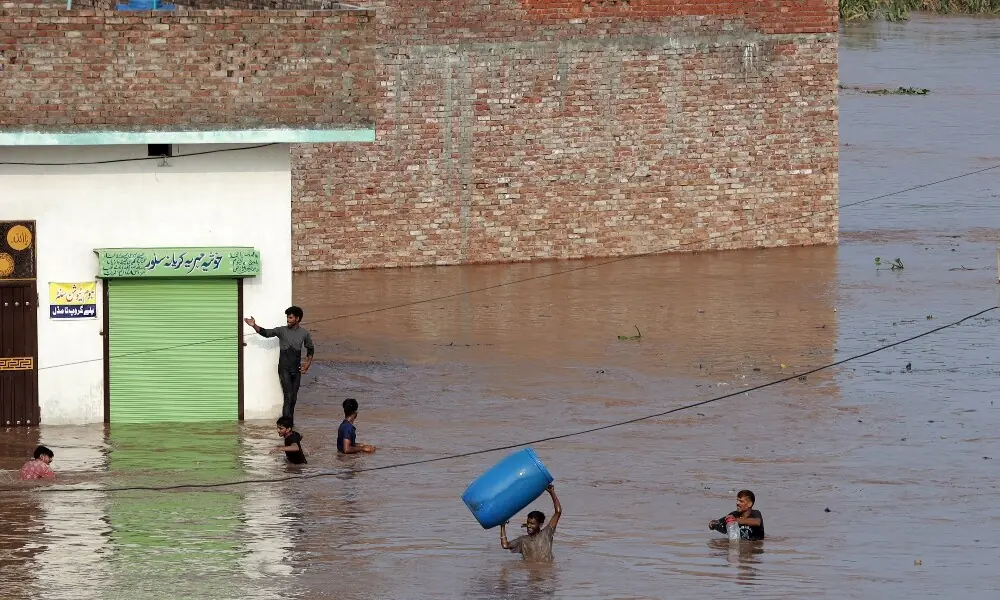

The ‘exceptionally high’ level flood situation in the rivers of Punjab continues, amid forecast of more heavy rains in the province, while the floods have started moving towards Sindh, Aaj News reported on Friday.
Due to the floods, dykes have broken at many places and hundreds of settlements have been submerged. According to the Provincial Disaster Management Authority director general (PDMA DG), at least 20 people have died in various recent accidents due to the floods.
Floods have wreaked havoc in the province after India released water into the rivers of Punjab. Dykes have broken at several places, causing water to enter the settlements. Floodwaters in the Ravi, Chenab and Sutlej rivers flooded the surrounding villages, while the crops were also destroyed.
Thousands of people are forced to live in the open air in a state of disrepair and are facing a shortage of food and medicine. Three thousand people have been evacuated to safer places in thirty districts and seven hundred boats are involved in rescue operations.
Villages in many areas including Wazirabad, Kasur, Narowal, Hafizabad, Kamalia, Mandi Bahauddin, Bahawalnagar, Sialkot, Sargodha, Vehari and Pakpattan were surrounded by floods and land connectivity was cut off, while temporary dykes broke at many places.
Flood alert: Exceptionally high flood levels reported in Ravi, Sutlej rivers
Meanwhile, due to the flood stream at Head Marala, the only road connecting Sialkot to 80 villages of Bajwat sector was destroyed. The chairlift installed in the area at a cost of Rs15 million in five years was also swept away in the water. The affected people say that three days have passed but no one has helped them, and the MNA belonging to their constituency came only for a photo session.
Hundreds of houses have been evacuated and residents have been shifted to safer places after the Ravi River water entered several housing societies located on Multan Road in Raiwind Tehsil.
Floodwaters wreaked havoc in Theme Park Multan Road. The administration is trying to build a temporary barrier to stop water using a crane.
On the other hand, the rescue team has rescued more than fifty people from Manga Hathar and Nano Dogar who were trapped in floodwaters.
Rivers situation
Torrential monsoon rain and neighbouring India’s release of excess water from its dams swelled three rivers that flow into Punjab, forcing authorities to breach river banks in some places — causing flooding in more than 1,400 villages, Punjab’s disaster management authority said.
Residents of villages such as Qadirabad were walking through water up to their chests on Thursday after the River Chenab overflowed, causing sudden flooding, said Reuters.
“We spent the whole night awake and frightened,” Nadeem Iqbal, 26, a labourer, told Reuters as he waded through the water with one of his children.
“Everyone was frightened. Kids cried. Women were worried. We were helpless,” he said.
Lahore admin on high alert after flood warning
Officials say flooding has been worsened in Punjab — home to half of Pakistan’s people and a major producer of wheat, rice and cotton — by the release of water into the three rivers, the Ravi, Sutlej and Chenab, from Indian dams that were full.
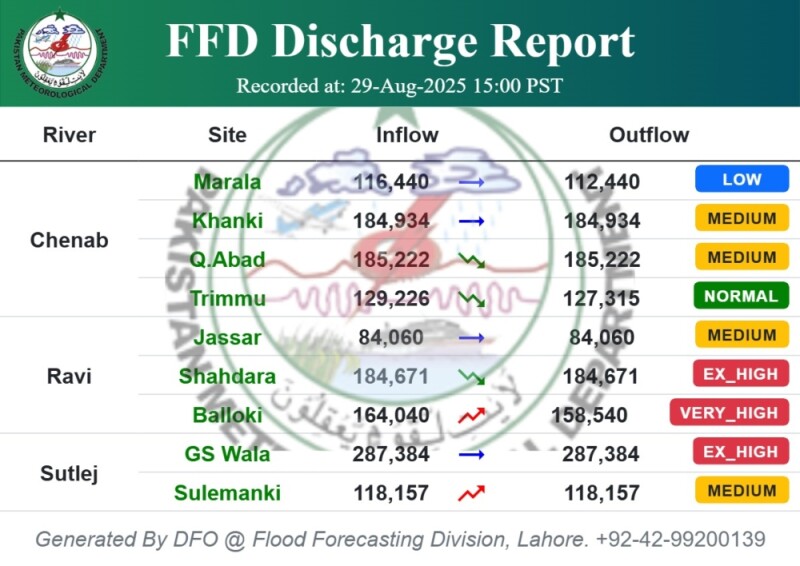
PDMA DG Irfan Ali Kathia said that there is a flood situation at the Baloki location in the Ravi River, the flood will reach Khanewal district in the next 24 hours. “All our institutions are on full alert,” he added.
The DG PDMA said that 1,769 areas in Punjab are still under water, while around 27,000 people have had to relocate.
Kathia said that the Pakistan Army, Punjab Rangers and rescue teams are engaged in relief operations, after water was suddenly released by India, without reporting it in a timely manner.
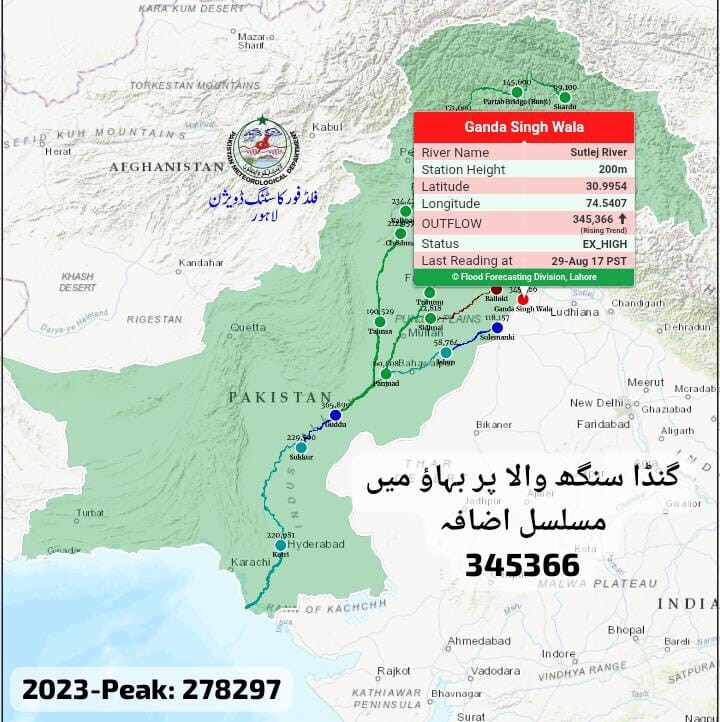
He said that the water flow at Chiniot Bridge was recorded at 824,500 cusecs.
Meanwhile, a PMD report showed, there was a risk of exceptionally high level flood at Shahdara in Ravi river and at GS Wala in Sutlej river.
Countrywide heavy rains forecast
Heavy rainfall and potential flooding across multiple regions of Pakistan is expected from Friday.
According to the National Disaster Management Authority (NDMA), rain with thunderstorm is likely in the federal capital from Friday (today) to Tuesday.
Whereas from August 30 to 31, heavy rains and flooding situation is expected in the northern and north-eastern districts of Punjab including Rawalpindi, Attock, Jehlum, Chakwal, Lahore, Gujranwala, Sialkot, Gujrat, Narowal, Hafizabad and Mandi Bahauddin.
In central and southern Punjab, rains are expected from August 29 to 31, in which low-lying areas may be inundated. Heavy rains in Multan, Dera Ghazi Khan, Rajanpur, Layyah, Bhakkar, Sahiwal, Bahawalpur, Bahawalnagar and Rahim Yar Khan may cause flash floods.
In Khyber Pakhtunkhwa, heavy rains are expected from Friday to 31st of this month which can cause landsliding in Malakand and Hazara divisions.
As per the NDMA, the current weather system which is active over the upper catchments of the Jehlum is expected to enter Pakistan by Friday, which will persist till Tuesday.
Under the influence of this system moderate to heavy rainfall is expected in different areas of Azad Jammu and Kashmir including Kotli, Bagh, Mirpur, Poonch, Rawalakot, Muzaffarabad, Haveli and the surrounding regions. The system can cause localized urban and low-lying area flooding, landslides and flash flooding.
In Gilgit Baltistan, heavy rains are expected from Friday to Sunday which can cause landsliding and Glacial Lake Outburst Flood in the districts of Gilgit, Skardu, Hunza, Diamer, Astore, Ghizer and Ghanche.
In Sindh, downpour is expected in the coastal districts.
Heavy rains are expected in the districts of interior Sindh, including Hyderabad, Dadu, Sukkur, Ghotki, Larkana, Jacobabad, Kashmore from August 30 to September 1.
Rains, with a risk of flooding in low-lying areas, are likely in coastal and eastern districts of Balochistan including Gwadar, Kech, Panjgur, Khuzdar, Lasbela, and Kalat from Friday (today) to Monday.
The NDMA has urged tourists to avoid traveling to northern areas due to possible rains and the risk of landslides.
Iran offers assistance for flood-affected areas
In a telephone call to Prime Minister Shehbaz Sharif, Iranian President Dr Masoud Pezeshkian on Friday offered assistance for flood-affected areas in Pakistan.
President Pezeshkian offered his sincere condolences to the Pakistani citizens over the ongoing floods across various parts of the country, the PM Office said.
While conveying his sympathy and support to the flood affected families, over the loss of precious lives and properties, the Iranian president “offered any assistance that Iran could provide to the brotherly people of Pakistan at this difficult time”.
The prime minister thanked President Pezeshkian for his kind and thoughtful gesture and for Iran’s expression of solidarity in this hour of pain and suffering.
PM Shehbaz also requested the president that his profound regards and good wishes may kindly be conveyed to Iranian Supreme Leader Ayatullah Ali Khamenei.
The two leaders looked forward to their interaction at the upcoming Shanghai Cooperation Organisation (SCO) Summit in Tianjin, China.
Floods submerge Kartarpur Sahib temple
Rescue operations continued in Kartarpur city in Punjab on Friday after heavy flooding submerged areas near the Kartarpur Sahib shrine.
Floodwaters reached the roads leading to Gurdwara Sri Darbar Sahib Kartarpur, forcing rescue teams to navigate boats and move people to safety. The historic shrine, believed to be the final resting place of Guru Nanak Dev, was partially submerged after the Ravi River overflowed, as Punjab faces its worst flooding in four decades.
According to the PDMA, more than 1,600 villages have been inundated across Punjab, killing at least 17 people and affecting over one million residents. Authorities said over one million people have been evacuated this week as rising waters destroyed crops and swept through hundreds of settlements.
The crisis has been fuelled by torrential monsoon rains and the release of excess water by India from upstream dams, swelling the Ravi, Sutlej, and Chenab rivers. In some areas, embankments were deliberately breached to divert floodwaters. Punjab, home to half of Pakistan’s population and a major producer of wheat, rice, and cotton, has been especially devastated.

























Comments
Comments are closed for this article.