


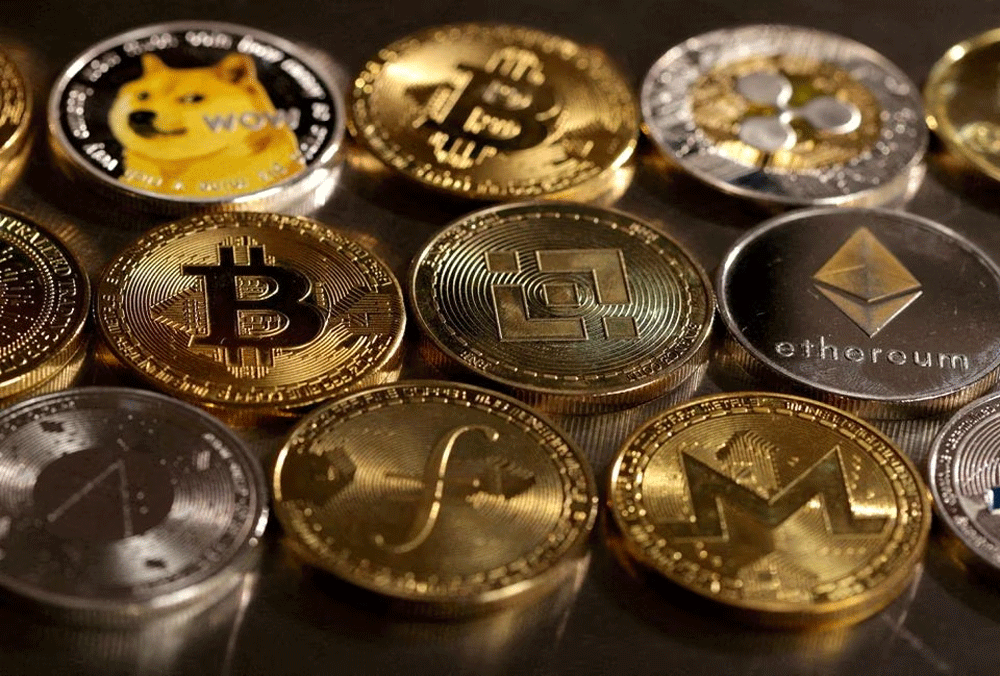
EDITORIAL: There is a clear sense of urgency within the board of the newly-formed Pakistan Virtual Assets Regulatory Authority (PVARA) to legalise trade and transactions in digital currencies.
The State Bank of Pakistan (SBP), however, is sensibly reluctant to develop a regulatory framework in haste, recognising that the repercussions could be severe for a country whose external accounts are perpetually under pressure.
The finance minister, however, seems eager to kick-start trading under a regulatory framework soonest for fear of being relegated to the FATF grey list as, according to him, there is already a sizeable number transactions already in play without any regulatory oversight.
In 2018, SBP issued a circular directing all financial institutions to refrain from dealing in virtual currencies and tokens. This effectively made crypto trading illegal in Pakistan, with banks required to report such transactions as suspicious to the Financial Monitoring Unit (FMU).
The PVARA board now wants this circular withdrawn. Recently, the finance minister even warned that Pakistan could be pushed back to the FATF grey list, as around 15 percent of the population is engaged in crypto trading. His argument is that it is better to legalise quickly.
We find ourselves unable to support the minister’s assertion as in our opinion the pitfalls and the ensuing consequences of allowing such transactions without enactment of a carefully considered robust framework for such transactions would be horrendous and far more damaging than the country’s placement on the FATF grey list.
To do otherwise would be somewhat akin to the textile barons request for subsidies to ensure external account stability, realtors pushing to keep real estate undocumented under the guise of job creation and turning the wheels of 40 or so industries in the documented sector, or traders demanding interest rates be slashed to as low as 2 percent for economic revival.
Such rent-seeking behaviour is usually wrapped in the narrative of serving the “larger national interest.” It is worth noting that the finance minister is not on the board member of PVARA; he attended only as a special invitee.
The SBP Governor’s cautious approach to the matter is correct. SBP, as an institution, has consistently upheld its regulatory responsibility. This is precisely why Pakistan’s banking system still stands on solid ground.
Recently, SBP resisted pressure to slash interest rates, maintaining policy stability at a time when the currency was under strain. SBP should take on this task in earnest to formalize regulations around digital currencies and crypto assets. It should resist opening the sector without a proper framework and not risk enabling both documented and undocumented funds to flow unchecked, with little oversight of their magnitude or destination.
The grapevine suggests that certain authorities in Islamabad and Rawalpindi are looking forward to an early adoption of a digital currency framework and even exploring incentives for crypto mining in Pakistan.
Reportedly, US President Donald Trump has shown interest as well. This may eventually happen — but it must be approached with caution and in full recognition of Pakistan’s limitations. Unlike the UAE, which attracts global capital due to low taxation and a superior living environment, Pakistan is the opposite: those with savings often look for ways to take their money out.
To counter this, SBP has imposed restrictions on foreign currency purchases, while the government continues cracking down on illegal money transfers. Ironically, some in government are advocating for digital currency legalisation without a proper framework. The math simply does not add up. Whatever the pressures or compulsions, SBP must stand firm and carefully design the framework.
Digital currencies, crypto, and tokenization are real, and they will play a key role in the global financial system. Pakistan must also take them seriously. SBP is already working on its own digital currency, and it should be launched alongside a comprehensive framework for regulating crypto and digital assets — only after thorough groundwork has been completed.
Last but not least, the SBP’s stance on the crypto challenge is complex for all the right reasons, so to speak, acknowledging the technology’s potential, particularly in developing countries where currency debasement is a grim reality, but showing legitimate concerns over industry’s growth in certain parts of the world for its criminal elements and conflicts of interest.
Copyright Business Recorder, 2025



















Comments
Comments are closed for this article.