


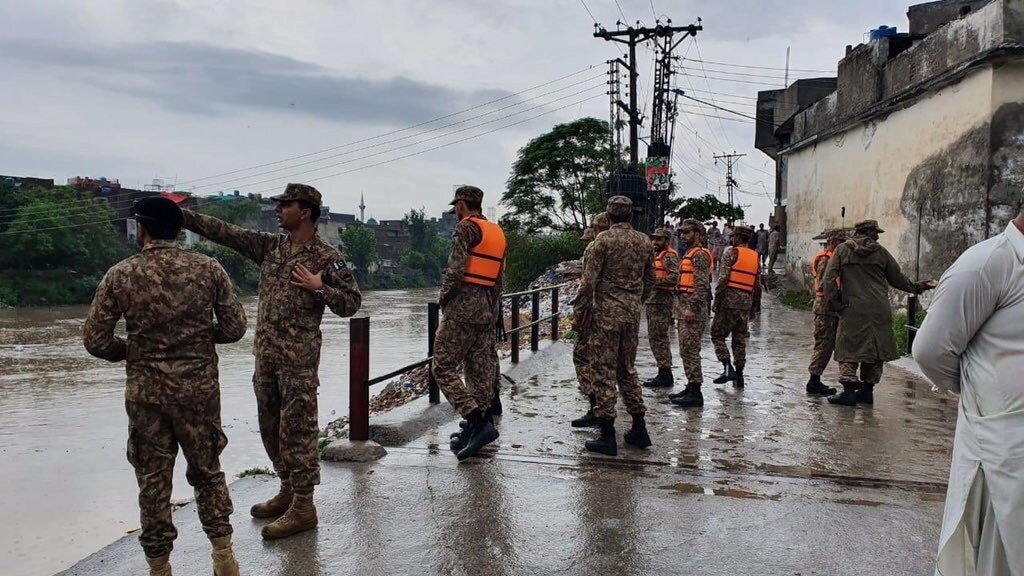

ISLAMABAD: Relief operations by the Pakistan Army in flood-affected regions are continuing on the directives of Field Marshal Asim Munir.
The announcement was made by Director General ISPR, Lieutenant General Ahmed Sharif Chaudhry, during a press conference in Islamabad, where he was joined by Minister for Information Attaullah Tarar and the Chairman of the National Disaster Management Authority (NDMA).
He stated that so far, the army has rescued more than 28,000 people from severely impacted areas. The army, he said, stands firmly with the people in their time of crisis.
PM, COAS briefed about rescue, relief operations in KP
Lieutenant General Chaudhry confirmed that during these rescue operations, two Pakistan Army soldiers embraced martyrdom and two others sustained injuries. He noted that the soldiers were actively engaged in difficult terrain and harsh weather conditions when the incident occurred.
In addition to rescue work, the army has played a critical role in restoring infrastructure. Three major bridges damaged by the floods in Khyber Pakhtunkhwa and Gilgit have already been repaired and reopened.
In Azad Kashmir, army battalions remain engaged in rehabilitation activities, ensuring vital road connections and supply routes are maintained.
Army engineers, working alongside district administrations, have also cleared several roads to reconnect isolated communities.
A large-scale rescue operation is also underway in Kartarpur, where troops are providing assistance to stranded residents. To address health concerns in flood-hit regions, the Pakistan Army has established 29 medical camps to provide treatment and relief to displaced families.
The DG ISPR further said that while relief operations are ongoing, the army continues its counter-insurgency missions to ensure that hostile elements do not exploit the situation. He affirmed that the Pakistan Army and the people stood united, saying: “No malicious force can drive a wedge between them.” He said that the Chief of Army Staff had issued directives to military formations to assist in flood operations.
Lieutenant General Inamur Rahman stated that Pakistan is currently in the eighth and penultimate spell of rainfall for 2025. He reiterated that heavy precipitation has been recorded in northern Punjab and occupied Kashmir, with over 300 mm of rain around Jammu and 600 mm near Sialkot. Water flow in the Indus River remains normal up to Kalabagh, Chashma, and Taunsa.
He said: “Rainfall exceeded 300 mm around Jammu, while areas near Sialkot experienced up to 600 mm. The floodwaters have now entered Pakistan’s territory through the Sutlej, Chenab, and Ravi rivers.”
“The Chenab River at Head Marala peaked at 700,000 cusecs, presently decreasing to approximately 550,000 cusecs due to reduced rainfall in north-eastern areas. Flash floods and cloudbursts in occupied Kashmir have caused significant damage, submerging settlements and damaging infrastructure. Floodwaters from the Chenab, Ravi, and Sutlej rivers have now crossed into Pakistan’s borders,” the NDMA chairman. “At Head Khanki, a flood discharge of 1 million cusecs is causing increased pressure on Qadirabad in the coming days.

























Comments
Comments are closed for this article.